
Suzuki Carry Kei Truck: Buy & Import from Japan
Ready to import a Suzuki Carry kei truck from Japan to the USA? Mirai sources, inspects and ships them to U.S. buyers with export and 25-year import handling. The Suzuki Carry kei truck has evolved from a 359cc two-stroke workhorse launched in 1961 into today’s 658cc DA16T. Explore the Japanese truck lineage, match chassis codes to engines and equipment, compare working configurations, and check the likely import pathway for your destination.
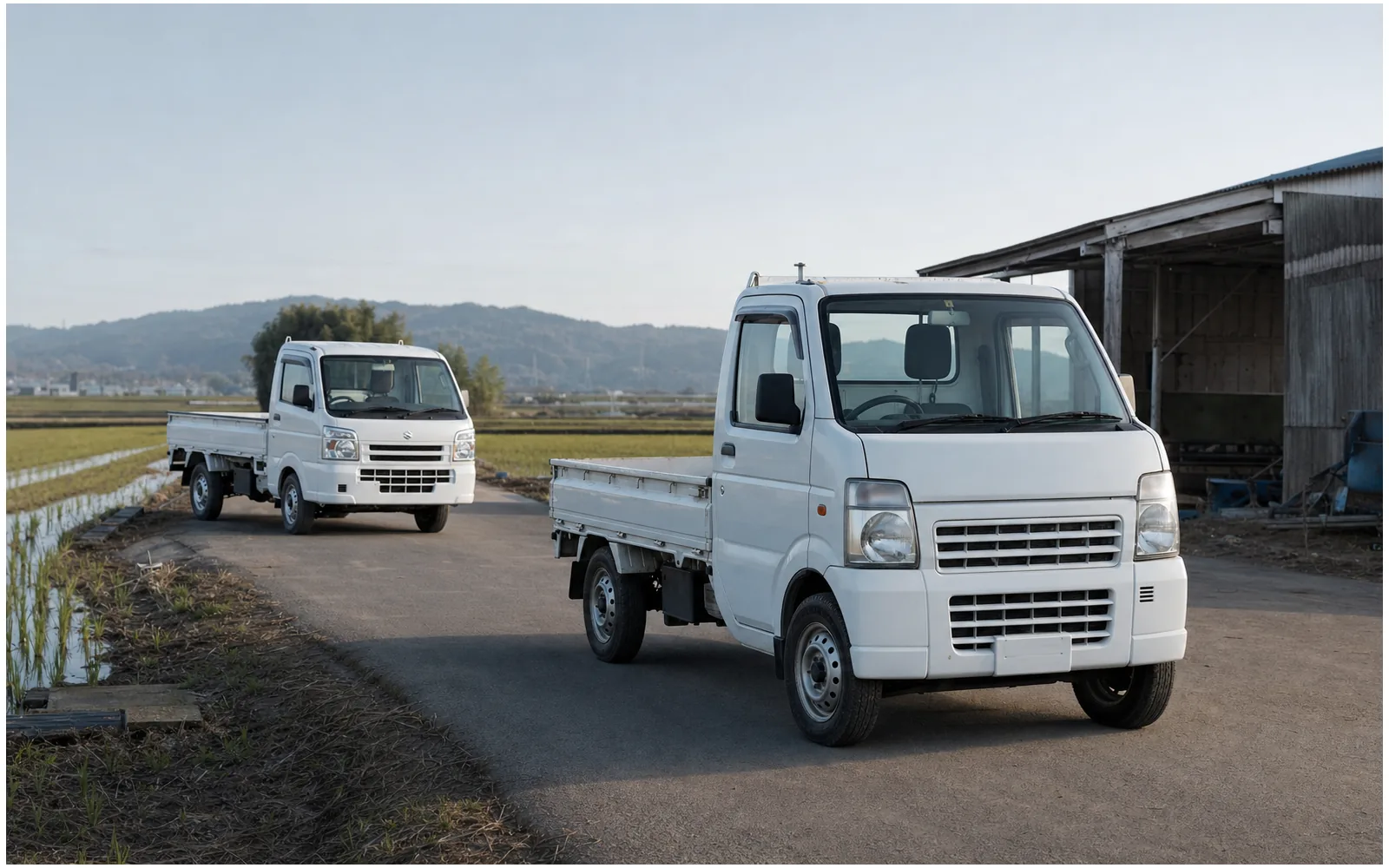
The Suzulight Carry FB began Suzuki’s longest-running nameplate.
Plus important regulation and wheelbase derivatives.
Approximately 770 lb for Japanese kei-class trucks.
Federal 25-year rule plus your state’s title and registration steps.
What This Guide Covers—and What a Chassis Code Can Tell You
A Carry’s year alone is not enough. The chassis family, drive type, engine, grade and installed equipment must agree.
Suzuki’s official history identifies 11 core Carry generations from the 1961 FB through the current DA16T. Within those generations, emissions prefixes, two-wheel-drive and four-wheel-drive codes, wheelbase derivatives and special bodies can change without creating a new headline generation.
The letter T commonly identifies the truck body in later chassis families. On several generations, adjacent codes distinguish 2WD and 4WD, but this is not universal enough to decode a vehicle from one character alone. The authoritative check is the stamped chassis number, Japanese export certificate, model plate and the equipment physically fitted to the truck.
This page excludes Carry vans and Suzuki Every passenger/cargo vans. It includes standard three-way-drop-side trucks, Super Carry extended-cab trucks, factory dump models, lift bodies, refrigerated bodies and other documented Carry special-purpose trucks.
Equipment changed inside the same chassis family
A/C, power steering, differential lock, high/low transfer gearing and automatic availability were grade- and year-dependent. Treat the matrices below as a verified buying guide, not a substitute for the individual Japanese model code and inspection sheet.
Interactive Suzuki Carry Production Timeline
Filter by engine era, then select a period card for representative factory specifications and documented chassis families.
Carry Chassis-Code Finder
Enter a code such as DD51T, DA52T, DA63T, DA65T or DA16T. Prefixes such as V-, GD-, LE-, EBD- and 3BD- describe Japanese approval/emissions categories and may appear before the base chassis.
Spaces and common Japanese type prefixes are ignored. Partial searches return all plausible period matches.
Engine Lineage by Carry Period
Suzuki’s own digital library confirms the engine families and installation periods below. Power is representative because output changed with tune, induction and regulations.
FB · 359cc
Air-cooled, two-stroke inline-two. The first four generations used the FB family, rising from 21 PS to a representative 25 PS in the L40 period.
L50 · 359cc
Water-cooled, two-stroke inline-two. Suzuki lists 28 PS for the fifth-generation L50 truck.
LJ50 · 539cc
Water-cooled, two-stroke inline-three introduced for the revised 550cc kei rules; continued into the early eighth generation.
F5A · 543cc
Water-cooled four-stroke inline-three. It overlapped the LJ50 before the Carry became four-stroke-only after the 1986 update.
F5B · 547cc
Short-lived late-550cc four-stroke inline-three bridge to the 660cc era.
F6A · 657cc
Four-stroke inline-three used by the revised eighth, ninth and early tenth generations. The 1999 range included naturally aspirated and turbo forms.
K6A · 658cc
All-aluminum DOHC 12-valve inline-three. Used in the later tenth-generation long-wheelbase and DA65T short-wheelbase trucks.
R06A · 658cc
DOHC 12-valve inline-three with VVT. It powers the DA16T Carry and Super Carry.
Engine swaps change eligibility evidence
For EPA, emissions, inspection and registration purposes, an engine replacement can matter. Match the engine number, configuration and paperwork before shipment.
Trims, A/C, 4WD, Differential Locks & Transmissions
Carry grade names evolved. The useful question is not “What is the best trim?” but “Which period offered the equipment combination I need?”
| Period / representative grade | A/C | Steering assist | 4WD / low range | Differential traction | Transmissions |
|---|---|---|---|---|---|
| 1990–1999 KA / KC / TA | Grade-dependent | Grade-dependent | 2WD and 4WD; verify transfer controls | Verify factory equipment | Primarily manuals; period automatics existed on selected versions |
| 1999–2001 KA / Turbo / agricultural-use Carry | Option/grade-dependent | Option/grade-dependent | 2WD or 4WD; long wheelbase | Agricultural specification requires individual confirmation | 5MT and selected 3AT |
| 2001 KU family / agricultural selection | Check model code | Separate power-steering grade documented | 4WD 2×5MT documented | Agricultural selection documented with diff lock | 5MT, 2×5MT, 3AT |
| 2005–2013 FC / FC agricultural specification (DA65T) | Base, A/C and A/C+PS grades | Available; grade-specific | 4WD agricultural versions | Diff lock standard on agricultural specification | 5MT and selected automatic versions in the wider range |
| 2013 launch KC / KX / agricultural specification | Base and A/C+PS choices | Base and assisted choices | 2WD; part-time 4WD; high/low on specified 5MT grades | Agricultural and selected upper 4WD 5MT equipment | 5MT, 3AT, later 5AGS; 4AT added later |
| 2026 KC / KC Agricultural / KX (DA16T) | Published current equipment includes A/C | Published current equipment includes power steering | 2WD or 4WD; high/low on KC Agricultural and KX 4WD 5MT | Diff lock/traction equipment on specified 4WD 5MT models | 5MT or 4AT |
“Agricultural specification” is a descriptive translation of Suzuki’s documented 農繁仕様/農繁 selections. This guide does not use “Noujou” or “Farm Special” as an asserted factory trim name.
Base / KC-type grades
Lowest-complexity work configuration. Older examples may lack A/C or power steering; current published KC equipment is substantially more complete.
- Best for buyers prioritizing serviceability
- Confirm cabin comfort equipment individually
- 2WD and 4WD availability varies by period
KX / upper grades
Typically add convenience, cabin trim and electrical equipment. On current 4WD 5MT KX, Suzuki documents high/low transfer gearing.
- A/C and power steering more likely
- Power windows/locks on later upper grades
- Do not assume automatic means diff lock
Agricultural specification
Designed for fields, steep access tracks and slippery ground. Diff lock and low gearing are highly desirable, but exact pairing changes with year and transmission.
- Prefer factory 4WD and verified diff lock
- Inspect transfer and lock engagement
- A/C was not universal on older trucks
Super Carry X / L
DA16T derivative introduced in 2018 with 460mm more cab length, added recline and behind-seat storage, while preserving useful bed length under the cab extension.
5MT, 3AT, 4AT & 5AGS
Manuals dominate the working-grade history. 5AGS is an automated manual, not a conventional torque-converter automatic. Current 2026 production lists 5MT and 4AT.
What to photograph before buying
Model plate, chassis stamp, engine number, transmission selector, 4WD switch/lever, transfer range control, diff-lock switch, A/C panel and underbody driveline.
Standard, Dump & Specialty Carry Bodies
Suzuki currently documents a broad special-body range. Older auction trucks may be factory-built, dealer-converted or independently coachbuilt.
Three-way drop-side bed
General hauling platform with rear and side gates. Current standard Carry payload remains 350 kg.
Kintaro dump
Compact electric-hydraulic dump in Suzuki’s special-body range. Current versions are offered as 4WD with 5MT or 4AT.
Reinforced / sturdy dump
Heavier-duty floor and body construction for demanding material handling. Added body mass reduces remaining payload margin.
Deep, shallow & sanitation dumps
Body geometry is matched to bulky light materials, low-side loading or collection work; names and availability change by model year.
Lift dump & gate lifter
Lift-dump bodies raise before tipping; vertical gate lifters assist loading. Inspect hydraulics, pivot pins, switches and safety locks. For dedicated aerial work platforms, see Mirai’s kei bucket trucks guide.
Chilled, frozen & mobile sales
Insulated, refrigerated and mobile-sales bodies are documented. Verify power system, refrigerant, body maker and export compliance.
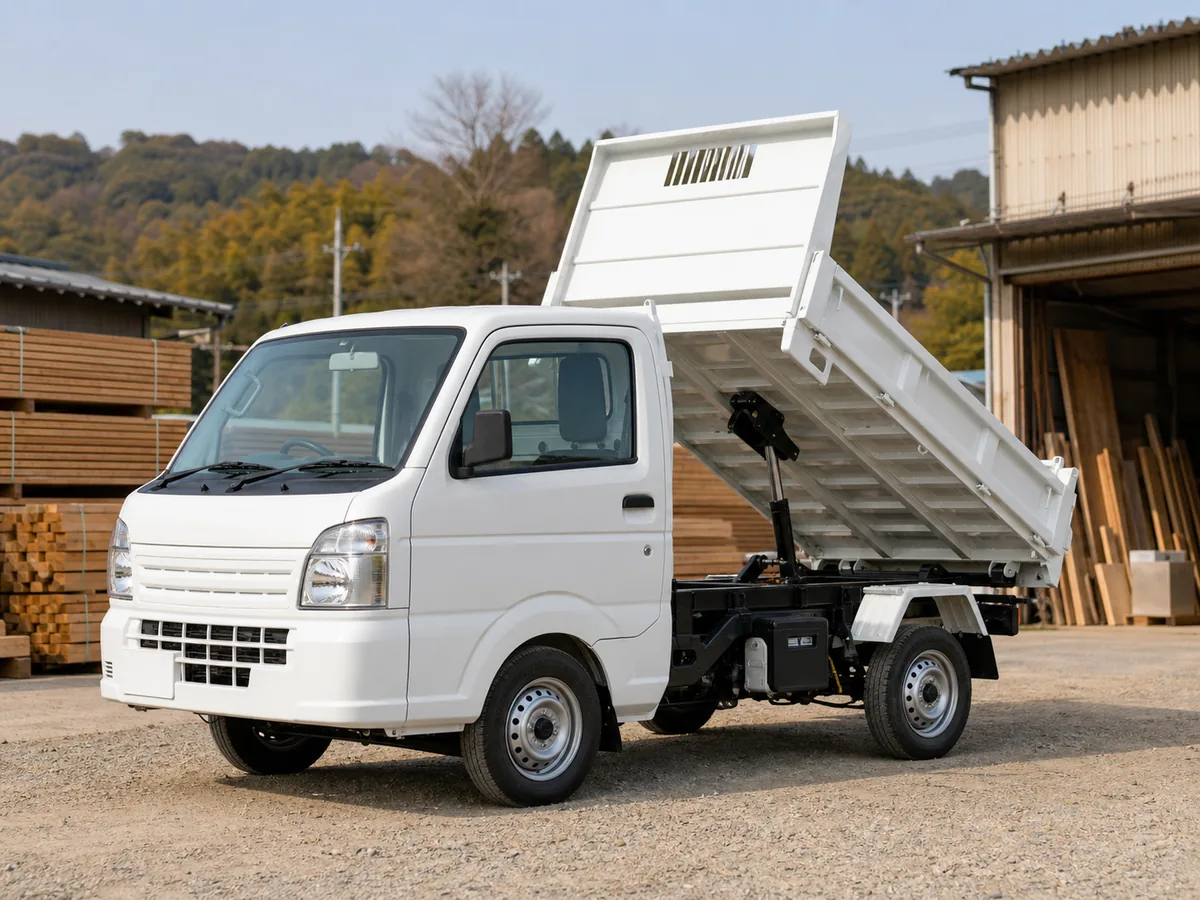
Special-body inspection matters more than the label
A clean cab does not prove a sound dump mechanism. Request a full raise/hold/lower video with the engine running, then inspect:
- Subframe welds, hinge pins and cylinder leaks
- Bed-floor corrosion and deformation
- Hydraulic power pack, wiring and emergency lowering
- Body-maker plate and any build-date evidence
- Actual empty weight and remaining legal payload
Suzuki Carry Configuration & Import Pathway Finder
Select the truck and destination. The tool separates national import age/pathway from state, province or local road-use rules.
Build the Carry You Want
Results are screening guidance, not an approval. Manufacture month and chassis evidence control age-based pathways.
Your screening result
Choose a build yearThe USA calculates the federal age exemption from month and year, not merely the model year.
A truck may be importable yet still need a state or local registration pathway.
How to Buy the Right Suzuki Carry From Japan
Start with the job and destination, then choose the chassis. Buying by paint color and advertised trim name is backwards.
Define load, terrain and distance
Standard bed, dump, refrigerated or lift body; flat land or steep muddy tracks; short private-site use or road travel.
Check destination before bidding
Use the manufacture month, original chassis identity, body classification and intended road use—not a seller’s “25-year legal” slogan.
Match the actual controls
Photograph A/C, transmission, 4WD selector, transfer range, diff lock, power steering evidence and body-maker plate.
Inspect known work-truck stress areas
Chassis rust, bed mounts, front suspension, wheel bearings, transfer case, CV boots, diff operation and hydraulic subframe.
Keep an identity chain
Export Certificate and translation, auction sheet, invoice, chassis photos, manufacture-date evidence, bill of lading and customs forms.
Send the complete specification
The configurator creates a prefilled request so Mirai can source against the correct generation, drivetrain, equipment and body.
A practical high-demand specification
For farms, properties and rough sites, many buyers prioritize a naturally aspirated 4WD manual with factory low range, verified differential lock, A/C and a clean standard or dump bed. That combination is not present on every “4WD” Carry.
For frequent paved use where local registration permits it, consider cabin comfort, gearing, braking condition and speed suitability just as seriously as off-road traction.
Suzuki Carry Kei Truck FAQs
Direct answers to the most common model and import-selection questions.
What year did the Suzuki Carry kei truck begin?
The first Suzulight Carry FB was launched in October 1961. Suzuki continues the Japanese kei-class Carry today in the DA16T family.
Which Suzuki Carry chassis is currently produced?
The current Japanese Carry and Super Carry use the DA16T chassis family with the 658cc R06A engine. Japanese approval prefixes have changed over the model’s life.
Which Carry generation is eligible under the U.S. 25-year rule?
Eligibility depends on the exact manufacture month. As of July 2026, Carry trucks manufactured in or before the corresponding month of 2001 can use the NHTSA age route; later units must wait unless another lawful basis applies.
Does every 4WD Suzuki Carry have differential lock?
No. Four-wheel drive and differential lock are separate features. Verify the grade, model code, physical control and operation on the individual truck.
Does every agricultural-specification Carry have A/C?
No. Older agricultural versions could be ordered in different comfort specifications. Later catalogs include A/C-equipped versions, and current published grades are better equipped, but the individual model code still controls.
Is 5AGS the same as a normal automatic?
No. Suzuki’s 5AGS is an automated manual: actuators operate a manual gearbox’s clutch and shifts. Current 2026 Carry production lists conventional 4AT and 5MT.
Is DA52T the correct pre-2001 Carry truck?
Yes. DA52T and DB52T are documented early tenth-generation Carry codes using the F6A engine. Check 2WD/4WD, grade and month because related codes and running changes exist.
What is the Suzuki Carry’s payload?
The Japanese kei-truck regulatory ceiling is 350 kg, approximately 770 lb. A heavier specialty body consumes part of the vehicle’s weight margin, so confirm the plate and body-specific specification.
Is the “Noujou” or “Farm Special” a verified Suzuki trim?
No reliable Suzuki documentation reviewed for this project establishes that English/Japanese name as a formal grade. This page uses Suzuki’s documented agricultural-specification terminology instead.
Is the Kintaro dump a real Suzuki Carry version?
Yes. Suzuki documents the Kintaro dump in its Carry special-body range. Availability, transmission and equipment depend on model year.
Can a current DA16T be imported into the USA?
Not yet. The U.S. 25-year exemption is calculated from the month and year of manufacture, so a current DA16T is not eligible; earlier Carry generations past 25 years are.
Can Mirai confirm a county will register my Carry?
No exporter can guarantee a local authority’s decision. Mirai can document and source the correct chassis; the buyer should obtain written vehicle-specific confirmation from the responsible authority and insurer.
Primary Sources & Verification Method
Suzuki factory history and technical material support the vehicle data; national government sources support the import-pathway calculations.
- Suzuki Digital Library: Carry history and representative specifications.
- Suzuki Digital Library: engine installation periods.
- Suzuki December 2025 Carry series update, launched January 23, 2026.
- Suzuki current Carry and Super Carry grade page.
- Suzuki current Carry special-body dump range.
- Suzuki September 2001 Carry update—K6A, KU grades and agricultural selection equipment.
- NHTSA vehicle import FAQ—25 years from manufacture date.
How this page was checked
Mirai compared Suzuki’s generation history, engine index, period releases, current catalogs and special-body pages. The import finder uses the user’s manufacture month and current date for age calculations. Results deliberately stop short of promising road registration and route readers to jurisdiction-specific guides for those details. For a comparable rival-brand kei truck, see Mirai’s Honda Acty Kei Truck guide. For real-world top speed by configuration, see Mirai’s kei truck top speed guide.
Send Mirai the Exact Carry You Want
Choose the generation, drivetrain, A/C, differential lock, transfer gearing and body. Mirai can source against that specification and document the chassis before shipment.