
Kei Truck Top Speed: How Fast Do Kei Trucks Go in MPH?
The short answer: kei truck top speed is usually best treated as a range, not a single model-wide number. Most stock 660cc trucks from the 1990s should be planned around roughly 50–65 mph on flat ground, while a calmer 45–55 mph is often the more realistic sustained cruising range.
The 25 mph figure commonly seen online refers to a U.S. non-road import classification that requires a permanent governor. It is not a universal Japanese kei-truck speed limiter.
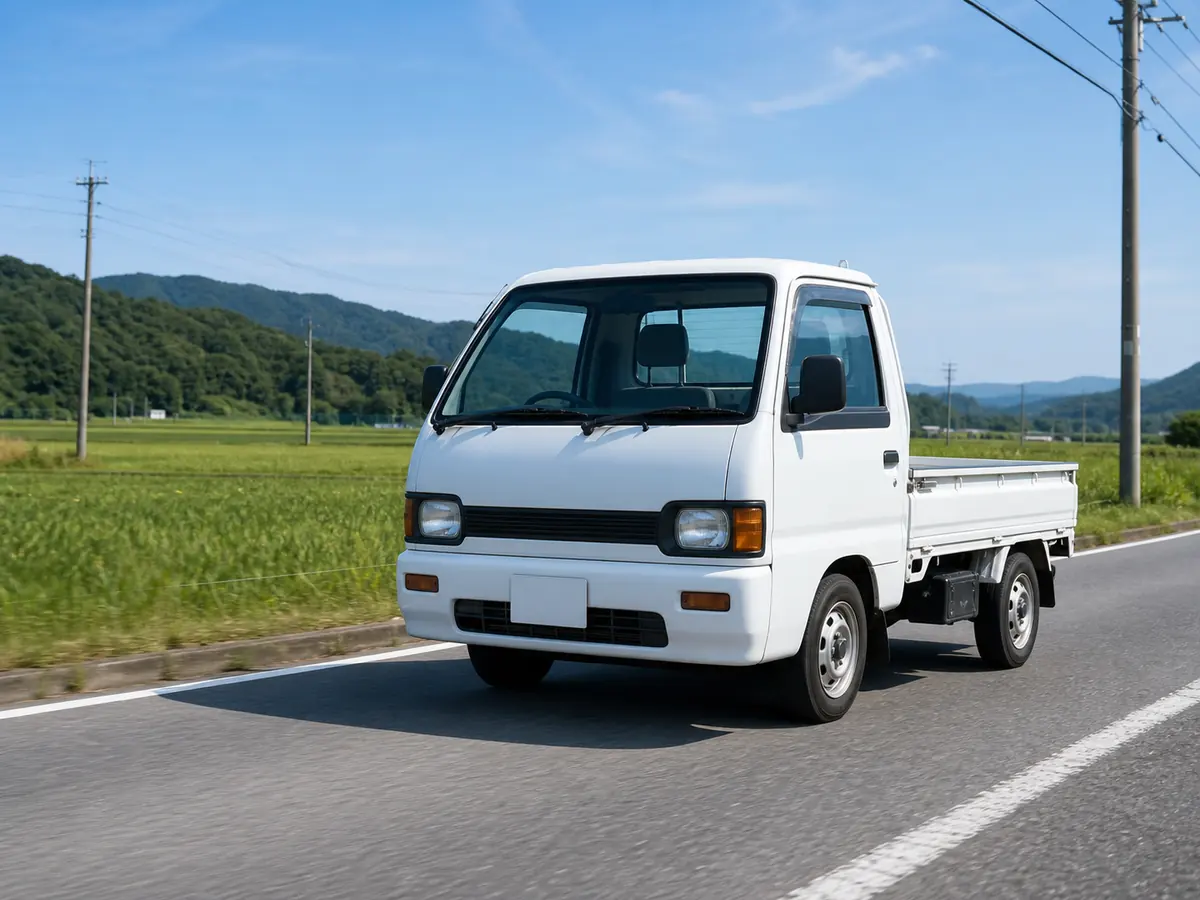
Brief maximum on level road, stock truck, favorable conditions.
Often the better expectation for noise, stability and reserve power.
An import-use classification, not an inherent Japanese factory cap.
1 How Fast Can a Kei Truck Go?
Most stock 660cc kei trucks reach about 50–65 mph on flat ground, with a more realistic sustained cruising speed of 45–55 mph. Older 550cc, heavily loaded or 4WD trucks tend to sit at the lower end of that range, while a healthy 5-speed or forced-induction configuration can reach the upper end or slightly beyond it.
A truck can be capable of a speed without being comfortable—or sensible—to hold there.
For the 660cc Honda Acty, Suzuki Carry, Daihatsu Hijet, Subaru Sambar and Mitsubishi Minicab trucks commonly exported from Japan, about 50–65 mph is a sensible buyer-planning range for a brief top speed. A healthy 5-speed truck on level ground may reach the upper end. A 4-speed, automatic, loaded 4WD truck, or one facing a hill or headwind may not.
That is why an advertisement claiming an exact “Honda Acty top speed” or “Suzuki Carry top speed” without identifying the chassis, gearbox, final-drive ratio, tires, load and test conditions is less useful than it appears. Japanese factory specification sheets typically list engine output, transmission ratios, tire size and vehicle weight, but they do not provide one standardized real-world maximum for every trim.
Brief top speed
The highest speed a particular truck can reach under favorable conditions. It may require full throttle and may not be sustainable.
Sustained cruise
A speed the truck can hold with acceptable noise, stability and some power in reserve. This is the more useful buying number.
Legal road speed
The posted or statutory limit where the vehicle is registered. Legality depends on the country, state or province—not the speedometer.
There is no universal Japanese 140 km/h kei-truck governor
Japan’s official vehicle-class comparison describes ordinary kei vehicles as having no structural top-speed restriction. Kei status is defined by dimensions and engine displacement; it does not itself create an 87 mph factory limit. Japan’s road speed limit is a separate rule.
2 Kei Truck MPH by Typical Configuration
These are conservative planning ranges for stock, road-going trucks—not manufacturer-certified performance figures.
| Typical setup | Brief flat-road maximum* | More realistic cruise* | What to expect |
|---|---|---|---|
| Pre-1990 550cc, often 4-speed | 40–55 mph | 35–45 mph | Lower output and shorter gearing; condition has an outsized effect. |
| 1990s 660cc, 4-speed manual or 3-speed automatic | 45–60 mph | 40–50 mph | Work-oriented gearing or an older automatic can raise engine noise and reduce reserve power. |
| 1990s–early 2000s 660cc, 5-speed manual | 50–65 mph | 45–55 mph | The usual road-use sweet spot; fifth gear helps, but it is not an overdrive guarantee on every chassis. |
| Forced-induction or road-oriented configuration | Vehicle-specific | Confirm by chassis | Some supercharged/turbo variants can exceed the typical range, but tires, brakes and condition still set the safe limit. |
*Mirai Trading buyer-planning synthesis based on regulator descriptions of typical mini-truck powertrains, factory specification data and documented real-world reports. These are not guarantees. Do not conduct maximum-speed testing on a public road.
A speedometer reading is not automatically GPS speed
Replacement tire diameter, tire wear and normal speedometer tolerance can change the indicated number. If a road test is appropriate and legal, compare the dash reading with a safely mounted GPS reading—never a handheld phone.
3 Popular Kei Trucks: What Changes Their Speed?
Model name alone is not enough. Chassis code, drivetrain and transmission matter more than internet rankings.
Honda Acty
HA3/HA4 · HA6/HA7The mid-engine Acty is often praised for balance. For road use, a healthy 5-speed is generally a better match than an ultra-low-geared work trim or 3-speed automatic. Verify the actual gearbox rather than assuming every Acty performs alike.
Suzuki Carry
DC51T/DD51T · DA52TCarry gearing varies by generation, 2WD/4WD and agricultural equipment. A 5-speed road-oriented truck may sit comfortably above a 4-speed work truck, even when both use a 660cc engine.
Subaru Sambar
KS3/KS4 · TT1/TT2The four-cylinder EN07 and rear-engine layout make the Sambar distinctive. Naturally aspirated and supercharged versions should not be grouped under one top-speed figure; confirm the engine code and transmission.
Daihatsu Hijet
S100P/S110P · S200P/S210PHijet trucks were sold with multiple gearboxes and drivetrains. Low-range or agricultural gearing improves low-speed control, not highway performance. A clean cooling system matters on sustained climbs.
Mitsubishi Minicab
U41T/U42T · U61T/U62TLike its rivals, the Minicab was configured for work first. Transmission, final drive, compression, ignition condition and correct commercial tires are more informative than a generic model-name speed claim.
4 What Is the Fastest Kei Truck?
Among the five trucks most commonly exported from Japan, the Subaru Sambar has a genuine structural edge — but “fastest” still comes down to the individual truck’s engine, transmission and condition.
The Sambar’s rear-mounted, four-cylinder EN07 engine is unusual among kei trucks, which mostly use three-cylinder layouts, and some Sambar generations were offered with a factory supercharger. That combination gives a well-specified Sambar variant a real advantage in usable power over a same-era naturally aspirated rival. It does not mean every Sambar outruns every Acty, Carry, Hijet or Minicab: a tired, poorly geared or non-supercharged Sambar can be slower than a healthy 5-speed truck from another brand. Treat “the Sambar is fastest” as a starting point for verification, not a guarantee — confirm the exact engine code, transmission and supercharger status (see Section 3 above) before assuming any one truck will outrun another.
5 Eight Factors That Decide Real Kei Truck Speed
Two trucks with the same badge can feel completely different at 55 mph.
Transmission and final drive
Gear count does not tell the full story. Fifth gear can still be short, while a farm-oriented final drive trades road speed for pulling ability.
Engine output and tune
Carbureted, fuel-injected, naturally aspirated and forced-induction engines deliver different usable power. Misfire or poor fueling can erase much of it.
2WD versus 4WD
Four-wheel drive adds components, weight and friction. It improves traction where needed, but it does not automatically make a truck faster.
Payload and accessories
The kei-truck payload ceiling is 350 kg (about 770 lb). Load, dump hardware, lift kits and heavy tires all affect acceleration and hill speed.
Grade, altitude and wind
A small bluff-front truck has little spare power against a climb or headwind. Naturally aspirated engines also lose output as elevation rises.
Tire size and pressure
Taller tires can lower engine rpm but also reduce effective torque and alter the speedometer. Use properly rated tires and factory-safe pressures.
Mechanical condition
Compression, cooling, valve adjustment, ignition, fuel delivery, wheel bearings, dragging brakes and clutch slip can all reduce speed.
Driver and test method
Indicated speed, GPS speed, direction, wind, road slope and duration should be recorded before two results are meaningfully compared.
6 Kei Truck KM/H to MPH Conversion
Japanese speedometers are marked in km/h. Use these exact conversions when reading listings or road-test videos.
| KM/H | MPH | How it relates to kei-truck driving |
|---|---|---|
| 40 km/h | 24.9 mph | Near the U.S. 25 mph non-road governor threshold. |
| 60 km/h | 37.3 mph | Comfortable local-road pace for nearly any healthy road-going truck. |
| 80 km/h | 49.7 mph | A practical benchmark for many 660cc trucks. |
| 90 km/h | 55.9 mph | Near the upper comfortable cruise for many stock 1990s examples. |
| 100 km/h | 62.1 mph | Japan’s general expressway limit for light vehicles; not a guarantee the truck will hold it. |
| 105 km/h | 65.2 mph | Upper end of the usual planning range. |
| 110 km/h | 68.4 mph | Possible only for some configurations and conditions. |
| 120 km/h | 74.6 mph | Do not treat isolated online reports as a standard stock-truck expectation. |
| 140 km/h | 87.0 mph | A widely repeated limiter number for Japanese cars—not a normal kei-truck target. |
Formula: mph = km/h × 0.621371. Values are rounded to one decimal place.
7 Can a Kei Truck Drive on the Highway?
Answer three separate questions: can it maintain traffic speed, is it safe for the route, and is it legal where registered?
How Fast Do Kei Trucks Go on the Highway?
A healthy 5-speed 660cc kei truck can often sustain 55–60 mph, matching many U.S. and Canadian highway limits, but a loaded, 4WD, automatic or mechanically tired truck may fall well short of that. Confirm the specific truck’s configuration and condition — not just the model name — before counting on it for regular highway use. Fuel use over a long route is a separate question; see the kei truck MPG guide.
Can this truck hold the route’s speed?
A truck that briefly touches 60 mph on flat ground may fall well below that on a long grade, with cargo or into a headwind. Merging reserve matters more than the peak number.
Is it prepared for sustained speed?
Inspect tires, brakes, steering, wheel bearings, cooling, belts, hoses and fluids first. Many imported trucks are over 25 years old, regardless of low odometer readings.
Is that road use permitted?
Federal import eligibility and local registration are different. In the U.S., state rules can restrict where a kei truck may operate even when federal import paperwork is valid.
U.S. buyers: understand the two age rules
NHTSA says a vehicle at least 25 years old may be imported without regard to FMVSS compliance, measured from its manufacture date. EPA separately describes an emissions pathway for vehicles at least 21 years old that retain the original-equivalent engine configuration. Neither rule automatically guarantees state title, registration or highway access. See our guide to importing a kei truck to the USA for the full process.
Why “25 mph kei truck” results are confusing
EPA guidance treats a mini truck permanently limited to 25 mph or less as a non-road vehicle. Removing that governor can violate the conditions under which it was imported. A road-vehicle import that qualifies through the age exemptions is a different case—check its documents before buying or modifying anything.
8 Speed-Focused Kei Truck Buyer Checklist
Buy the truck’s condition and gearing—not a seller’s headline number.
Confirm before purchase
- Exact chassis code, build month and model year
- Engine code and naturally aspirated or forced-induction setup
- Transmission: 4MT, 5MT, 3AT or another configuration
- 2WD/4WD, high-low transfer case and differential-lock equipment
- Original tire size versus the tires currently fitted
- Whether any 25 mph non-road governor is present in the import history
Inspect before higher-speed use
- Commercial-load-rated tires, date codes, pressure and wheel torque
- Brake balance, fluid age, steering play and wheel bearings
- Cooling-system pressure, fan operation, hoses and coolant condition
- Compression, ignition, fuel delivery, clutch slip and dragging brakes
- Seat belts, mirrors, lighting and wiper operation
- A route-specific test at legal speeds with no cargo first
When road speed matters, tell your exporter before bidding
Ask for a 5-speed, road-oriented gearing, stock-size commercial tires and documented mechanical condition. Mirai Trading can use the chassis code and auction information to avoid low-speed work configurations that do not match your intended route — see our guide to reading a Japanese auction sheet to understand what that documentation actually shows.
9 Kei Truck Speed FAQs
Concise answers to the questions buyers ask most often.
What is the top speed of a kei truck in mph?
For a stock 660cc 1990s truck, about 50–65 mph is a useful planning range on flat ground. A more realistic sustained cruise is often 45–55 mph. The exact result depends on chassis, gearing, load, terrain, wind, tires and mechanical condition.
How fast does a Honda Acty go?
There is no single honest Acty-wide number. A 5-speed road-oriented truck may reach the upper part of the typical 50–65 mph range, while a 4-speed work trim, automatic, loaded truck or tired engine may be slower. Confirm the chassis and gearbox.
How fast does a Suzuki Carry go?
Most healthy 660cc Carry trucks belong in the same broad 50–65 mph planning range, but 4-speed, 5-speed, 2WD, 4WD and agricultural configurations differ. The final-drive ratio and tire size matter as much as the model badge.
Is a Subaru Sambar faster than other kei trucks?
Not automatically. The Sambar’s four-cylinder engine and available supercharger make some versions more speed-capable, but a naturally aspirated or poorly maintained example may not be faster than a healthy rival. Compare exact engine and transmission codes.
Are kei trucks limited to 25 mph?
Not as a Japanese factory rule. In the U.S., 25 mph is associated with mini trucks permanently converted and imported as non-road vehicles. Do not remove a governor without checking the truck’s import basis and applicable law.
Are kei trucks limited to 140 km/h (87 mph)?
Kei classification does not impose a universal 140 km/h structural cap. In any case, a stock utility kei truck usually lacks the power and gearing to approach 87 mph, so that repeated figure is not a useful buying expectation.
Is a 5-speed kei truck faster than a 4-speed?
Often, but not always. A fifth gear can reduce engine rpm or extend road speed, yet final-drive and individual gear ratios decide the result. Some work-focused 5-speeds include very low gearing rather than a tall cruising gear.
Does 4WD reduce kei truck top speed?
It can. Additional weight and drivetrain friction may slightly reduce acceleration or speed, but gearing and condition can be more important. Use 4WD for traction and follow the manufacturer’s instructions about when it may be engaged.
Can a kei truck hold 60 mph on the highway?
Some healthy 5-speed 660cc trucks can hold 60 mph on level ground, but hills, headwinds and cargo may pull them below it. Route safety, merging room and local law still need separate consideration.
Can larger tires make a kei truck faster?
Larger-diameter tires can lower engine rpm at a given road speed, but they also reduce effective wheel torque, alter the speedometer and may create clearance or load-rating problems. They do not create horsepower and can make hill performance worse.
How can I make a kei truck faster?
Start by restoring factory performance: correct tires and pressure, compression, valve adjustment, ignition, fueling, cooling, clutch and free-rolling brakes. Performance modifications can affect safety, reliability, insurance and legal status; use a qualified specialist.
Should top speed decide which kei truck I buy?
Usually not by itself. If your regular route demands sustained speeds above about 55 mph, a kei truck may be the wrong tool. For local roads, farms, campuses and short-distance work, condition, gearing, parts support and documentation matter more.
How fast can a kei truck go?
Most stock 660cc kei trucks can reach about 50–65 mph on flat ground, with a more realistic sustained cruising speed of 45–55 mph. The result depends heavily on chassis, gearing, load, terrain and mechanical condition — see the short answer above for the full breakdown.
How fast do kei trucks go on the highway?
A healthy 5-speed 660cc kei truck can often sustain 55–60 mph, matching many U.S. and Canadian highway limits, but a loaded, 4WD, automatic or mechanically tired truck may fall well short of that. Confirm the specific truck’s configuration and condition before counting on it for regular highway use.
What is the fastest stock kei truck?
Among the five most commonly exported models, a well-specified Subaru Sambar has a structural edge from its four-cylinder EN07 engine and available factory supercharger. But condition and configuration matter more than badge — a tired or non-supercharged Sambar can be slower than a healthy 5-speed Acty, Carry, Hijet or Minicab. Confirm the exact engine code and transmission before assuming any one truck is fastest.
What is the fastest kei van?
Engine and gearing decide it, as with trucks. Kei vans such as the Daihatsu Hijet Cargo and Atrai, Suzuki Every, Honda Acty Van and Subaru Sambar van share their truck siblings’ 660cc engines, and the quickest are the turbocharged or supercharged versions, such as the Atrai and Every turbo models and the supercharged Sambar van. Vans are heavier and taller than trucks, so plan for similar or slightly lower top speeds, and confirm the exact engine code and transmission before buying.
10 Sources and Research Method
Primary regulators and manufacturer archives were prioritized; ranges are clearly separated from official legal facts.
- Light Motor Vehicle Inspection Association — What is a kei vehicle? Official current and historical limits for engine displacement and vehicle dimensions.
- Japan Ministry of Land, Infrastructure, Transport and Tourism — Vehicle-class comparison Distinguishes ordinary kei vehicles from speed-restricted ultra-compact mobility and shows no structural top-speed restriction for the ordinary kei class.
- Japan MLIT — Expressway and ETC FAQ Notes the general 100 km/h legal maximum discussed for light vehicles/motorcycles; a legal limit is not a performance rating.
- U.S. EPA — Learn about importing vehicles and engines Current overview of EPA requirements and the 21-year original-equivalent engine provision.
- U.S. EPA — Instructions for certifying imported mini trucks Explains permanent 25 mph limitation for classification as a non-road mini truck.
- NHTSA — Importation and Certification FAQs Official 25-year FMVSS import exemption, measured from manufacture date.
- NHTSA interpretation concerning mini trucks Demonstrates the legal distinction between 25 mph off-road configurations and a mini truck capable of ordinary road speeds.
- Honda Acty Truck official specification archive Example of manufacturer-published engine, gearing, tire and weight data used to interpret capability.
- Subaru — 1999 Sambar launch release Official background on the Sambar’s chassis, suspension and rear-engine layout.
- Daihatsu — Hijet 60th anniversary history Official generation history, including the 1999 ninth-generation Hijet Truck.
How this guide was created
Official sources establish the vehicle class, road-law and import distinctions. Manufacturer data establishes the hardware differences. Because factories did not publish one controlled top-speed test for every historical truck and trim, the MPH tables are labeled as buyer-planning ranges synthesized from those specifications and documented real-world reports. Final performance must be assessed vehicle by vehicle.
Need a Kei Truck That Matches Your Roads?
Tell Mirai Trading your typical speed limit, terrain, payload and market. We can help you prioritize the right chassis, transmission, gearing and documented condition before bidding in Japan.