
Lifted Kei Trucks for Sale: Japan Auctions & U.S. Buyer Guide
Lifted kei trucks for sale deserve more than a dramatic stance photo. This U.S. buyer guide compares Japan-sourced small pickups, screens lift kits and all-terrain tire fitment, explains the age and state handoff, and shows how to request exclusive Mirai Auction Portal access to filtered candidates.
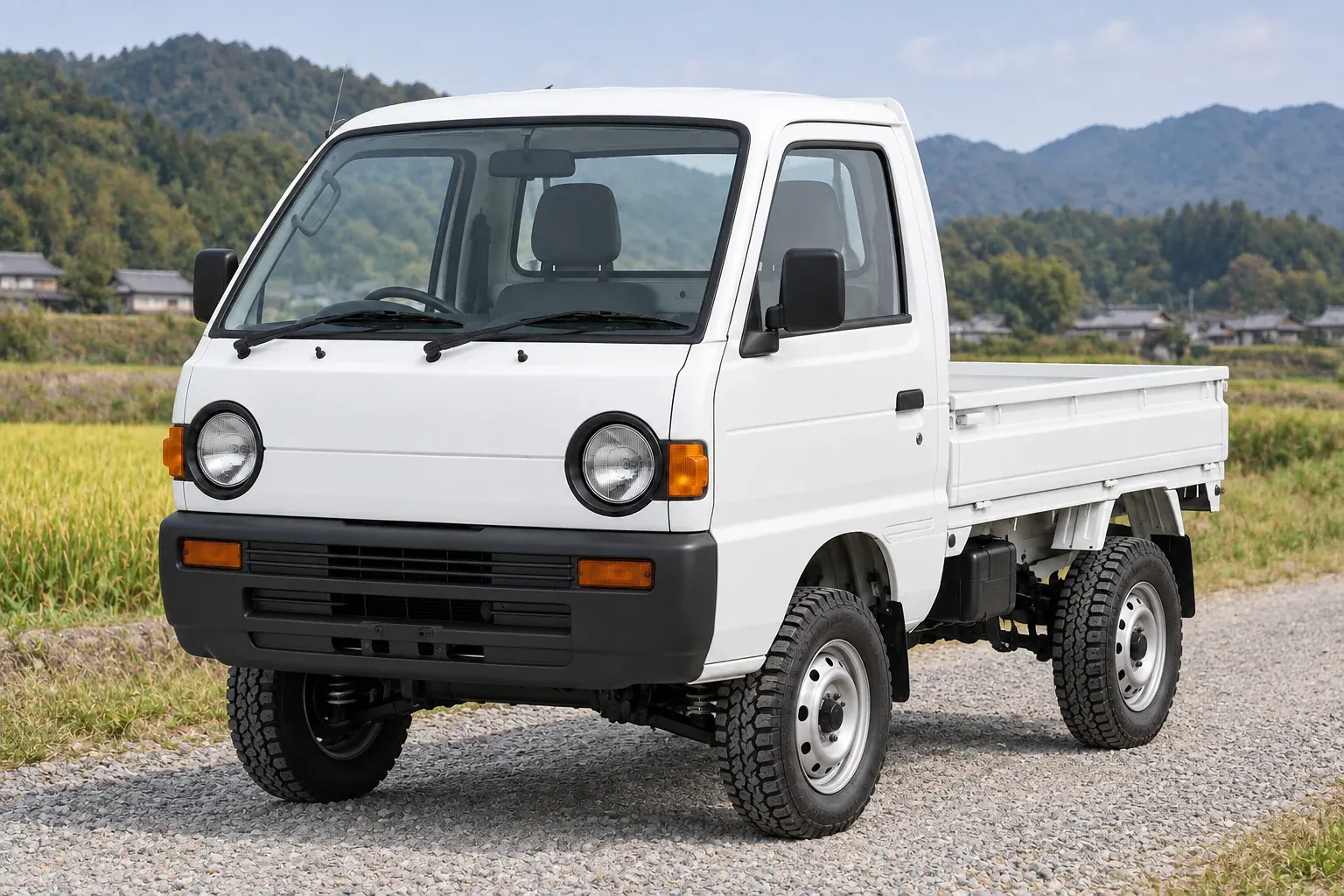
Confirm the exact chassis code and manufacture month, not the model name.
Use the actual manufacture date, not a model-year label.
Check the chassis, transfer controls and installed driveline.
Height, fitment, load rating, steering and braking interact.
Lifted kei trucks buyer overview
Start with factory identity, then make condition and import decisions around the actual vehicle.
Lifted kei trucks should be searched by the job: farm lanes, private land, light utility work or a proposed road-registered vehicle. Height alone does not establish 4WD, low gearing, tire capacity or permission to use public roads. We source the base truck and evaluate its actual lift, tires, documents and destination state together.
Suzuki’s official Carry archive identifies 1991-era DD51T 4WD examples and DC51T two-wheel-drive examples, while its January 1999 tenth-generation specification lists different DA52T and DB52T driveline combinations. That is why a badge, styling cue or generic model name is a poor substitute for the chassis and model plate.
Mirai’s customer-only Auction Portal brings listings from major Japanese auctions into a filterable search. We can shortlist trucks around make, build date, 4WD evidence, mileage, auction grade, body condition, modifications and U.S. destination, then request inspection before a bid. It is auction access and sourcing, not a claim that Mirai owns every listed truck.
Page ownership
This existing page owns lifted-truck shopping, lift/tire inspection and U.S. sourcing intent. The kei-truck hub covers the broader category; the U.S. import guide covers the federal and state process in depth.
Kei truck models, lift kits and tire fitment
Official Suzuki and Honda reference vehicles define the baseline; year, market, body and grade can change the individual specification.
| Item | Factory or modification reference | Buyer evidence |
|---|---|---|
| Period Carry reference | Suzuki 1991 ninth-generation archive: DC51T 2WD and DD51T 4WD | Use stamped chassis and export record to distinguish layouts. |
| Carry powertrain | Suzuki 1991 archive: 657 cc F6A gasoline three-cylinder; grade and gearing vary | Match installed engine model/configuration to the original-type file. |
| Carry running gear | Suzuki 1991 archive: front MacPherson strut/coil and rear semi-elliptic leaf spring | Inspect the actual spacer, spring, shackle and shock combination. |
| Factory tire baseline | Suzuki 1991 archive lists 5.00-12 and 145R12 light-truck fitments by version | Record the replacement tire size, load rating and clearance under steering/articulation. |
| Later Carry | Suzuki January 1999 tenth-generation DA52T/DB52T specification | Do not copy 1991 lift hardware or dimensions onto a later chassis. |
| Honda Acty | Honda archive separates 1988–1999 and 1999–2003 truck generations | Identify HA-series build and factory drivetrain before selecting parts. |
| Modification | Lift height and tire size are aftermarket choices, not a factory grade | Request installer invoice, part numbers, alignment and road-test evidence. |
| Payload | No lift or larger tire increases the maker’s rated load | Compare tire load rating and actual use with the candidate’s factory record. |
Reference editions and access dates are listed in the sources section.
Identity, body and engine choices
A generation nickname cannot replace the full chassis and model record.
Suzuki Carry
Use Suzuki’s chassis code to separate 2WD and 4WD versions. Its official strut-front, leaf-rear baseline guides a careful lift inspection, but kit fitment is chassis-specific.
Honda Acty
Honda’s archives separate pre-1999 and later trucks. Ask for the stamped HA code, factory drive layout, wheel/tire specification and any lift documentation before treating a listing as a match.
Daihatsu Hijet, Subaru Sambar and Minicab
These can be searched too, but suspension, driveline, wheel offset and parts compatibility differ by code and year. Shortlist by the exact candidate rather than assuming a universal kei lift kit.
Claims that change value need evidence
Match the stamped chassis, model plate, Japanese export certificate, translation, manufacture date, body and engine. Treat rare grade, factory 4WD, low-range, differential-lock and lift-kit claims as unproven until the records and hardware agree.
Lift-specific problems and exact checks
Use symptoms and component evidence to test the installation risks that matter on these trucks.
Carry strut and leaf-spring mismatch
The factory Carry baseline uses a strut/coil front and leaf rear. A mixed or undocumented lift can leave poor travel or uneven rake. Photograph front spacers and rear leaf/shackle work, measure ride height, and request alignment and bump-stop clearance.
Tire rubbing and steering range
Oversized tires can contact arches, struts or links at full lock and compression. Inspect both sides at lock, compressed travel and with the intended load; note offset and any cut bodywork.
CV, joint and hose travel
A raised independent front end changes operating geometry. Inspect boots, joints, brake hoses and steering linkage through travel, and road-test for vibration or binding. Treat the acceptable lift as vehicle-specific, not a universal inch rating.
Source: Inspection judgment against the factory Carry suspension layout
4WD and low-range mislabeling
A lifted 2WD truck can look identical to a 4WD listing. Match the stamped code and model plate, inspect the actual transfer/axle hardware, and test engagement. Suzuki’s official tables show different drive and gearing combinations by version.
Load and tire-rating mismatch
Aggressive tread and greater diameter do not raise payload. Read the tire’s load marking, check inflation guidance, inspect wheel/lug fitment and compare the working load with the specific factory vehicle record.
What drives value and market context
Value follows the evidence behind the specification and condition, not the model name alone.
Factory 4WD and working hardware
A documented 4WD chassis, working transfer selection and known gearing form a clearer comparison set than a lifted 2WD truck advertised as trail-ready.
Lift workmanship
Among lifted kei trucks, identified parts, measured geometry, alignment, clean mounts and a calm road test add more confidence than a taller stance alone.
Originality and engine identity
A matching chassis and original-type engine simplify the U.S. evidence file. Undocumented swaps and mixed-generation parts belong in a different risk tier.
Mileage and history
Odometer reading matters when auction records, maintenance, tire age, lift invoices and condition support it. Inconsistent wear weakens the claim.
Condition tier and use
Sound working trucks, carefully built recreation vehicles and projects should be compared separately. Rust, underbody damage and worn driveline parts can outweigh attractive accessories.
How to compare candidates
Compare like-for-like vehicles by factory identity, originality, mileage evidence, documented history and condition tier. Auction grade can help frame the review, but the sheet, photographs, inspection and repair history explain why two apparently similar vehicles can belong in different value bands. This guide does not publish a fixed price because timing, specification, condition and transaction terms move independently.
Buyer inspection priorities
Turn the listing into a chassis-specific inspection brief with photographs, measurements, tests and a road report.
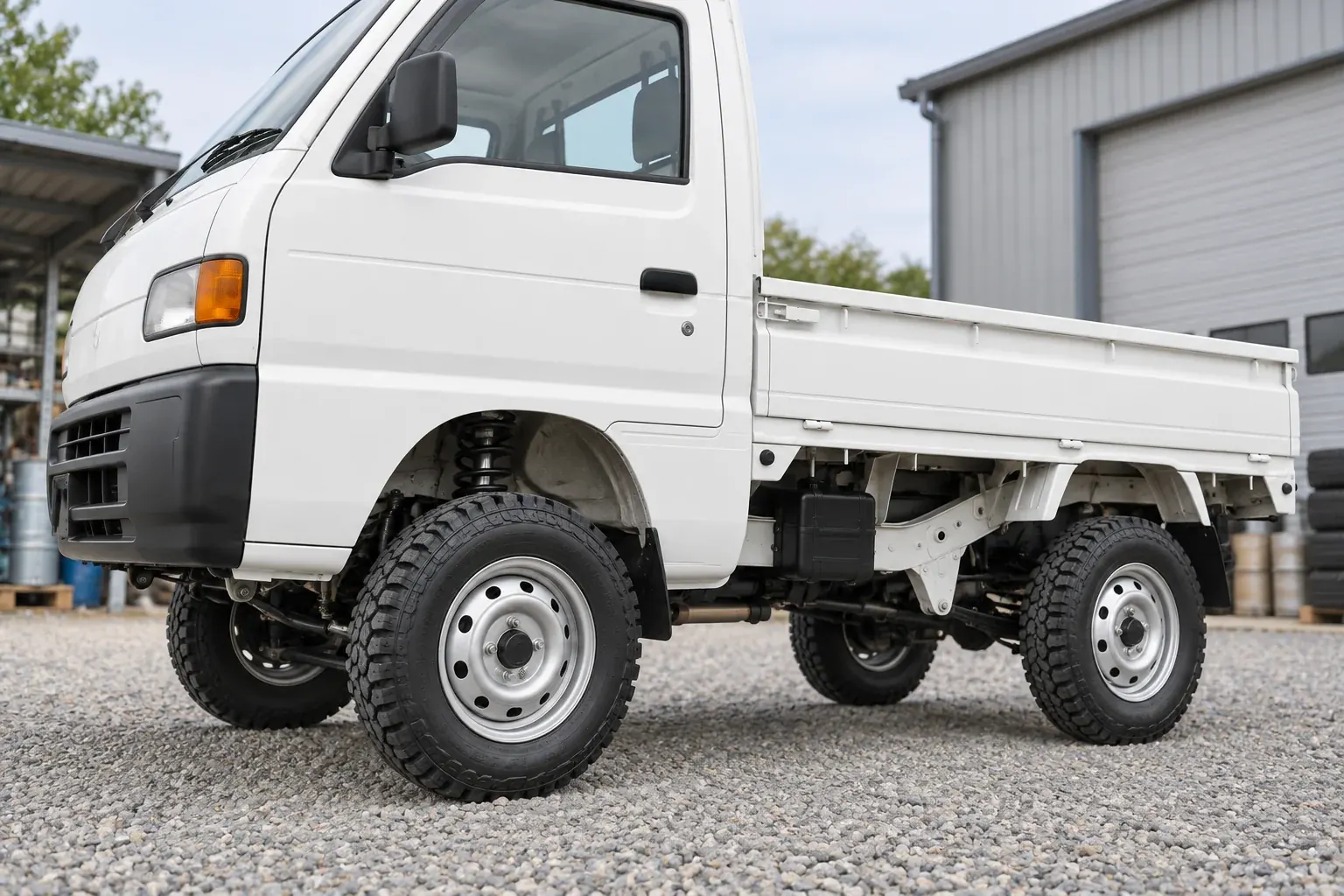
Evidence to request
Give the inspector the claimed model, engine, body, modifications, intended use and U.S. destination. Ask for the following evidence around that exact candidate.
- Photograph the stamped chassis, model plate, engine code, export certificate, auction sheet and all four corners at normal ride height.
- Identify each lift component by maker and part number; measure installed height and inspect mounts, fastener quality, corrosion, cracking and rubbing marks.
- Cycle steering from lock to lock and suspension through safe travel; check tire-to-body, brake-hose, steering-link, driveshaft and CV clearance.
- Record tire size, load index, age, wheel offset and lug fitment; compare with the truck’s factory tire/load evidence. NHTSA’s current TireWise page supports load and inflation checks.
- Request alignment printout, straight-line road test, braking check and photos of front struts plus rear springs, mounts and bump stops.
- Verify the claimed 4WD or low-range hardware on the actual truck, then assess the intended state title and road-use path separately from federal import age.
Compare the kei truck platforms before you buy
The best base depends on the exact chassis, working drivetrain, parts fitment and evidence quality.
Carry
Strong documentary baseline from Suzuki’s archive; decide among 2WD, 4WD and gearing by chassis rather than silhouette.
Acty
A distinct Honda platform and generation split; review actual drivetrain and lift hardware before using a Carry parts assumption.
Hijet / Sambar / Minicab
Widen the portal search when size, parts availability or working configuration matters more than one badge; inspect each candidate’s lift geometry separately.
See the broader buyer map
Use Mirai’s kei-truck hub for small-truck choices. Buyers comparing a road-focused JDM car can also use the JDM sports-cars hub.
U.S. import, title and state planning
Federal age, EPA configuration, customs paperwork and state registration are connected steps.
NHTSA says a vehicle at least 25 years old may enter without conforming to FMVSS under Box 1 of the HS-7 declaration. The period runs from the actual manufacture date. A lifted truck still needs its own manufacture-date evidence. On September 20, 2026, a 2001 build through August has cleared the 25-year anniversary; a September 2001 build needs its exact day, and later 2001 builds have not yet cleared it.
EPA’s over-21 provision calls for the engine to be the same model and configuration as originally installed. A swap, conversion or uncertain engine identity can change the route. CBP still needs the correct ownership, transport and federal declaration file.
The destination state controls title, VIN inspection, emissions, equipment, registration and insurance. Start with USA.gov’s official state motor-vehicle directory. California direct imports deserve early review because federal age eligibility alone does not establish state registration.
U.S. candidate planner
Choose the vehicle facts and destination. Every change refreshes the result and all five WhatsApp drafts.
- Alabama
- Alaska
- Arizona
- Arkansas
- California
- Colorado
- Connecticut
- Delaware
- District of Columbia
- Florida
- Georgia
- Hawaii
- Idaho
- Illinois
- Indiana
- Iowa
- Kansas
- Kentucky
- Louisiana
- Maine
- Maryland
- Massachusetts
- Michigan
- Minnesota
- Mississippi
- Missouri
- Montana
- Nebraska
- Nevada
- New Hampshire
- New Jersey
- New Mexico
- New York
- North Carolina
- North Dakota
- Ohio
- Oklahoma
- Oregon
- Pennsylvania
- Rhode Island
- South Carolina
- South Dakota
- Tennessee
- Texas
- Utah
- Vermont
- Virginia
- Washington
- West Virginia
- Wisconsin
- Wyoming
- 1988
- 1989
- 1990
- 1991
- 1992
- 1993
- 1994
- 1995
- 1996
- 1997
- 1998
- 1999
- 2000
- 2001
- Unknown
- January
- February
- March
- April
- May
- June
- July
- August
- September
- October
- November
- December
- Suzuki Carry
- Honda Acty
- Daihatsu Hijet
- Subaru Sambar
- Mitsubishi Minicab
- Unknown
- Original-type gasoline engine
- Replacement same-model engine
- Different engine or major swap
- Unknown
- Factory 4WD documented
- Factory 2WD documented
- Converted or unknown
- Documented modest lift and rated all-terrain tires
- Stock truck; lift planned
- Undocumented lift or tire fitment
- Major suspension or body conversion
- Unknown
- Export certificate and matching plate
- Complete file with auction sheet
- Partial document file
- Mismatch or missing documents
Keyboard: Arrow keys, Home, End, type-ahead, Enter and Escape. Click outside to close.
Candidate screening result
ROUTE OPENCheck the exact manufacture date against the import date.
Verify factory 4WD, lift components, tire load rating, full-travel clearance, alignment, underbody condition and the U.S. document chain.
Use your destination state’s current agency process.
The selected file starts with matching identity evidence.
Current federal references: NHTSA FAQ, EPA page updated September 1, 2026, and CBP Article 000001340 published February 13, 2026.
Mirai Auction Portal access for U.S. buyers
Move from a broad model search to a filtered candidate pool across Japan.
Exclusive customer access across major Japanese auctions
After inquiry, Mirai customers can receive exclusive access to the Mirai Auction Portal. It brings together vehicles from various major auctions across Japan and provides robust filters for generation, chassis, engine, body, year, mileage, condition and other search priorities.
For a U.S. brief, Mirai can filter around the 25-year date, identity, original engine configuration, auction and document evidence, inspection needs and destination state. “USA-ready” describes that preparation and screening; customs entry, title and registration still depend on the individual vehicle and agencies.
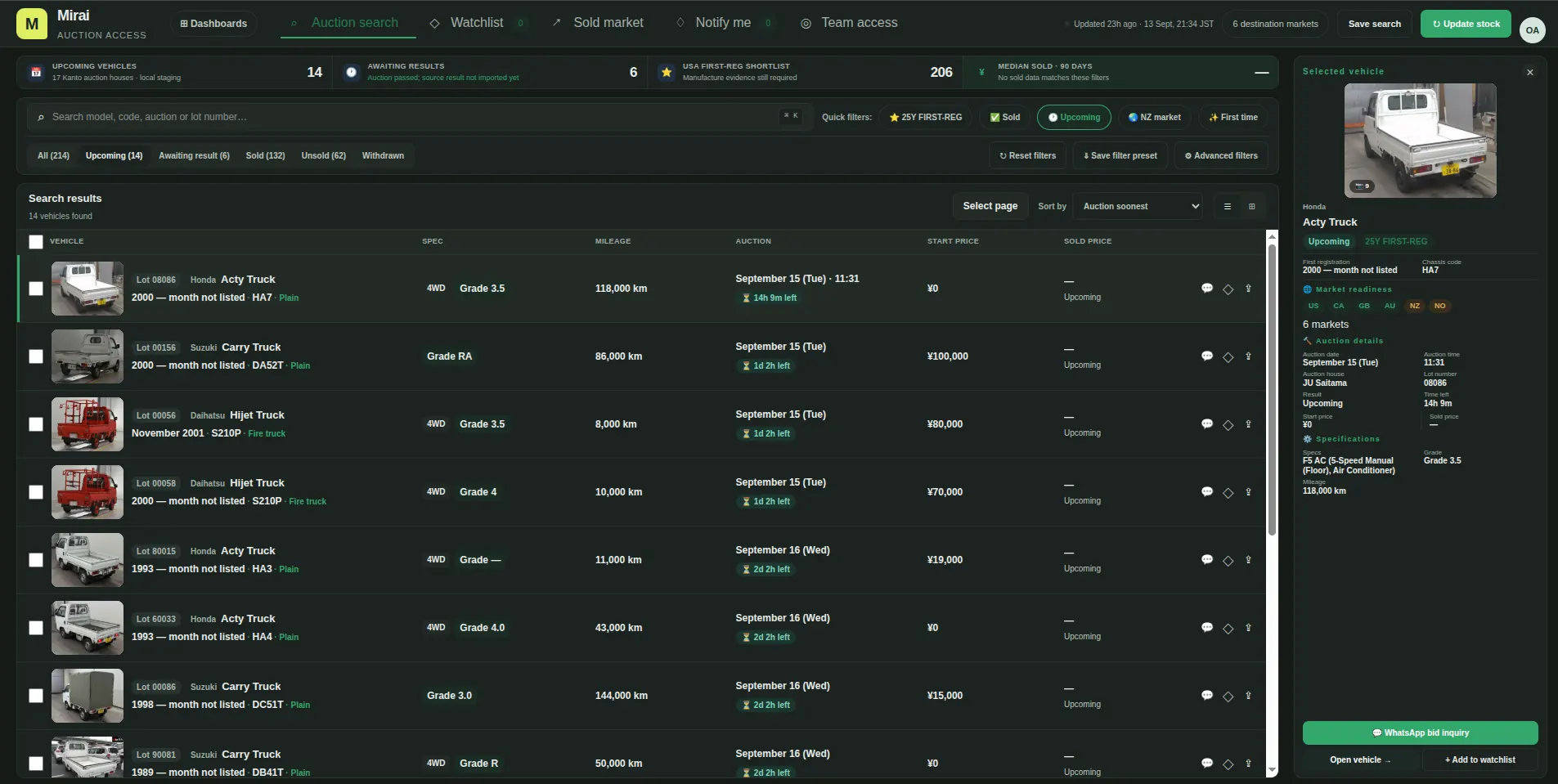
Actual Mirai Auction Portal interface example supplied by Mirai. The visible kei-truck results demonstrate filters, watchlists, auction timing, market-readiness tags and vehicle detail workflow; they are not current inventory for the featured truck family.
Candidate-to-export workflow
Keep one reviewable evidence chain from portal filter to U.S. handoff.
Build the portal brief
Set the model, engine, body, age boundary, condition, modification tolerance, budget and destination state.
Resolve expensive unknowns
Use chassis-specific photos, mechanical tests, cold start, road behavior, underbody review and document comparison.
Prepare the handoff
Align the export certificate and translation, ownership, invoice, shipping papers, federal declarations and destination-state file.
Frequently asked questions
Direct answers for U.S. buyers evaluating this vehicle family.
Are all lifted kei trucks factory 4WD?
No. Lift height does not establish the drivetrain. Match the chassis and model plate to the factory specification and inspect the installed hardware.
Can Mirai source a lifted kei truck for sale in Japan?
Yes. Mirai can filter major Japanese auctions through its customer-only Portal, then review the actual truck, lift, tires and documents before a buyer authorizes a bid.
Does a lift kit make a kei truck road legal in every U.S. state?
No. Federal import age and state title or road-use rules are different decisions; modified height and tires may add state equipment questions.
Can an engine-swapped kei truck use the EPA over-21 provision?
Generally no. EPA describes that provision around an engine of the same model and configuration as originally installed. An uncertain swap needs its own import-route review.
Are larger all-terrain tires automatically safer for work?
No. Check size, load rating, pressure, clearance and wheel fitment against the truck and its intended load. Aggressive tread does not increase rated payload.
Does a two-inch lift fit every kei truck?
No. Chassis, suspension, kit design, tire size and condition change the geometry. Judge the installed truck through travel and alignment rather than a universal lift number.
Is a 2001 kei truck old enough to import in September 2026?
Generally yes. Builds through August 2001 have passed 25 years; a September build needs its exact manufacture day and import date. October through December builds have not reached 25 years on September 20, 2026.
What should an auction inspection show on a lifted truck?
It should show chassis identity, lift parts and mounts, tire markings, underbody condition, full-lock clearance, brake hoses, driveline joints, alignment and a road test.
Can I choose a stock truck and fit a lift later?
Yes. A sound factory truck can be a better starting point if the desired kit and tires are selected for its exact chassis and intended use.
Is the Auction Portal public inventory?
No. Mirai offers exclusive customer access after inquiry. Auction listings are third-party candidates, and filters are a screening tool rather than an ownership or approval claim.
What changes the value of a lifted kei truck?
Factory drivetrain, matching identity, body condition, mileage evidence, documented lift workmanship, tire age and inspection results create the practical value tiers.
How do I request a shortlist for my U.S. state?
Use any WhatsApp button on this page and share the preferred model, work or recreation use, lift/tire brief, budget and destination state. The planner can add its selections to the draft.
Primary sources and verification method
Official manufacturer and government pages were checked against their current live editions on the research date.
- Suzuki Digital Library, ninth-generation Carry — 1991-09 factory specification; current manufacturer archive accessed 2026-09-20. Used for DC51T/DD51T chassis, drive and gearing, F6A, tire and suspension baseline.
- Suzuki Digital Library, tenth-generation Carry — 1999-01 factory specification; current manufacturer archive accessed 2026-09-20. Used for DA52T/DB52T variants and different drive combinations.
- Honda, Acty Truck model archive — current Honda archive accessed 2026-09-20; model ranges 1988-05–1999-04 and 1999-05–2003-03. Used for generation boundary and code-specific inspection need.
- NHTSA, TireWise — current page accessed 2026-09-20. Used for size, load rating, pressure and alignment considerations.
- Mirai Trading, How We Work — current live page accessed 2026-09-20. Used for auction sourcing and inspection workflow.
- NHTSA, Importation and Certification FAQs — current page accessed 2026-09-20. Used for 25-year FMVSS route, HS-7 Box 1 and actual manufacture date.
- EPA, Learn About Importing Vehicles and Engines — current page accessed 2026-09-20; linked detailed manual EPA-420-B-10-027 dated July 2010. Used for over-21 original engine model and configuration condition.
- CBP, How to Import Your Automobile — Article 000001340 published 2026-02-13; accessed 2026-09-20. Used for entry and declaration workflow.
- USA.gov, State Motor Vehicle Services — current directory accessed 2026-09-20. Used for destination-state DMV handoff.
- California DMV, Register an Imported Vehicle — current page accessed 2026-09-20. Used for California imported-vehicle registration caveat.
How this guide was checked
Suzuki and Honda sources support model dates and factory references. Federal sources support the age, engine and entry framework; state planning routes readers to the current agency. Lift condition and state approval are kept separate from factory references.
Open a filtered Japanese kei pickup with documented lift and tire fitment search
Tell Mirai the vehicle, engine, body, condition, budget and U.S. state. We can prepare exclusive Auction Portal access and an inspection brief around those priorities.