
Toyota MR2 for Sale: SW20 3S-GTE Import & Buyer Guide
Toyota MR2 for sale searches should separate an original SW20 turbo from naturally aspirated cars, swaps and cosmetic replicas. This U.S. guide covers 3S-GTE identity, mid-engine inspection risks, value evidence, federal and state planning, and a direct route into Mirai’s exclusive customer Auction Portal.
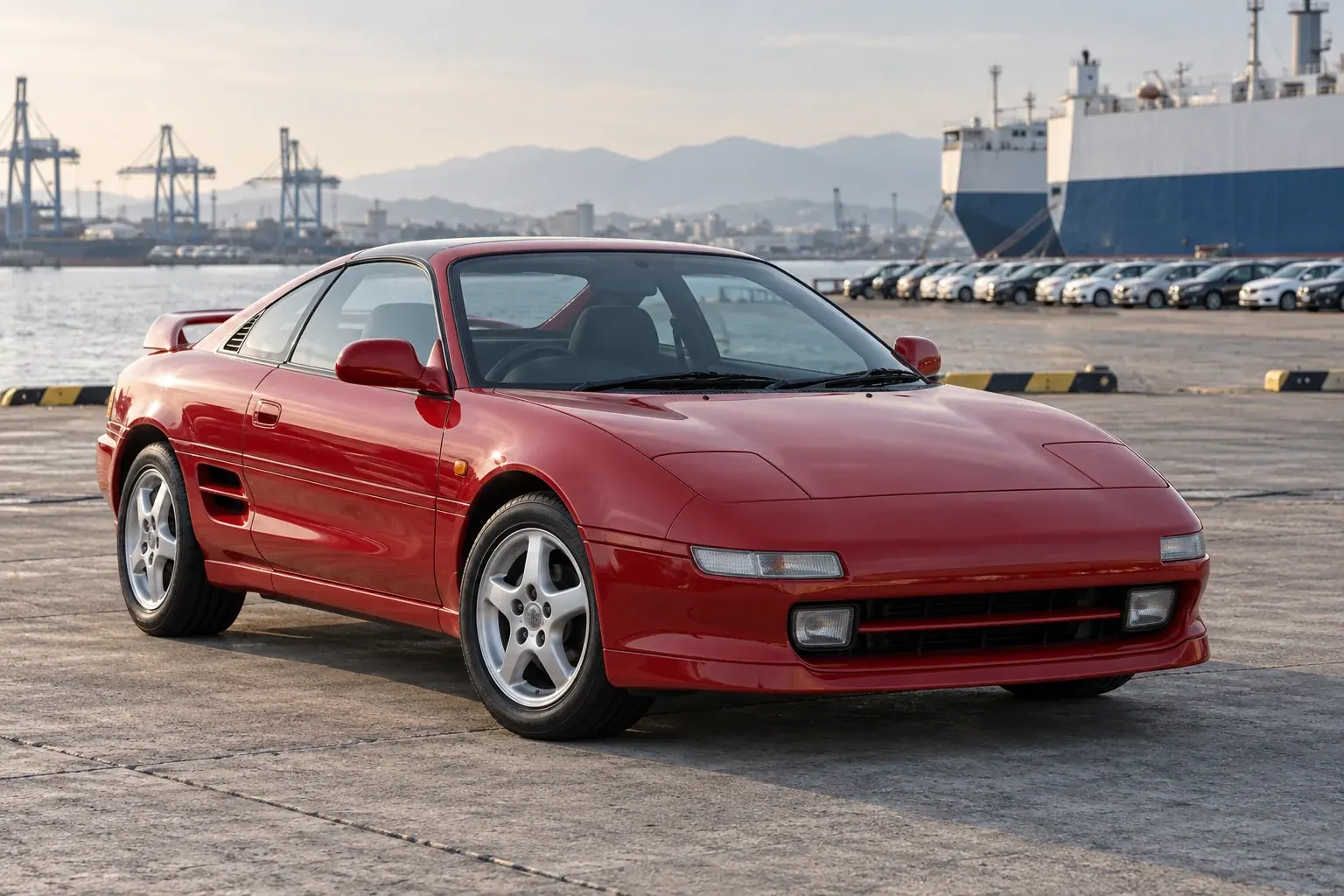
Toyota’s SW20-era production range is fully beyond the federal 25-year threshold.
Toyota’s October 1989 launch reference rates the Japanese turbo at 225 PS.
Transverse powertrain placement changes cooling, access and handling inspection priorities.
Roof identity, seals, drains and structural repair history affect the buying brief.
Toyota MR2 for sale buyer overview
Start with factory identity, then make condition and import decisions around the actual vehicle.
Toyota launched the completely renewed MR2 on October 17, 1989 as a mid-engine two-seater. The official release lists a 1,998 cc 3S-GTE with a twin-entry ceramic turbocharger, air-cooled intercooler, 225 PS and 31 kg-m, alongside the naturally aspirated 3S-GE at 165 PS.
The launch chassis used four-wheel independent strut suspension, staggered tire sizes, ventilated disc brakes and electro-hydraulic power steering. Toyota offered a standard roof and reinforced T-bar body, while ABS was standard on 3S-GTE cars and optional on applicable 3S-GE versions at launch.
A Toyota MR2 for sale listing can mix Japanese GT grades, naturally aspirated G models, U.S.-market names, later revisions, engine conversions and track-oriented builds. Use the stamped SW20 identity, model plate, export certificate, engine, transmission, roof and repair record before comparing value.
Mirai customers can request exclusive access to the Auction Portal across major auctions in Japan. The commercial path starts with filtered candidates, then adds auction-sheet review, chassis-specific inspection, purchase authorization and export-document preparation for the buyer’s U.S. state.
Page ownership
This page owns commercial Toyota MR2 for sale, SW20 3S-GTE inspection and U.S. import intent. Mirai’s JDM sports-car hub provides broader comparisons, while specialty vehicle sourcing covers wider Japanese requests.
SW20 MR2 and 3S-GTE specifications
Official Toyota reference vehicles define the baseline; year, market, body and grade can change the individual specification.
| Item | Toyota factory reference | Buyer and auction use |
|---|---|---|
| Generation | Second-generation MR2 launched October 17, 1989; production ended August 1999 | Confirm the actual SW20 manufacture date and export record. |
| Layout | Transverse mid-engine, rear-wheel drive, two seats | Inspect the rear structure, cooling circuit, powertrain mounts and service access. |
| Turbo engine | 3S-GTE · 1,998 cc DOHC turbo · 225 PS launch reference | Later specifications vary; identify the installed generation and management rather than applying one output to every car. |
| Naturally aspirated engine | 3S-GE · 1,998 cc DOHC · 165 PS launch reference | Separate original G-family cars from turbo swaps and GT-style conversions. |
| Suspension | Four-wheel independent strut system | Measure alignment and inspect arms, struts, links, hubs and pickup points. |
| Brakes | Ventilated discs on all four wheels at launch | Confirm caliper, rotor, ABS and conversion condition on the candidate. |
| Roof | Standard roof or T-bar roof | Test glass-panel fit, seals, drains, storage hardware and water entry. |
| Steering | Speed-responsive electro-hydraulic power steering | Check pump operation, warning behavior, fluid loss and steering consistency. |
Reference editions and access dates are listed in the sources section.
Identity, body and engine choices
A generation nickname cannot replace the full chassis and model record.
GT and turbo identity
The 3S-GTE defines the factory turbo buying set. Match grade, engine, transmission, brakes, body hardware and records instead of treating a turbo swap or spoiler as factory GT evidence.
G and G Limited
Naturally aspirated 3S-GE cars can be lighter, simpler candidates. Their condition and originality should be compared within the correct grade and engine tier.
Standard roof and T-bar
T-bar panels add open-air appeal and extra water-entry points. A Toyota MR2 for sale candidate needs coherent roof hardware, seals, drains and structural seams.
Claims that change value need evidence
Match the stamped chassis, model plate, Japanese export certificate, translation, manufacture date, body and engine. Treat rare grade, factory turbo, diesel conversion and special-market claims as unproven until the records and hardware agree.
Model-specific known problems and exact checks
Use symptoms and component evidence to test the weak points that matter on this model.
Cooling circuit length and trapped-air evidence
Pressure-test the system, verify both radiator fans and stable temperature, then inspect the radiator, long underfloor pipes, hoses, heater circuit and expansion path. Service records should explain coolant changes and any overheating event.
Source: Toyota’s mid-engine SW20 layout and factory launch specification
3S-GTE turbo, oil and modification history
Check cold start, hot idle, oil pressure, smoke, shaft noise, boost response, intercooler plumbing, fuel system and ECU. Compression, leak-down and tuning evidence matter more than a claimed power figure.
Source: Toyota 3S-GTE launch hardware reference dated 1989-10-17
Rear suspension geometry and collision repair
Measure four-wheel alignment and inspect rear struts, arms, links, hubs, crossmember and pickup points. Mixed suspension revisions, bent hardware or extreme alignment can make a visually clean car unstable and expensive to sort.
Source: Toyota four-wheel strut and staggered-tire factory baseline
T-bar leakage and body sealing
Water-test both panels and drains and inspect seals, glass fit, roof latches, sills, floor edges and repaired seams. A dry presentation does not replace evidence under trim and carpets.
Source: Toyota standard-roof and reinforced T-bar body reference
Gearbox, clutch, CV and steering wear
Road-test from cold and hot for synchro resistance, clutch slip, differential noise, CV clicking, wheel-bearing play and inconsistent steering assist. Inspect mounts, boots, fluid leaks and any transmission conversion work.
Source: Toyota manual-transmission and EHPS launch reference
What drives value and market context
Value follows the evidence behind the specification and condition, not the model name alone.
Factory grade and powertrain
A documented Japanese GT-family 3S-GTE car belongs in a different comparison set from an original 3S-GE model or a turbo conversion. Model-plate and export evidence establish the tier.
Revision and coherent specification
SW20 production evolved. Buyers value a car whose body, engine, transmission, brakes, suspension and exterior hardware form a documented specification rather than a mixture of generations.
Roof and structural condition
Standard-roof and T-bar cars attract different buyers. Leak-free original hardware, straight suspension pickups and sound floors carry more weight than cosmetic presentation.
Mileage and service continuity
Kilometers become useful when auction history, timing and cooling service, inspections and wear agree. Replaced clusters, long storage or track use need separate evidence.
Modification and condition tier
Original survivors, restored cars, sorted street builds, track cars and projects require separate benchmarks. Reversible, documented changes usually create a clearer buying case than undocumented power work.
How to compare candidates
Compare like-for-like vehicles by factory identity, originality, mileage evidence, documented history and condition tier. Auction grade can help frame the review, but the sheet, photographs, inspection and repair history explain why two apparently similar vehicles can belong in different value bands. This guide does not publish a fixed price because timing, specification, condition and transaction terms move independently.
Buyer inspection priorities
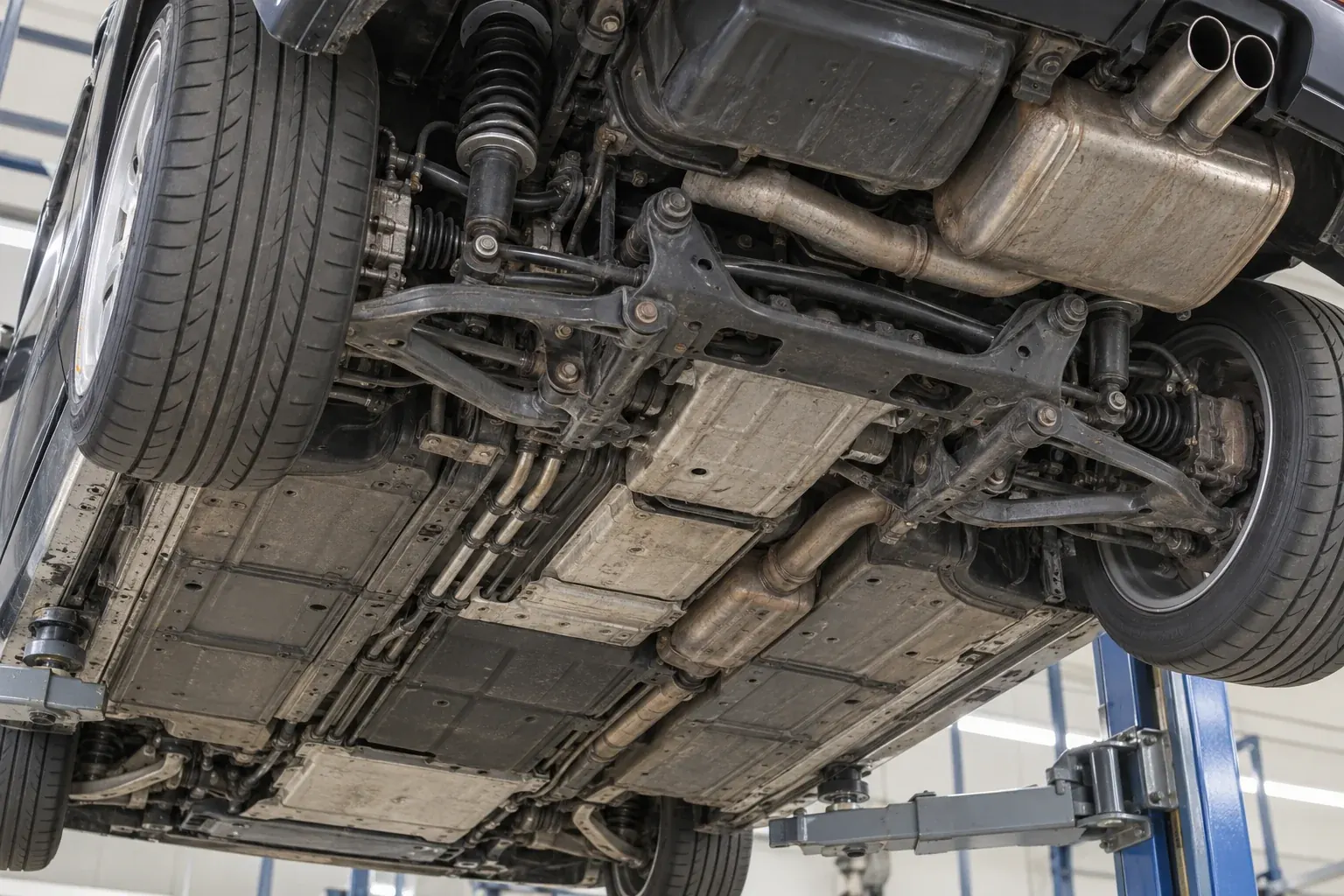
Turn the listing into a chassis-specific inspection brief with photographs, measurements, tests and a road report.
Evidence to request
Give the inspector the claimed model, engine, body, modifications, intended use and U.S. destination. Ask for the following evidence around that exact candidate.
- Photograph the chassis stamping, model plate, export certificate, engine identity, turbo system, transmission case and roof configuration.
- Pressure-test the full cooling circuit; inspect the long underfloor pipes, radiator, fans, hoses, heater circuit, expansion system and evidence of air pockets or overheating.
- Run cold and hot compression and leak-down tests, verify oil pressure and inspect turbo smoke, boost control, intercooler plumbing, fuel changes and ECU calibration.
- Measure four-wheel alignment and inspect rails, towers, floor seams, rear crossmember, suspension pickups, undercovers and rocker pinch welds for collision or corrosion repair.
- Road-test gearbox synchros, clutch, differential, CV joints, wheel bearings, electro-hydraulic steering and brake balance from cold and hot.
- On T-bar cars, water-test the panels and drains and inspect the seals, headliner edges, sills, carpets and storage hardware for leakage evidence.
Compare the SW20 with other JDM sports cars
Choose by layout, intended use, service access, modification exposure and the quality of the candidate evidence.
Toyota MR2 SW20
Mid-engine balance, turbo potential and compact packaging create a focused sports-car experience with higher cooling and access sensitivity.
Toyota Supra A80
A front-engine grand-tourer alternative with a larger powertrain, more cabin and luggage space, and a different value scale.
Honda NSX NA1/NA2
A higher-tier mid-engine comparison with aluminum structure and different service economics. Compare intended use and evidence quality rather than layout alone.
See the broader buyer map
Use Mirai’s JDM sports-cars hub for the wider Japanese enthusiast-vehicle map before narrowing the Auction Portal brief.
U.S. import, title and state planning
Federal age, EPA configuration, customs paperwork and state registration are connected steps.
NHTSA says a vehicle at least 25 years old may enter without conforming to FMVSS under Box 1 of the HS-7 declaration. The period runs from the actual manufacture date. Toyota launched the second-generation MR2 on October 17, 1989 and records production ending in August 1999. Every original SW20 production month is beyond 25 years on this review date, while the individual manufacture date still belongs in the import file.
EPA’s over-21 provision calls for the engine to be the same model and configuration as originally installed. A swap, conversion or uncertain engine identity can change the route. CBP still needs the correct ownership, transport and federal declaration file.
The destination state controls title, VIN inspection, emissions, equipment, registration and insurance. Start with USA.gov’s official state motor-vehicle directory. California direct imports deserve early review because federal age eligibility alone does not establish state registration.
U.S. candidate planner
Choose the vehicle facts and destination. Every change refreshes the result and all five WhatsApp drafts.
- Alabama
- Alaska
- Arizona
- Arkansas
- California
- Colorado
- Connecticut
- Delaware
- District of Columbia
- Florida
- Georgia
- Hawaii
- Idaho
- Illinois
- Indiana
- Iowa
- Kansas
- Kentucky
- Louisiana
- Maine
- Maryland
- Massachusetts
- Michigan
- Minnesota
- Mississippi
- Missouri
- Montana
- Nebraska
- Nevada
- New Hampshire
- New Jersey
- New Mexico
- New York
- North Carolina
- North Dakota
- Ohio
- Oklahoma
- Oregon
- Pennsylvania
- Rhode Island
- South Carolina
- South Dakota
- Tennessee
- Texas
- Utah
- Vermont
- Virginia
- Washington
- West Virginia
- Wisconsin
- Wyoming
- 1989
- 1990
- 1991
- 1992
- 1993
- 1994
- 1995
- 1996
- 1997
- 1998
- 1999
- Unknown
- January
- February
- March
- April
- May
- June
- July
- August
- September
- October
- November
- December
- Standard roof coupe
- T-bar roof coupe
- Unknown
- GT turbo
- GT-S turbo
- G Limited
- G
- Other documented market grade
- Unknown
- Original-type 3S-GTE turbo
- Original-type 3S-GE naturally aspirated
- Replacement same-model engine
- Different engine or major swap
- Unknown
- Factory 5-speed manual
- Factory automatic
- Converted or unknown
- Export certificate and matching plate
- Complete file with auction sheet
- Partial document file
- Mismatch or missing documents
Keyboard: Arrow keys, Home, End, type-ahead, Enter and Escape. Click outside to close.
Candidate screening result
ROUTE OPENThe selected production year is more than 25 years old.
Confirm SW20 grade, engine and roof identity, then inspect cooling, 3S-GTE health, rear suspension geometry, water entry, gearbox and modification quality.
Use the current Florida agency process.
The selected file starts with matching identity evidence.
Current federal references: NHTSA FAQ, EPA page updated September 1, 2026, and CBP Article 000001340 published February 13, 2026.
Mirai Auction Portal access for U.S. buyers
Move from a broad model search to a filtered candidate pool across Japan.
Exclusive customer access across major Japanese auctions
After inquiry, Mirai customers can receive exclusive access to the Mirai Auction Portal. It brings together vehicles from various major auctions across Japan and provides robust filters for generation, chassis, engine, body, year, mileage, condition and other search priorities.
For a U.S. brief, Mirai can filter around the 25-year date, identity, original engine configuration, auction and document evidence, inspection needs and destination state. “USA-ready” describes that preparation and screening; customs entry, title and registration still depend on the individual vehicle and agencies.
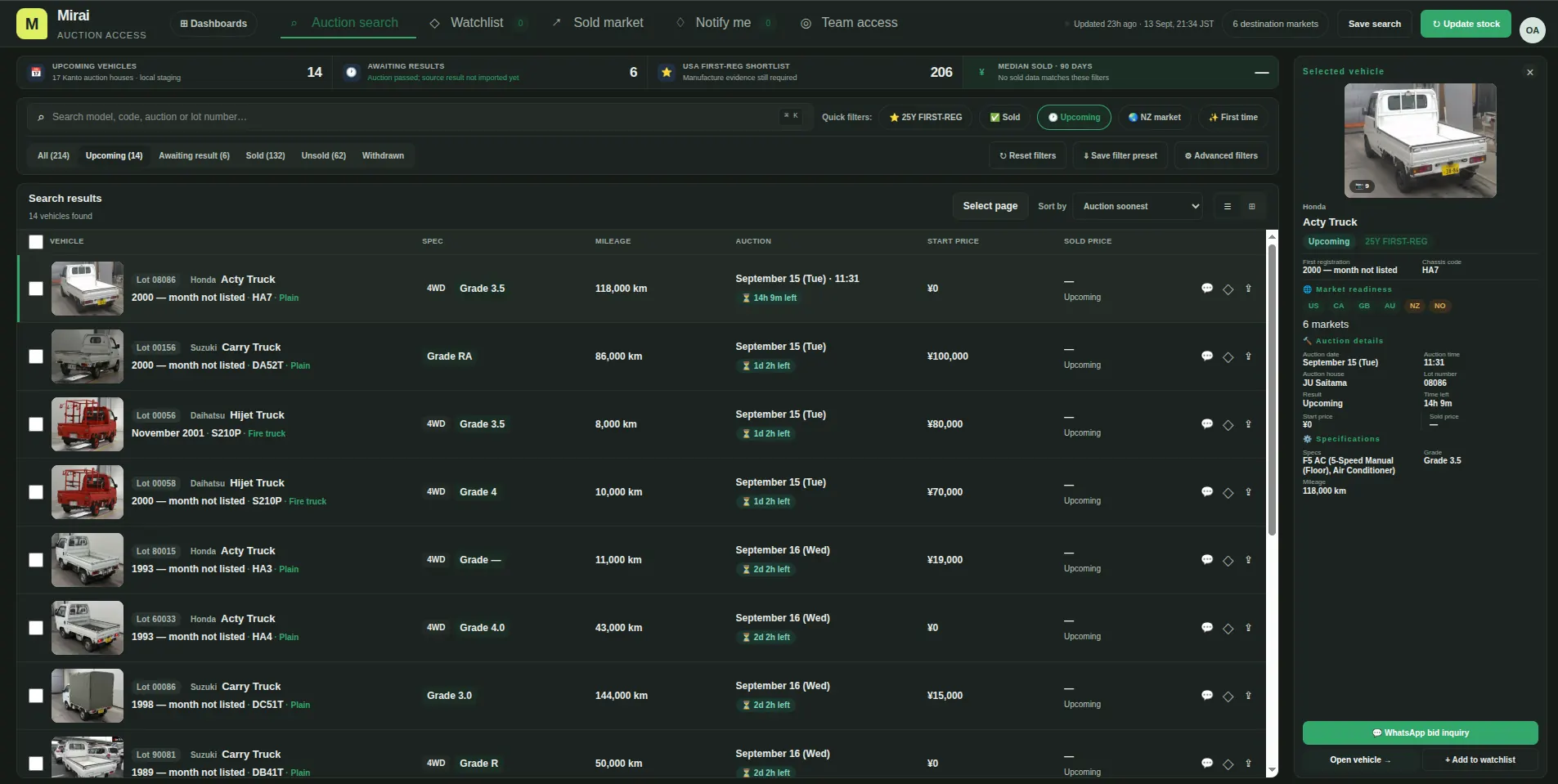
Actual Mirai Auction Portal interface example supplied by Mirai. The visible kei-truck results demonstrate filters, watchlists, auction timing, market-readiness tags and vehicle detail workflow; they are not current inventory for this model.
Candidate-to-export workflow
Keep one reviewable evidence chain from portal filter to U.S. handoff.
Build the portal brief
Set the model, engine, body, age boundary, condition, modification tolerance, budget and destination state.
Resolve expensive unknowns
Use chassis-specific photos, mechanical tests, cold start, road behavior, underbody review and document comparison.
Prepare the handoff
Align the export certificate and translation, ownership, invoice, shipping papers, federal declarations and destination-state file.
Frequently asked questions
Direct answers for U.S. buyers evaluating this vehicle family.
What does SW20 mean on a Toyota MR2?
SW20 is Toyota’s second-generation 2.0-liter MR2 chassis-family reference. The stamped identity, model plate and export certificate should agree with the candidate.
Is every SW20 MR2 turbocharged?
No. Toyota offered the turbocharged 3S-GTE and naturally aspirated 3S-GE. Grade, engine hardware and records must identify the individual car.
Did the Japanese launch-version 3S-GTE make 225 PS?
Yes. Toyota’s October 17, 1989 release lists 225 PS and 31 kg-m for the launch 3S-GTE. Later years and markets should be checked against their own specification.
Was an automatic turbo SW20 offered at launch in Japan?
No. Toyota’s launch record describes the automatic with the 3S-GE. A 3S-GTE automatic candidate needs conversion and engine-history evidence.
Are all original SW20 cars over 25 years old?
Yes. Toyota records MR2 production ending in August 1999, so the complete original range is now beyond 25 years. Keep the manufacture-date record in the file.
Does federal age eligibility guarantee a state title?
No. The destination state separately controls title, VIN inspection, emissions, equipment, registration and insurance.
Can an SW20 be registered in California?
Generally no. Federal age eligibility alone does not establish California registration, so review the exact direct-import and emissions route early.
Can an engine-swapped MR2 use the EPA over-21 provision?
Generally no. EPA ties that provision to the same engine model and configuration originally installed, so a swap needs route-specific review.
What should be checked first on a 3S-GTE MR2?
Start with cooling-system integrity, compression and leak-down results, oil pressure, turbo condition, timing service, fuel and ECU changes, then inspect rear structure and suspension geometry.
Do T-bar MR2 cars need a water test?
Yes. Test both panels, latches, seals and drains, then inspect the sills, floor edges and trim for leakage history.
Where can I find a Toyota MR2 for sale in Japan?
Ask Mirai on WhatsApp for exclusive customer Auction Portal access. It covers major auctions across Japan and can filter SW20 candidates by grade, engine, roof, year, mileage, condition and U.S. destination brief.
Does requesting portal access reserve or buy an MR2?
No. An inquiry starts the search and review. Mirai confirms the candidate, auction evidence, inspection scope, costs, terms and your authorization before a bid or purchase.
Primary sources and verification method
Official manufacturer and government pages were checked against their current live editions on the research date.
- Toyota, Completely Renews Its MR2 — official release dated 1989-10-17; current archive accessed 2026-09-18. Used for SW20 launch, 3S-GTE/3S-GE output, mid-engine layout, roof, suspension, brakes and steering.
- Toyota 75-year Vehicle Lineage PDF — current archive PDF accessed 2026-09-18; historical coverage through 2012. Used for second-generation MR2 timeline from October 1989 to 1999.
- Toyota vehicle recycling table, MR2 SW20 series — current Toyota page accessed 2026-09-18. Used for SW20 series identity and 1989 introduction reference.
- Toyota 75-year history, affiliate production milestones — current Toyota archive edition accessed 2026-09-18. Used for August 1999 MR2 production end.
- Mirai Trading, How We Work — current live page accessed 2026-09-18. Used for vehicle-specific sourcing, purchase, inspection and document workflow.
- Mirai Trading, Terms of Service — version dated 2026-07-21; accessed 2026-09-18. Used for auction sourcing model, inspection evidence and customer authorization boundary.
- Mirai Trading, JDM Sports Cars — current live page accessed 2026-09-18. Used for cross-model category boundary and internal linking.
- NHTSA, Importation and Certification FAQs — current page accessed 2026-09-18. Used for 25-year FMVSS exemption, HS-7 Box 1 and manufacture-date evidence.
- EPA, Learn About Importing Vehicles and Engines — page updated 2026-09-01; accessed 2026-09-18. Used for over-21 provision and original engine-configuration condition.
- U.S. Customs and Border Protection, How to Import Your Automobile — Article 000001340, published 2026-02-13; accessed 2026-09-18. Used for entry process and federal declaration references.
- USA.gov, State Motor Vehicle Services — current 50-state and DC directory accessed 2026-09-18. Used for official destination-state agency handoff.
- California DMV, Register an Imported Vehicle — current page accessed 2026-09-18. Used for California direct-import registration and emissions warning.
How this guide was checked
Toyota sources support model dates and factory references. Federal sources support the age, engine and entry framework; state planning routes readers to the current agency. Candidate condition and approval are kept separate from reference specifications.
Open a filtered Toyota MR2 SW20 mid-engine two-seat sports car search
Tell Mirai the vehicle, engine, body, condition, budget and U.S. state. We can prepare exclusive Auction Portal access and an inspection brief around those priorities.