
Honda Beat for Sale: Buy & Import a Kei Sports Car from Japan
Looking for a Honda Beat for sale to import from Japan to the USA? Mirai sources, inspects and ships them to U.S. buyers with export and 25-year import handling. Honda Beat shoppers in the United States need a PP1/E07A identity check, not just a kei-roadster label. This guide covers the naturally aspirated MTREC engine, five-speed manual, model-specific inspection points, qualitative value evidence, federal age route and state registration planning.
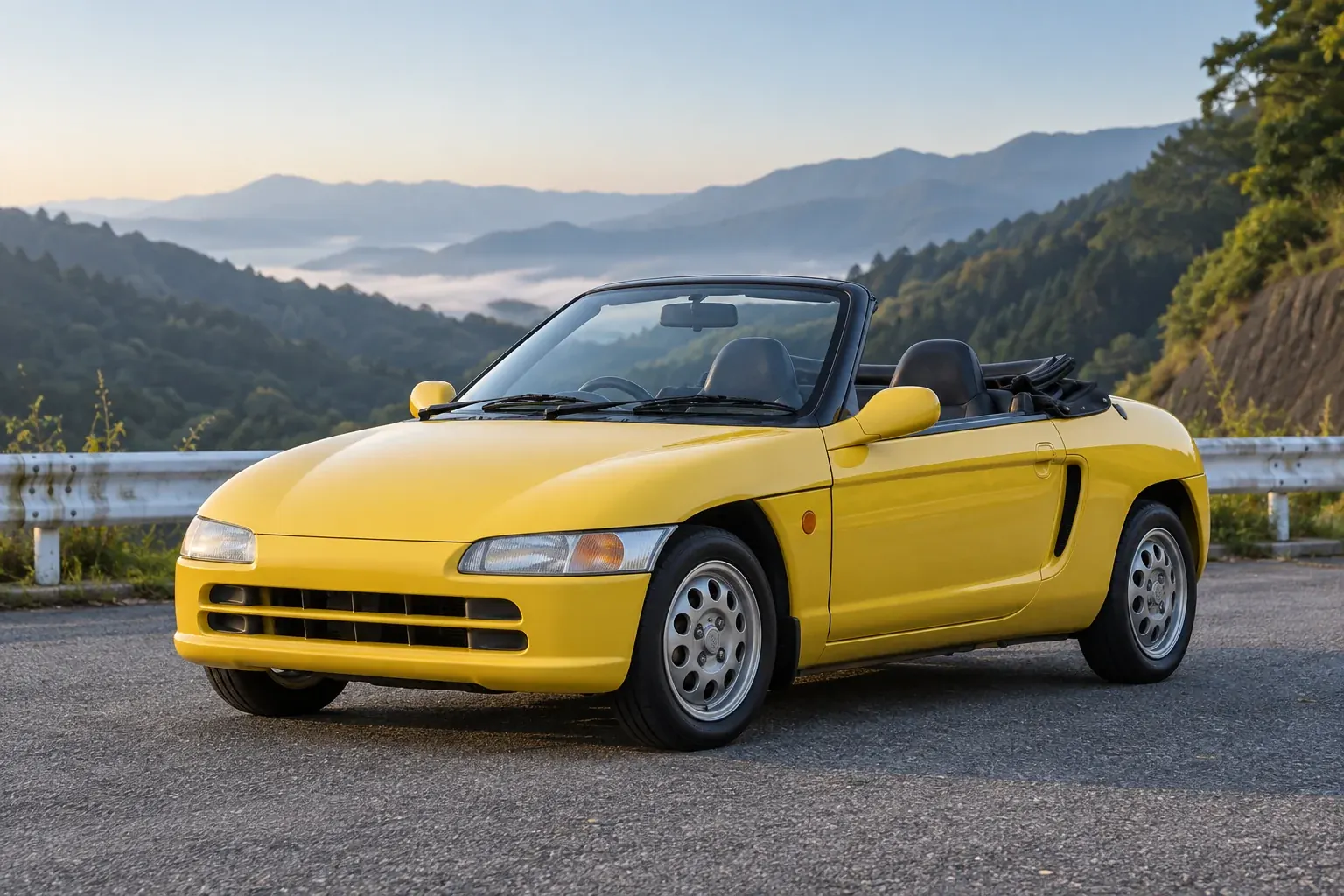
All original production years exceed 25 years in September 2026.
656 cc naturally aspirated three-cylinder with MTREC induction.
Peak output at 8,100 rpm; present health depends on the candidate.
Soft top, two seats, five-speed manual and mid-engine rear drive.
Honda Beat buyer overview
Start with factory identity, then make condition and import decisions around the actual vehicle.
Honda launched the Beat in May 1991 as a two-seat full-open kei car with a transverse mid-engine and rear drive. The factory factbook lists chassis model E-PP1, a 656 cc E07A water-cooled inline-three, five-speed manual, 760 kg curb weight and staggered 13-inch front and 14-inch rear tires.
The E07A uses a belt-driven SOHC 12-valve head and Honda’s MTREC system with individual throttles and dual fuel-control maps. Honda lists 64 PS at 8,100 rpm and 6.1 kg-m at 7,000 rpm. It is naturally aspirated; a turbocharged listing describes a modified car, not a factory Beat configuration.
Honda’s current sold-car archive runs from May 1991 through 1996, placing the whole factory production span beyond the federal 25-year threshold in 2026. Condition is the real separator: water entry, sill integrity, cooling, engine-management electronics, timing service, gearbox feel and modification quality.
Page ownership
This page owns the PP1 E07A kei sports roadster vehicle, inspection and U.S. import query. Mirai’s JDM sports-car hub provides broader performance-car context, while specialty vehicle sourcing covers wider Japanese collector and 4×4 requests.
Honda Beat PP1 and E07A specifications
Official Honda reference vehicles define the baseline; year, market, body and grade can change the individual specification.
| Item | Honda factory reference | Buyer application |
|---|---|---|
| Model identity | Honda E-PP1 · two-door convertible | Match the chassis stamping, model plate and export certificate. |
| Engine | E07A · 656 cc · inline three · SOHC 12-valve | Verify original engine type, stamping, timing history and cold/hot behavior. |
| Induction | Naturally aspirated MTREC with individual throttles | A turbo, carburetor or different-engine claim is a modification. |
| Factory output | 64 PS at 8,100 rpm; 6.1 kg-m at 7,000 rpm | Use as identity context, not a claim about current power. |
| Transmission and layout | Five-speed manual · mid-engine · rear drive | Test cable shift, clutch, mounts, joints and every gear hot. |
| Size and chassis | 3,295 × 1,395 × 1,175 mm · 760 kg | Inspect open-body sills, floor, seams, suspension and staggered wheels. |
Reference editions and access dates are listed in the sources section.
Identity, body and engine choices
A generation nickname cannot replace the full chassis and model record.
PP1 / original E07A
This is the coherent factory identity: naturally aspirated MTREC, five-speed manual, mid-engine rear drive. Match the engine installation and records rather than relying on the rear badge.
Factory color or special-edition claim
Color, interior pattern, wheel, option and limited-version claims can affect buyer interest. Verify them through the model plate, period material and a complete hardware inventory.
Modified Beat
Turbo kits, engine swaps, hardtops, suspension changes and wheel conversions can be usable, but they change inspection scope, EPA analysis and value comparisons.
Claims that change value need evidence
Match the stamped chassis, model plate, Japanese export certificate, translation, manufacture date, body and engine. Treat rare grade, factory turbo, diesel conversion and special-market claims as unproven until the records and hardware agree.
Honda Beat known problems and exact checks
Use symptoms and component evidence to test the weak points that matter on this model.
ECU, main relay and distributor-area electronics
On a cold and fully hot start, verify the fuel-pump prime, stable idle, clean warning-light sequence and restart. Remove and inspect the ECU for capacitor leakage or prior board repair, test the main relay under heat, and check distributor shaft play, oil entry, cap, rotor and igniter condition.
Timing belt and water-pump age
Honda’s factory specification confirms a belt-driven valvetrain. Require a dated belt, tensioner and water-pump record; if history is absent, treat the service as due in the ownership plan and inspect for oil or coolant contamination around the covers.
Cooling circuit and trapped-air symptoms
Honda’s layout places the radiator, engine and plumbing across a compact mid-engine chassis. Pressure-test the circuit, verify fan operation and heater output, inspect underbody pipes and bleed points, then hold stable temperature through idle, road load and hot restart.
Soft-top leaks, sill water and open-body corrosion
Honda documents a manual soft top and reinforced double-structure side sills. Water-test the roof, rear window, drains and seals; lift carpets and trim to inspect floor, sill seams, jacking points and rear arches for trapped moisture or repair.
Cable shift, synchros and clutch
Honda’s factory record specifies a short-stroke cable-operated five-speed. Drive the car cold and hot, shift rapidly and gently through every gear, test reverse selection and clutch take-up, then inspect cables, bushes, mounts and gearbox oil for evidence behind any notchiness or crunch.
Honda Beat value and market context
Value follows the evidence behind the specification and condition, not the model name alone.
Factory grade and specification
A correct PP1/E07A, factory color and trim, original soft-top arrangement, staggered wheels and documented options define the useful comparison set. Special-version claims need evidence.
Originality and matching identity
An original naturally aspirated E07A, five-speed layout and coherent body hardware are easier to value. Turbo conversions, swaps and replica details need a separate workmanship and document review.
Mileage with evidence
Lower indicated kilometers help when auction history, export records, cabin wear and service chronology agree. Storage age can still create belt, seal, cooling, tire and electrical work.
Documented history
Auction sheets, ownership continuity and invoices for timing, cooling, ECU, distributor, roof and corrosion work reduce uncertainty. Photos of repairs are more useful than an unsupported parts list.
Condition tier
A dry, structurally sound and original car ranks above a good driver with ordinary wear; a leaking, rusty or heavily modified project belongs in another tier. Mechanical response and body integrity matter more than fresh paint.
How to compare candidates
Compare like-for-like vehicles by factory identity, originality, mileage evidence, documented history and condition tier. Auction grade can help frame the review, but the sheet, photographs, inspection and repair history explain why two apparently similar vehicles can belong in different value bands. This guide does not publish a fixed price because timing, specification, condition and transaction terms move independently.
Buyer inspection priorities
Turn the listing into a chassis-specific inspection brief with photographs, measurements, tests and a road report.
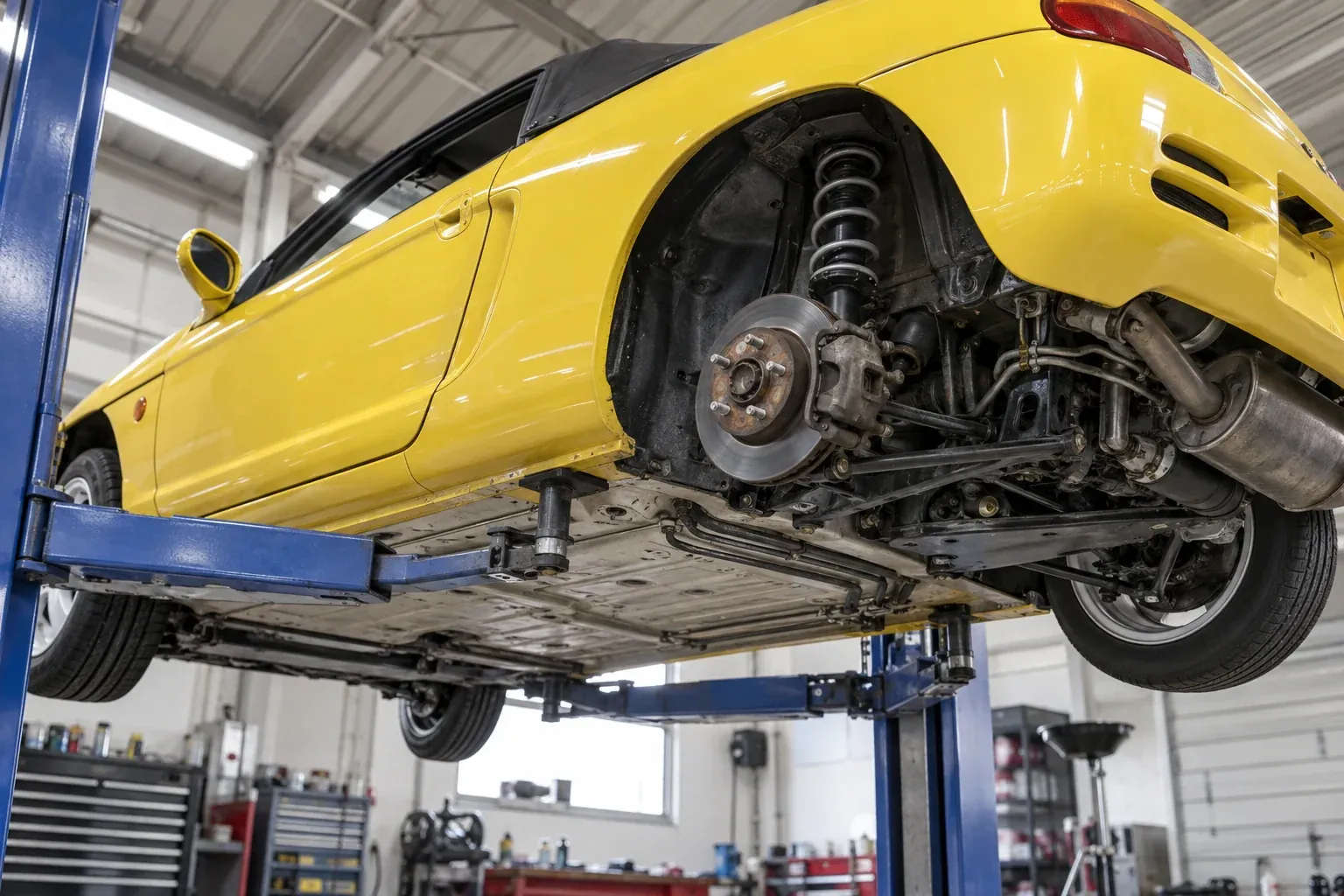
Evidence to request
Give the inspector the claimed model, engine, body, modifications, intended use and U.S. destination. Ask for the following evidence around that exact candidate.
- Verify PP1 chassis identity, E07A installation, model plate, export certificate, manufacture date and claimed color or special-version details.
- Cold-start and hot-restart the engine; record warning lamps, idle quality, throttle response, smoke and noise, then inspect ECU, relay and distributor evidence if symptoms appear.
- Pressure-test the cooling system, inspect radiator, fans, hoses, underbody pipes, bleed points and heater behavior, and monitor temperature through a full road cycle.
- Water-test the manual roof and removable rear window; inspect seals, drains, floors, double-structure sills, jacking points, arches and previous repairs with trim lifted where practical.
- Drive every gear cold and hot, checking synchros, clutch, shift cables, mounts, wheel bearings, driveshaft joints, dampers, bushes, brakes and correct staggered tire sizing.
- Inventory turbo hardware, engine swaps, hardtops, suspension, wheels, wiring and audio changes; photograph reversible parts and evaluate the workmanship of everything retained.
Compare this Honda with other JDM sports cars
Choose by intended use, mechanical character and evidence quality.
Versus Honda NSX
Both use a mid-engine rear-drive layout, but the Beat delivers kei-scale speed, cost and packaging. The NSX adds an aluminum monocoque, V6 performance and much higher provenance and repair stakes.
Versus Nissan Silvia S15
The Silvia offers front-engine turbo performance, larger dimensions and deep modification culture. The Beat is slower and more intimate, with roof sealing, compact cooling and E07A electronics as key checks.
Versus Suzuki Cappuccino-class kei sports
Other kei sports cars can add turbo power or different roof systems. The Beat’s naturally aspirated MTREC response, mid-engine packaging and PP1-specific condition evidence define its case.
See the broader buyer map
Use Mirai’s JDM sports-cars hub to compare more Japanese performance-car families before narrowing the Auction Portal brief.
U.S. import, title and state planning
Federal age, EPA configuration, customs paperwork and state registration are connected steps.
NHTSA says a vehicle at least 25 years old may enter without conforming to FMVSS under Box 1 of the HS-7 declaration. The period runs from the actual manufacture date. Honda’s archive dates Beat production from May 1991 through 1996, so every original production year is now beyond 25 years. The exact date still belongs in the identity and state-title file.
EPA’s over-21 provision calls for the engine to be the same model and configuration as originally installed. A swap, conversion or uncertain engine identity can change the route. CBP still needs the correct ownership, transport and federal declaration file.
The destination state controls title, VIN inspection, emissions, equipment, registration and insurance. Start with USA.gov’s official state motor-vehicle directory. California direct imports deserve early review because federal age eligibility alone does not establish state registration.
Honda Beat U.S. candidate planner
Choose the vehicle facts and destination. Every change refreshes the result and all five WhatsApp drafts.
- Alabama
- Alaska
- Arizona
- Arkansas
- California
- Colorado
- Connecticut
- Delaware
- District of Columbia
- Florida
- Georgia
- Hawaii
- Idaho
- Illinois
- Indiana
- Iowa
- Kansas
- Kentucky
- Louisiana
- Maine
- Maryland
- Massachusetts
- Michigan
- Minnesota
- Mississippi
- Missouri
- Montana
- Nebraska
- Nevada
- New Hampshire
- New Jersey
- New Mexico
- New York
- North Carolina
- North Dakota
- Ohio
- Oklahoma
- Oregon
- Pennsylvania
- Rhode Island
- South Carolina
- South Dakota
- Tennessee
- Texas
- Utah
- Vermont
- Virginia
- Washington
- West Virginia
- Wisconsin
- Wyoming
- 1991
- 1992
- 1993
- 1994
- 1995
- 1996
- Unknown
- January
- February
- March
- April
- May
- June
- July
- August
- September
- October
- November
- December
- Standard Beat
- Factory special version
- Unknown
- Original E07A naturally aspirated
- Replacement E07A with records
- Different engine or major swap
- Unknown
- Original-type manual soft top
- Replacement soft top with records
- Factory-style hardtop retained
- Modified body or unknown
- Stock and documented
- Mild reversible changes
- Major power or track build
- Unknown
- Export certificate and matching plate
- Complete file with auction sheet
- Partial document file
- Mismatch or missing documents
Keyboard: Arrow keys, Home, End, type-ahead, Enter and Escape. Click outside to close.
Candidate screening result
ROUTE OPENThe selected production year is more than 25 years old.
Confirm PP1/E07A identity, then prioritize water entry and sill condition, timing and cooling history, ECU/distributor behavior, gearbox feel and modification quality.
Use the current Florida agency process.
The selected file starts with matching identity evidence.
Current federal references: NHTSA FAQ, EPA page updated September 1, 2026, and CBP Article 000001340 published February 13, 2026.
Mirai Auction Portal access for U.S. buyers
Move from a broad model search to a filtered candidate pool across Japan.
Exclusive customer access across major Japanese auctions
After inquiry, Mirai customers can receive exclusive access to the Mirai Auction Portal. It brings together vehicles from various major auctions across Japan and provides robust filters for generation, chassis, engine, body, year, mileage, condition and other search priorities.
For a U.S. brief, Mirai can filter around the 25-year date, identity, original engine configuration, auction and document evidence, inspection needs and destination state. “USA-ready” describes that preparation and screening; customs entry, title and registration still depend on the individual vehicle and agencies.
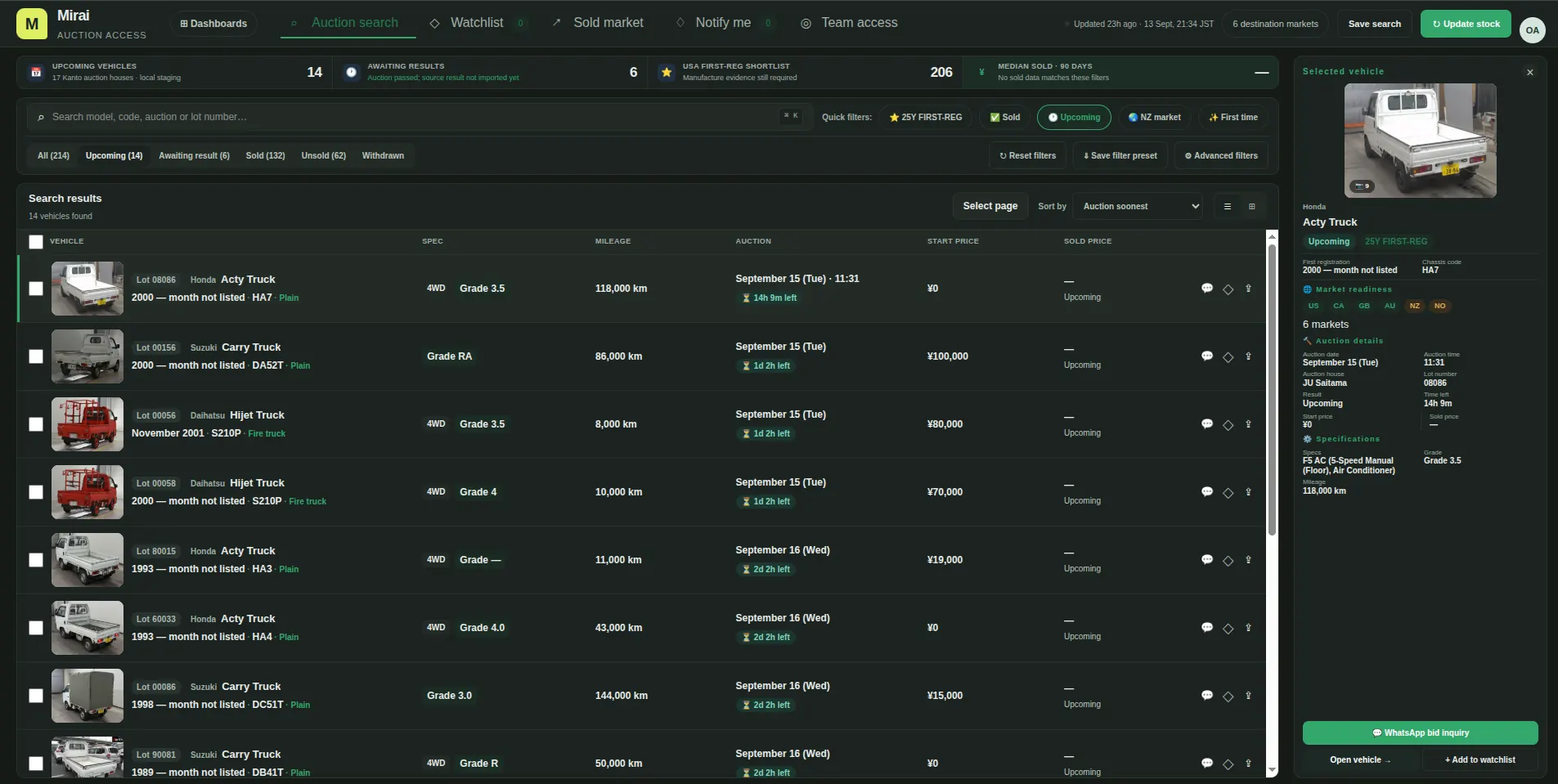
Actual Mirai Auction Portal interface example supplied by Mirai. The visible kei-truck results demonstrate filters, watchlists, auction timing, market-readiness tags and vehicle detail workflow; they are not current Honda Beat inventory.
Candidate-to-export workflow
Keep one reviewable evidence chain from portal filter to U.S. handoff.
Build the portal brief
Set the model, engine, body, age boundary, condition, modification tolerance, budget and destination state.
Resolve expensive unknowns
Use chassis-specific photos, mechanical tests, cold start, road behavior, underbody review and document comparison.
Prepare the handoff
Align the export certificate and translation, ownership, invoice, shipping papers, federal declarations and destination-state file.
Honda Beat frequently asked questions
Direct answers for U.S. buyers evaluating this vehicle family.
What engine does the Honda Beat use?
The factory Beat uses the E07A, a naturally aspirated 656 cc water-cooled inline-three with SOHC 12-valve construction and Honda’s MTREC induction system.
Was the Honda Beat turbocharged from the factory?
No. Honda’s factory factbook describes the Beat as naturally aspirated. A turbocharged candidate is modified and needs its hardware, tuning and EPA route reviewed.
How much power did the Honda Beat make?
Honda’s May 1991 reference lists 64 PS at 8,100 rpm and 6.1 kg-m at 7,000 rpm. That does not prove the present output of an individual car.
Is every Honda Beat now over 25 years old?
Yes. Honda’s current archive dates the model from May 1991 through 1996, so all original production years exceed 25 years in September 2026.
What should I check first on a Honda Beat?
Start with PP1/E07A identity, water entry and sill structure, then check timing service, cooling stability, ECU and distributor behavior, gearbox synchros and modifications.
Why should the Beat ECU be inspected?
Age-related board damage and prior repairs can cause difficult starts or unstable running. Inspect the board and connectors, then test cold and hot behavior rather than relying on a clean exterior.
Where does a Honda Beat rust or trap water?
Inspect roof drains and seals, floors, double-structure sills, jacking points, rear arches and repaired seams. Lift trim where practical and water-test the roof.
How do I test a Honda Beat cooling system?
Pressure-test it, verify fans and heater output, inspect radiator, hoses, underbody pipes and bleed points, then monitor temperature from cold start through road load and hot restart.
Does federal age eligibility guarantee a state title?
No. The destination state separately controls title, VIN inspection, emissions, equipment, registration and insurance.
Can a Honda Beat be registered in California?
Federal age alone does not establish California registration. Review the exact direct-import and emissions path early under the current state process.
Can an engine-swapped Beat use the EPA over-21 provision?
Generally no. EPA ties that provision to the same engine model and configuration originally installed, so a swap needs route-specific review.
How can I search Honda Beat cars in Mirai’s Auction Portal?
Ask Mirai on WhatsApp for exclusive customer access. The portal covers major auctions across Japan and can filter PP1 candidates by age, mileage, condition, modifications, documents and U.S. destination brief.
Primary sources and verification method
Official manufacturer and government pages were checked against their current live editions on the research date.
- Honda, Beat sold-car archive — current sold-car archive accessed 2026-09-14. Used for May 1991–1996 production range.
- Honda, Beat 1991 specifications — May 1991 factbook; current archive edition accessed 2026-09-14. Used for PP1, E07A, dimensions, weight, output, transmission, tires and suspension.
- Honda, Beat MTREC engine factbook — May 1991 factbook; current archive edition accessed 2026-09-14. Used for naturally aspirated 656 cc MTREC design.
- Honda, Beat engine and transmission factbook — May 1991 factbook; current archive edition accessed 2026-09-14. Used for individual-throttle control and cable-operated five-speed.
- Honda, Beat midship layout factbook — May 1991 factbook; current archive edition accessed 2026-09-14. Used for mid-engine cooling and component-layout context.
- Honda, Beat soft-top factbook — May 1991 factbook; current archive edition accessed 2026-09-14. Used for manual soft top and removable rear window.
- Honda, Beat open-body factbook — May 1991 factbook; current archive edition accessed 2026-09-14. Used for open monocoque and double-structure sill design.
- NHTSA, Importation and Certification FAQs — current page accessed 2026-09-14. Used for 25-year FMVSS exemption, HS-7 Box 1 and manufacture-date evidence.
- EPA, Learn About Importing Vehicles and Engines — page last updated 2026-09-01; accessed 2026-09-14. Used for over-21 provision and original engine-configuration condition.
- U.S. Customs and Border Protection, How to Import Your Automobile — Article 000001340, published 2026-02-13; accessed 2026-09-14. Used for entry process and federal declaration references.
- USA.gov, State Motor Vehicle Services — current 50-state and DC directory accessed 2026-09-14. Used for official destination-state agency handoff.
- California DMV, Register an Imported Vehicle — current page accessed 2026-09-14. Used for California direct-import registration and emissions warning.
How this guide was checked
Honda sources support model dates and factory references. Federal sources support the age, engine and entry framework; state planning routes readers to the current agency. Candidate condition and approval are kept separate from reference specifications.
Open a filtered PP1 E07A kei sports roadster search
Tell Mirai the vehicle, engine, body, condition, budget and U.S. state. We can prepare exclusive Auction Portal access and an inspection brief around those priorities.