
Kei truck tariff refunds: how to claim duty paid between August 2025 and February 2026
Kei truck tariff refunds depend on what your CBP entry actually charged. An August 2025–February 2026 entry may qualify for repayment of an IEEPA tariff, but ordinary truck duty and unrelated costs are not automatically refundable. Start with the entry summary, then use the current CBP route for the specific line.
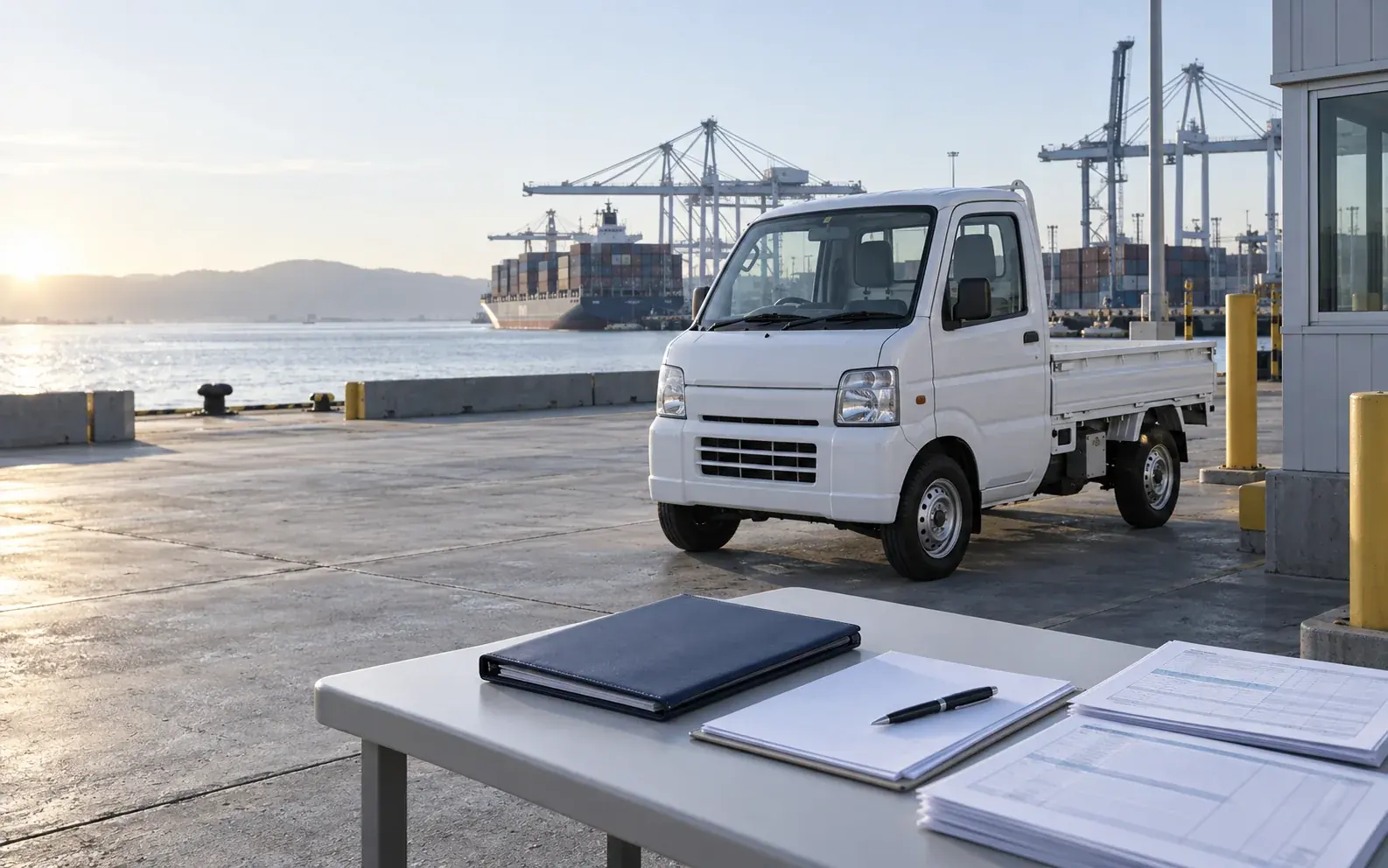
Identify Chapter 87 and Chapter 99 duty lines.
Only the importer or filing broker can submit CAPE.
Liquidation and reconciliation affect the route.
Submit eligible IEEPA entry numbers securely.
Kei truck tariff refunds: the direct answer
The paid tariff line, not the purchase date or the phrase “25% duty,” decides whether CAPE applies.
If your U.S. entry summary shows IEEPA duties actually paid, the importer of record or the broker that filed the entry can seek a refund through CBP’s Consolidated Administration and Processing of Entries (CAPE) tool in the ACE Secure Data Portal, subject to the entry’s status and current CBP eligibility rules. CBP launched CAPE on April 20, 2026 after the Supreme Court’s February 20, 2026 IEEPA tariff ruling. CBP CSMS 68340863, April 13, 2026; CBP CSMS 67823350, February 20, 2026.
The title’s August 2025–February 2026 period is a review window, not a promise of repayment. The August 7 start comes from the U.S.–Japan agreement’s retroactive entry date; the February endpoint is associated with the 2026 IEEPA tariff decision and cessation. A truck may have paid only its ordinary classification duty, a zero-rate Chapter 99 code, or a charge unrelated to IEEPA. Each produces a different answer.
Do not treat the entire customs invoice as a refund
Ask for the entry’s CBP Form 7501 or ACE line detail. If no positive IEEPA amount was paid, a CAPE refund is not established merely because the importer paid duty during this window. Do not upload a buyer’s bank details to a third-party “tariff recovery” site; CBP directs claims through verified ACE accounts.
Which kei-truck charges may be refundable?
Separate the legal basis of each line before estimating a claim.
| Entry charge | What it means | Use in this claim |
|---|---|---|
| Chapter 1–97 / Column 1 duty | Ordinary duty tied to the truck’s actual HTS classification. Cargo trucks are often in heading 8704; the line must be verified on the 7501. | Not an IEEPA refund through CAPE. |
| IEEPA Chapter 99 additional duty | A positive duty amount under an applicable IEEPA tariff line on the historical entry. | Potential CAPE review, subject to entry status and validation. |
| Section 232 automobile line | Separate trade-remedy treatment. CBP’s April 2025 guidance listed a zero additional rate for covered vehicles manufactured at least 25 years before the year of entry. | Do not assume CAPE covers it. Check whether the charge was actually assessed and whether a separate correction is warranted. |
| Section 122 line from February 24 | A later legal program distinct from IEEPA. CBP’s February 2026 guidance also listed a light-truck exemption. | Not an IEEPA refund. Have the broker examine any positive charge against the applicable exemption. |
| Brokerage, ocean freight, state tax | Commercial or domestic charges outside the IEEPA entry line. | Not recovered by CAPE. |
The distinction matters most for a conventional cargo mini pickup. CBP’s September 2025 Japan-agreement guidance (CSMS 66242844) said a Japan-origin product with a Column 1 rate of 15% or more had zero additional reciprocal tariff under 9903.02.72. It separately gave a zero additional Section 232 rate under 9903.94.40 for covered Japanese automobiles whose Column 1 rate was at least 15%. CBP’s earlier April 2, 2025 automobile notice (CSMS 64624801) also identified a 25-year-old vehicle exception to the additional Section 232 automobile duty. Those zero additional rates do not cancel ordinary classification duty.
That makes a “25% kei-truck tariff refund” claim especially easy to misunderstand. If the broker’s 7501 shows the 25% as Chapter 87 Column 1 duty and no positive IEEPA charge, the IEEPA judgment does not make the entire 25% repayable. If the historical entry shows IEEPA was deposited in error or under an earlier code, have the filer reconcile the entry’s actual lines and prior corrections. CBP recalculates an accepted CAPE entry after removing applicable IEEPA lines rather than paying a simple advertised percentage. CBP CSMS 68340863, April 2026.
For entries dated February 24–28, 2026, CBP said specified IEEPA collection had ended, while a distinct Section 122 program began. Its February 23, 2026 Section 122 instruction (CSMS 67844987) listed passenger vehicles and light trucks among the exemptions. Classification and the actual entry date remain decisive.
Why the August 2025–February 2026 dates matter
There are related but distinct government actions in this period.
August 7, 2025
CBP applied the 2025 U.S.–Japan framework retroactively to qualifying Japan-origin entries from this date. It later issued specific correction guidance for the new Japan tariff codes.
September 16, 2025
Japan-specific codes 9903.02.72 and 9903.02.73 became available in ACE; the prior Japan code 9903.02.30 stopped being used for new entries. Historic filings may need review.
February 20–24, 2026
The Supreme Court decided that IEEPA did not authorize the tariffs; CBP then stopped collecting specified IEEPA duties. The exact entry date still governs a historical claim.
April 20, 2026
CBP opened CAPE Phase 1 for specified unliquidated entries and entries within 80 days after liquidation.
June 29, 2026
CBP added eligible entries flagged for reconciliation when no type 09 reconciliation entry was yet on file.
October 6, 2026
CBP scheduled Phase 3 for finally liquidated entries of plaintiffs covered by court reliquidation orders. It is not a general older-entry filing lane.
The September 2025 Japan guidance told filers how to correct retroactive Japan-rate entries: a post-summary correction for eligible unliquidated entries, or a protest for liquidated entries. That was the route for that historical rate correction. CBP’s later April 2026 CAPE instruction says a PSC cannot initiate an IEEPA refund. Have the filing broker distinguish any classification or rate correction from the CAPE claim and complete separate corrections before CAPE is accepted.
For finally liquidated entries, CBP’s September 15, 2026 declaration in Freestyle World, Court No. 26-01088, Doc. 50 scheduled October 6 Phase 3 access for plaintiffs whose entries are covered by a court reliquidation order. Plaintiffs who supplied a valid IOR number by July 30 were expected to be able to file then; later submissions require further CBP instructions. A non-plaintiff with an older entry should not assume this phase applies.
How to claim a possible IEEPA refund: the filing checklist
Work from the customs entry rather than a seller invoice.
Obtain the entry file
Request CBP Form 7501, complete entry number, ACE line detail, proof of duty deposit, and any prior PSC, protest, drawback, or refund record from the filing broker.
Confirm the legal line
Identify the Chapter 1–97 classification, every Chapter 99 code, the paid amount by line, Japan origin, and whether the charge was IEEPA. A zero-rate code alone is not a paid refund.
Check authority to file
Read the importer-of-record field. The named importer or the broker that filed that entry can submit CAPE. If you purchased after import, ask the seller what the contract says about any refund.
Check liquidation now
Get the liquidation date and status. CAPE’s published rule covered certain unliquidated entries and certain entries within 80 days of liquidation. Older, protested, warehouse, drawback, or reconciliation cases need special review.
Submit through verified ACE
For an eligible entry, the IOR or filing broker uploads a CSV of complete entry numbers in ACE’s CAPE tab. CBP permits up to 9,999 entry numbers per declaration and reports rejections for correction.
Set up and track payment
Enroll the IOR or valid Form 4811 payee for ACH refunds. Retain the CAPE claim number, monitor ACE’s REV-615 report, and match any consolidated payment to the entry-level recalculation.
Act promptly on older or liquidated entries
Current CAPE phases exclude most entries more than 80 days past liquidation. CBP scheduled October 6 Phase 3 for plaintiffs covered by a court reliquidation order; it did not announce general access for older entries. Federal protest law generally gives 180 days from liquidation for a protestable CBP decision, but that is a distinct route and does not mean CAPE will accept the entry. A customs attorney should assess the current court orders and any deadline before it expires. 19 U.S.C. §1514(c)(3), current text; CBP court declaration, September 15, 2026.
Documents to assemble for the broker
Send enough to identify the entry and the right claimant, without posting private records in public forms.
- CBP 7501 / ACE summary: entry number, date, importer of record, Chapter 87 and Chapter 99 tariff lines, deposited amounts.
- Vehicle identity: Japanese export certificate, chassis number, auction or purchase record, bill of lading, and delivery record.
- Entry history: release date, liquidation date/status, prior corrections, protests, reconciliations, drawbacks, surety payments, and other refunds.
- Claim authority: broker name and account, IOR information, any valid CBP Form 4811 payee designation, ACH enrollment.
- Buyer contract: if the current owner was not the IOR, check who bears and receives customs charges or later repayments.
CBP cautions that the verified ACE Portal is the proper place to submit an IEEPA refund declaration. Its May 7, 2026 anti-fraud bulletin warns importers against sharing company, personal, or bank information with unknown recovery agents. Mirai can help retrieve the Japan-side records it holds, while the U.S. filing broker supplies the official entry record. CBP CSMS 68569567, May 7, 2026.
Entry refund triage
Choose what the 7501 and ACE history actually show. This tool suggests the next document or filing contact; it does not calculate a refund or determine legal entitlement.
No entry number or personal information is collected by this page. The WhatsApp draft contains only your selections.
Plan the next purchase with cleaner import records
Better documentation at sourcing time makes tariff, title, and insurance review easier later.
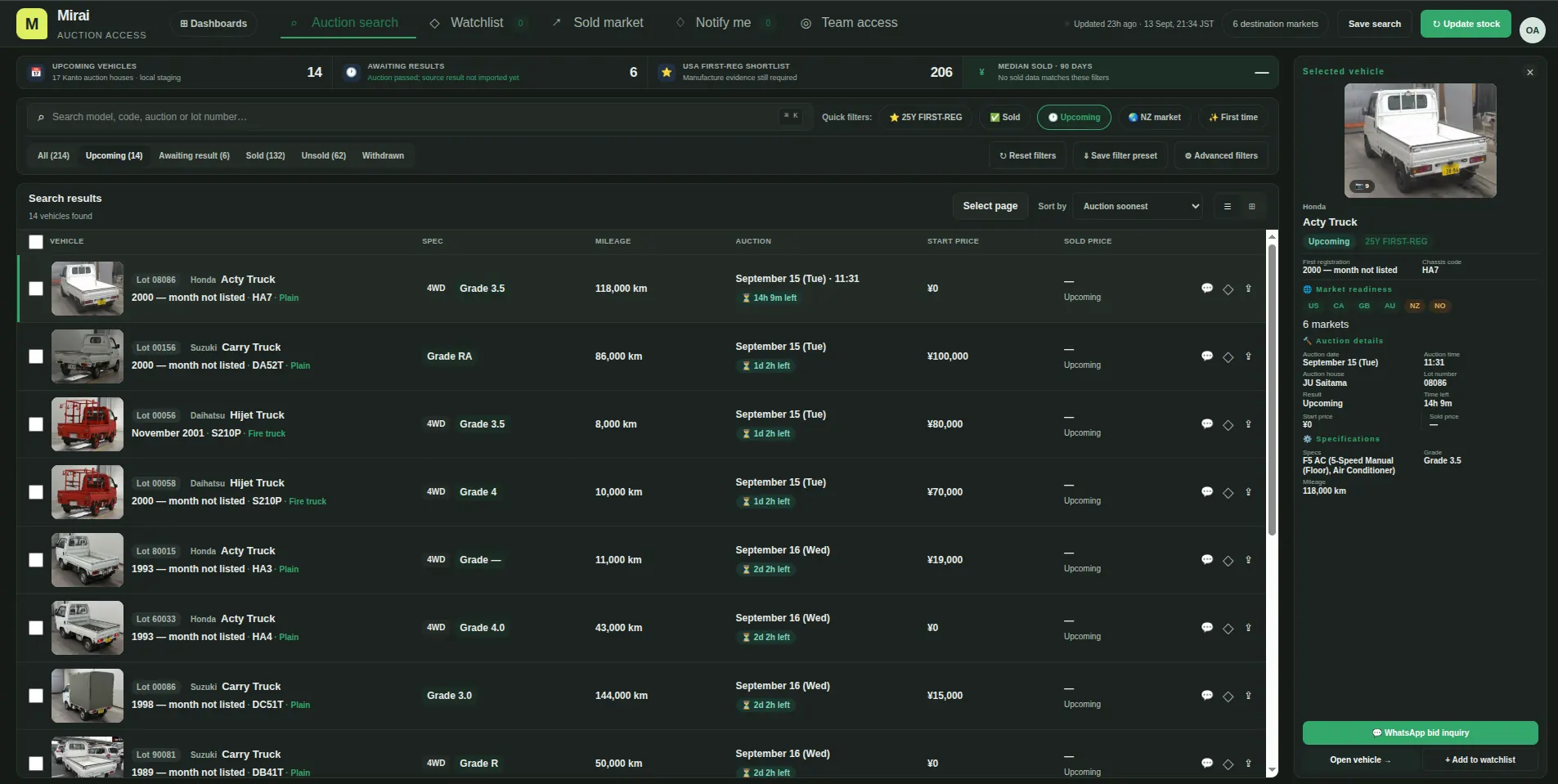
Mirai’s customer-exclusive Auction Portal brings search access across major Japanese auctions into one filtered workflow for U.S. buyers. Customers can narrow kei-truck candidates by model, year, chassis details, grade, mileage, and auction status, then request a review of export and U.S.-readiness documents for a specific vehicle. The portal is a sourcing platform, not a public list of Mirai-owned stock or a promise about a future customs rate.
If a prior truck is under refund review, keep that claim tied to its own CBP entry. For the next truck, ask the import broker to show the planned HTS treatment and the name that will appear as importer of record before shipment. Mirai can connect the auction, export, and transport records to that file. Mirai’s USA kei truck import guide explains the federal entry steps.
Kei-truck tariff refund FAQs
Answers for the specific U.S. customs entry, not a blanket promise for all 2025–26 imports.
Can I get back every duty charge paid on a kei truck between August 2025 and February 2026?
No. The refund path concerns eligible IEEPA tariff amounts shown on the entry, not every customs duty, fee, shipping charge, or state tax. Check the CBP entry summary line by line.
Does the normal 25% light-truck duty qualify for an IEEPA refund?
No. A Chapter 87 Column 1 duty is a different legal charge. CBP’s CAPE tool removes applicable IEEPA Chapter 99 lines, then recalculates the entry; it does not erase ordinary truck duty.
Did Japan’s August 7, 2025 tariff change automatically create a kei-truck refund?
No. CBP’s September 2025 guidance made the Japan treatment retroactive to entries from August 7, but a Japan-origin product with a Column 1 rate of at least 15% had zero additional reciprocal duty. The actual classification and paid lines control.
Are 25-year-old kei trucks exempt from all import duty?
No. CBP listed a zero additional Section 232 automobile rate for qualifying 25-year-old vehicles; that is not a waiver of ordinary Column 1 duty or every other charge.
Who can file a CAPE declaration?
The importer of record named on the entry, or the customs broker that filed that entry, can submit it through a verified ACE Portal account. A retail buyer who merely reimbursed someone else is not automatically the filer.
Can I claim an IEEPA refund with a post-summary correction?
No. CBP’s April 2026 CAPE guidance says a PSC cannot initiate an IEEPA refund request. Correct any separate entry issue with your broker before an accepted CAPE declaration blocks later PSC filing.
What if my entry has already liquidated?
Check the liquidation date immediately. Current CAPE phases cover eligible entries within 80 days of liquidation. CBP scheduled Phase 3 for October 6, 2026, for finally liquidated entries of plaintiffs with a court reliquidation order; other older entries need prompt customs-counsel review.
Does a 180-day protest period mean I can wait to file CAPE?
No. The statutory protest window and CAPE’s published 80-day acceptance rule are different. A live deadline or final liquidation calls for a customs attorney’s review, not a calendar guess.
What if the entry is flagged for reconciliation?
CAPE’s June 29, 2026 expansion accepts eligible types 01, 02, and 06 flagged for reconciliation only when the type 09 reconciliation entry is not yet on file. Have the broker check filing order and any approaching reconciliation deadline.
Will the refund be paid to the truck’s current owner?
Generally no. CBP consolidates eligible refunds for the importer of record or a valid designated Form 4811 party. Any pass-through to a later buyer depends on the sale contract and the parties’ arrangements.
How long does CBP take to pay an accepted claim?
For ordinary unliquidated entries that are not warehouse, suspended, extended, or under review, CBP stated a general 60–90-day expectation after CAPE acceptance. An accepted filing is not a guaranteed payment date or amount.
Can Mirai submit my CBP refund claim?
No. Mirai can help locate the vehicle, export, and transaction records it holds. The importer of record or the broker that filed the U.S. entry controls CAPE submission; a U.S. customs professional should review disputed entries.
Primary sources and editorial method
Verified September 28, 2026. Dated CBP bulletins and the court-filed declaration are identified by version and date; live statutory and HTS pages should be checked again before filing.
- CBP CSMS 67823350, Supreme Court IEEPA judgment, February 20, 2026; CBP CSMS 67834313, ending IEEPA collection effective February 24, 2026.
- CBP CSMS 68340863, CAPE deployment and filing rules, April 13, 2026; CAMS 68397554, CAPE available, April 20, 2026.
- CBP CSMS 69035485, reconciliation-flagged entries, June 23, 2026 (effective June 29); CBP CSMS 69127837, warehouse entries, July 2, 2026 (effective July 7).
- Declaration of Brandon Lord, Freestyle World, Court No. 26-01088, Document 50, filed September 15, 2026 (court filing copy hosted by AAEI).
- CBP CSMS 66242844, updated U.S.–Japan implementation, September 2025; CBP CSMS 66146676, interim retroactivity notice, September 5, 2025.
- CBP CSMS 64624801, Section 232 automobile duties and 25-year exception, April 2, 2025; CBP CSMS 67844987, Section 122 surcharge and light-truck exemption, February 23, 2026; USITC historical 2025/2026 HTS releases and 2026 HTS Revision 19, September 15, 2026.
- 19 U.S.C. §1514, current preliminary code text as of September 2026.
- CBP CSMS 67513690, electronic refunds and ACH, February 2026; CBP CSMS 68569567, IEEPA refund fraud precautions, May 7, 2026.
- CBP, live IEEPA Duty Refunds page for the latest CAPE instructions and quick reference guide.
How this article was checked
We separated ordinary tariff classification, Section 232, Section 122, Japan-agreement adjustments, and IEEPA line refunds using CBP’s dated guidance. No fixed recovery estimate is given because CBP recalculates each accepted entry and eligibility depends on its actual line items, importer, payment, and liquidation history. This is general import information; a filing broker or U.S. customs attorney should handle a disputed or deadline-sensitive claim.
Need the Japan-side file for your kei truck?
Tell Mirai your model and chassis number, and ask which auction, export, and shipping records we hold. For CAPE, send your U.S. entry number only to your verified filing broker or ACE account.