
Kei Truck Towing Capacity: Can a Kei Truck Tow a Trailer?
Kei truck towing capacity is not 770 lb. That frequently quoted figure is the Japanese mini truck’s maximum cargo load, not a manufacturer trailer rating. For most older Acty, Carry, Hijet, Sambar and Minicab trucks, no universal factory trailer-weight rating is published—so towing capacity must not be guessed from payload, engine size or an aftermarket hitch.
There is no published factory trailer rating for these trucks. The closest official reference is Japan’s own registration calculation, which caps a trailer without its own brakes at half the truck’s curb weight: about 350–395 kg (770–870 lb) gross for typical kei trucks, and often less. Beyond a light trailer, don’t guess—get a written rating for your exact chassis or use a properly rated vehicle instead. Use the calculator below only to sanity-check the hardware limits you already have in writing.
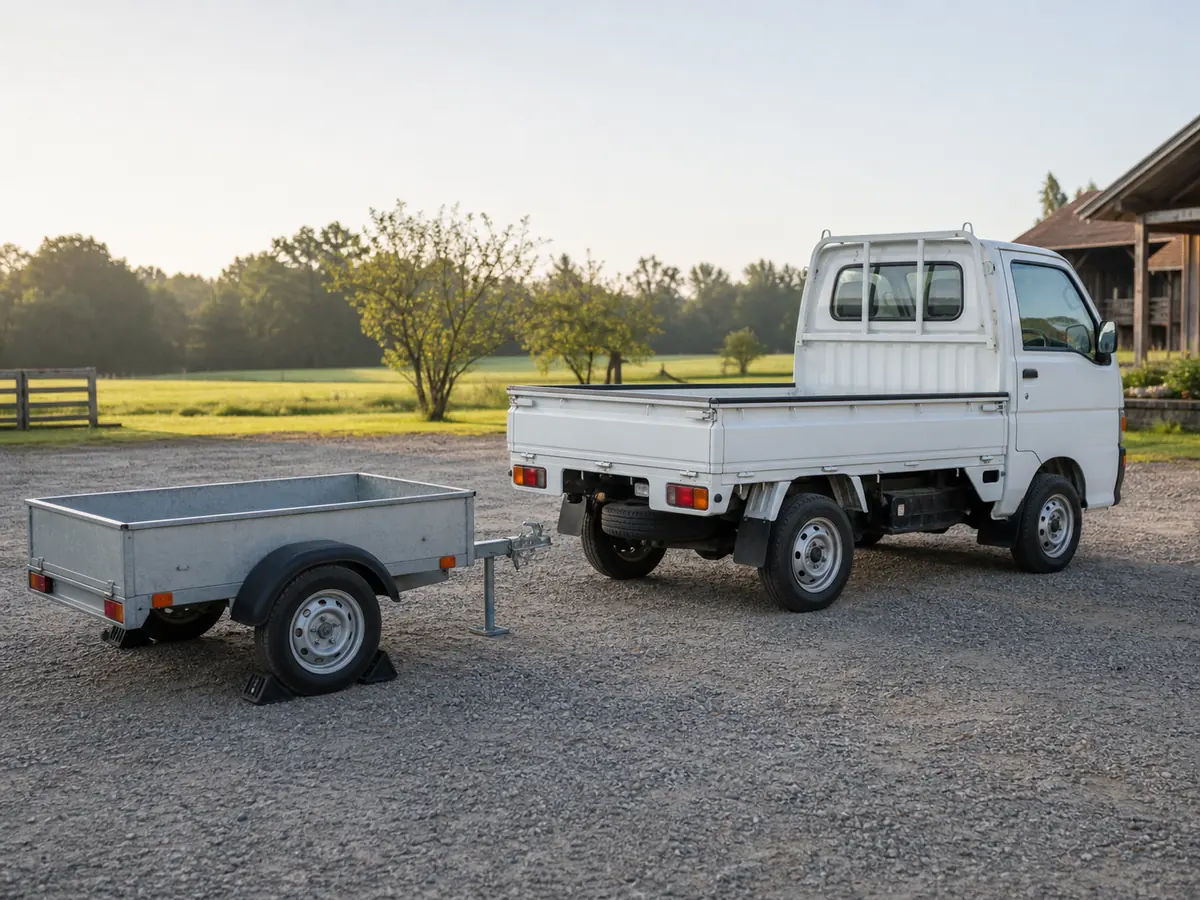
Common official kei-truck specification. It is payload—not trailer towing capacity.
Use only written manufacturer data for the exact chassis and configuration.
Vehicle, attachment, hitch, ball, trailer, tires, brakes and axles all matter.
1 The Honest Kei Truck Towing-Capacity Answer
Moving a trailer is a demonstration of traction. A towing rating is an engineering limit for acceleration, braking, stability, thermal load and structure.
Official Honda, Suzuki, Daihatsu and Subaru specification sheets consistently list a maximum cargo load of 350 kg (about 772 lb) for the Acty, Carry, Hijet and Sambar—and none of them convert that figure into a gross trailer weight rating. NHTSA confirms manufacturers are not federally required to disclose towing capability, and SAE J2807 exists precisely because a defensible tow rating requires controlled performance testing, not a horsepower guess.
Most kei trucks imported into the U.S. are at least 25 years old, and decades of work use, rust, repaired frames, worn brakes and nonstandard tires can reduce real capability well below anything a spec sheet ever implied. A number copied from another generation or a hitch advertisement cannot account for any of that.
No written rating means no verified road-towing capacity
This guide will not invent a “safe” 500, 1,000 or 1,500 lb number. Ask the original manufacturer or a qualified automotive engineer for documentation tied to the exact chassis, drivetrain, attachment design and intended trailer. Otherwise, use a properly rated tow vehicle for public-road trailer work.
Japan’s registration method gives a conservative ceiling
Japan does not publish a tow rating for kei trucks either, but it does publish how one is calculated. When a towing vehicle is registered for a trailer, inspection offices use the transport ministry’s trailer weight calculation sheet. For a trailer without its own brakes, the allowed gross trailer weight is the lowest of several parking-brake, engine-power, drive-axle and braking checks, and it may never exceed 750 kg or half the towing vehicle’s curb weight. For a kei truck, the half-curb-weight cap is the one that bites.
| Example truck | Curb weight | Ceiling for a trailer without brakes (trailer plus load) |
|---|---|---|
| Suzuki Carry 2WD, 5-speed manual (current specification) | 740 kg (1,630 lb) | 370 kg (about 815 lb) |
| Suzuki Carry 4WD, 4-speed automatic (current specification) | 790 kg (1,740 lb) | 395 kg (about 870 lb) |
| An older truck weighing 700 kg | 700 kg (1,545 lb) | 350 kg (about 770 lb) |
That is a ceiling, not an approval. The braking check can produce a lower figure, and the result belongs to one registered vehicle in Japan; it is not a U.S. rating. A trailer with its own brakes is calculated differently, with a 1,990 kg cap, but the truck’s other checks still apply. The 1,000–1,760 lb figures often quoted online sit above the ceiling for an unbraked trailer.
2 Payload, Towing Capacity and Tongue Weight Are Different
Most incorrect answers start by swapping one of these terms for another.
Maximum cargo load
The load carried by the truck. Japanese kei-truck sheets commonly show 350 kg. Occupant treatment and gross-weight math must be read from the exact specification, not assumed from U.S. labeling conventions.
Trailer weight rating (TWR)
The maximum loaded trailer weight the tow-vehicle manufacturer authorizes for a specific configuration. It includes the empty trailer, cargo, water, batteries and installed equipment.
Tongue weight
The downward load the coupled trailer places on the hitch. It loads the truck’s rear structure and axle and consumes gross-vehicle capacity even though most trailer weight remains on the trailer axle.
GVWR and GAWR
Gross Vehicle Weight Rating and Gross Axle Weight Ratings limit the loaded truck and each axle. A trailer can be below an alleged tow number while its tongue overloads the rear axle.
GCWR
Gross Combination Weight Rating covers the loaded truck plus loaded trailer. Without a published GCWR or engineering basis, subtracting curb weight to invent a tow rating is not valid.
Hitch or receiver rating
The component maker’s limit for that hardware under its specified installation. It does not certify the kei truck’s frame, brakes, powertrain, stability or attachment points.
Why 350 kg is not a trailer formula
A 350 kg box in the bed is supported close to the truck’s axles. A trailer applies leverage behind the rear axle, adds yaw and sway forces, pushes during braking, increases cooling and clutch load, and changes combination stability. Equal scale weights do not create equal stresses.
3 Popular Kei Truck Models: What the Sources Actually Show
Model badges cover many generations and drivetrains. Verify the chassis code and original manual.
| Model family | Common U.S.-eligible chassis examples | Published cargo load | Factory trailer rating found? | Practical conclusion |
|---|---|---|---|---|
| Honda Acty Truck | HA3/HA4; early HA6/HA7 | 350 kg in official Honda specifications | No universal TWR located | Do not convert the 350 kg bed-load figure into a tow rating. Check the exact Japanese manual and Honda documentation. |
| Suzuki Carry | DC51T/DD51T; DA52T | 350 kg in official Suzuki Carry material | No universal TWR located | Transmission, final drive, 2WD/4WD and farm equipment vary. A receiver listing is not Suzuki approval. |
| Daihatsu Hijet Truck | S100P/S110P; S200P/S210P | 350 kg class load; verify period sheet | No universal TWR located | Daihatsu’s current truck manual warns that the vehicle has no ability to tow another vehicle; recovery instructions are not trailer ratings. |
| Subaru Sambar Truck | KS3/KS4; early TT1/TT2 | 350 kg class load; verify period sheet | No universal TWR located | Rear-engine layout and supercharged variants do not create a rating. Subaru describes its rear recovery hook for a disabled or stuck truck. |
| Mitsubishi Minicab | U41T/U42T; early U61T/U62T | Kei commercial specification; verify exact plate/manual | Chassis-specific research required | Do not borrow Acty, Carry or Hijet numbers. Obtain Mitsubishi documentation for the exact build. |
“No universal TWR located” means the official sources reviewed did not supply a trailer rating that can responsibly be generalized to that whole imported family. It is not proof that no obscure market/trim document exists; the burden is to produce applicable written evidence before towing.
Age eligibility is not towing approval
NHTSA’s 25-year import exemption addresses federal safety-standard conformity at entry. It does not create a towing rating, approve a hitch installation or override state registration and trailer laws. See Mirai Trading’s guide to import a kei truck from Japan for the federal side of that process.
4 Kei Truck Trailer Weight Screener
This calculator checks only the numbers you enter. A factory tow rating is optional—it still screens using hitch, ball and GVWR limits without one.
Screening result
A green result means only that the entered arithmetic is not over. It does not certify brakes, frame attachment, axle load, stability, condition or legality.
Enter your hardware limits and scale weights
A written vehicle TWR is optional—the screener uses hitch, ball and GVWR limits if one isn’t on file.
The governing limit is the lowest valid rating in the complete system. You must also verify GCWR, front/rear axle weights, tire loads, trailer GVWR, brakes, lights, chains/breakaway equipment and local law.
Calculator formula
System trailer ceiling = the lowest of the entered vehicle TWR (if documented), engineered hitch/attachment limit and ball/coupler limit. Estimated tongue load = loaded trailer weight × entered percentage. Truck GVWR margin = GVWR − ready-to-tow scale weight − tongue load. A real scale check of the coupled front axle, rear axle, truck and trailer is still required.
5 The Lowest-Rated Part Controls the System
A strong-looking receiver cannot repair an unrated vehicle or weak attachment.
Recovery hooks are not trailer hitches. Subaru describes the Sambar’s rear towing hook as equipment for a vehicle stuck in mud or snow, and Daihatsu’s current Hijet manual states plainly that the truck has no ability to tow another vehicle in its emergency-recovery section. Neither concerns continuous tongue load, highway sway or trailer braking.
A hitch rating is not a vehicle rating. A receiver or ball label only certifies that component under its specified installation—it says nothing about frame geometry, corrosion, fastener grade or rear overhang. Low gearing can start a load on flat ground, but stopping distance, brake fade, crosswind stability and cooling reserve govern long before the engine runs out of pull.
Do not use the tie-down or recovery eye as a safety-chain anchor
Safety chains need independent, purpose-designed attachment points sized for the trailer system and installed under applicable instructions and state law. A chain looped around a bumper, tow eye or hitch ball does not establish a compliant secondary connection.
6 What Can a Kei Truck Tow?
The honest answer is use-specific and still starts with a written rating.
Small yard cart
Low-speed movement on flat private property may be possible with owner permission and engineered attachment. Keep people off the cart and do not infer public-road approval.
Empty 4×8 utility trailer
“Empty” can still be several hundred pounds, and the trailer needs lawful coupling, lights, chains and registration. Weight alone does not supply a vehicle rating.
Loaded landscape trailer
Soil, gravel, firewood and equipment become heavy quickly and shift dynamically. Use a vehicle with a published tow/combination rating and adequate brakes.
Boat or personal watercraft
Ramp grade, wet traction, tongue weight, corrosion and stopping load add risk. A light-looking hull can hide substantial trailer, fuel and equipment weight.
Teardrop camper
Large frontal area and crosswind leverage matter even when scale weight seems low. Highway travel demands stability and thermal reserve not proven by payload.
Another vehicle
A recovery hook is not approval to flat-tow a car or pull a disabled vehicle on public roads. Use professional recovery or a properly rated transport setup.
Private property changes access law—not physics
A farm, nursery, campus or closed industrial site may lawfully permit specialized low-speed use, but the property owner and employer still need a safe system, appropriate training, insurance and operating rules. Never carry a passenger in a utility trailer.
7 Which Kei Truck Fits a Real Payload or Light-Duty Job
If the job is moving real weight, the honest answer is usually payload—not an unrated tow setup.
Most buyers chasing a “kei truck towing capacity” number actually need to move a fixed amount of weight from one place to another, and the kei truck’s own 350 kg (770 lb) bed payload—not a trailer—is often the simpler, better-documented way to do it. A well-maintained 4WD Carry, Hijet or Acty with a sound frame, working brakes and a dump bed can handle real payload work without any of the hitch-engineering, GCWR or legal questions this guide raises.
The deciding factors are drivetrain, condition and configuration, not badge. A 4WD truck with low-range gearing and a factory dump bed handles farm and yard work that would otherwise tempt an unrated trailer. Mirai Trading can help you browse current kei truck inventory by drivetrain and bed configuration, and check kei truck auction prices to budget realistically before bidding on a chassis suited to the actual job rather than a hoped-for tow rating.
8 Trailer Setup and Pre-Trip Safety
Complete these checks only after vehicle-specific towing authorization exists.
Ratings and scale tickets
- Exact tow-vehicle TWR, GCWR, GVWR and both GAWR values
- Engineered hitch/attachment, drawbar and tongue limits
- Trailer GVWR, GAWR and coupled axle weights measured on a scale
- Insurance confirms the truck, hitch and intended trailer use
Connection and condition
- Coupler fully seated, latched, secured, and ball/coupler diameter matched
- Crossed safety chains on independent attachment points
- Breakaway device and trailer brakes where required
- Tail, stop, turn, marker and license-plate lights working
Kei truck mechanical inspection
- Frame rails and mounting area free of structural corrosion
- Service and parking brakes tested; fluid and hoses current
- Cooling system pressure-tested and fan operation verified
- Clutch, transmission, driveline and wheel bearings sound
Route and driving plan
- Trailer registration, brake, chain, mirror and speed laws checked
- Low-speed private test before any authorized road operation
- Longer stopping distance and wide turns planned; avoid steep grades and strong crosswind exposure
- Stop immediately for sway, overheating, odor, noise or instability
Trailer brakes do not increase an unrated truck’s capacity
Brakes can help the trailer control its own mass where properly installed and adjusted. They do not validate the kei truck’s frame, hitch attachment, GCWR, cooling, tires or stability, and they do not replace a published vehicle rating.
9 Towing a Kei Truck Is Different From Towing With One
Search results often mix these opposite tasks.
| Task | What it means | Recommended approach |
|---|---|---|
| Kei truck towing a trailer | The kei truck is the powered tow vehicle and must have applicable vehicle, hitch, combination and legal ratings. | Do not proceed without written authorization and complete weight/condition checks. |
| Transporting a kei truck on a trailer | A larger rated tow vehicle pulls a trailer carrying the kei truck. | Use actual kei-truck weight plus trailer weight/cargo against the larger vehicle’s TWR, GCWR, payload, axle and hitch ratings. |
| Flat-towing a kei truck | The kei truck rolls on all four wheels behind another vehicle. | Do not assume it is allowed. Transmission/4WD damage and steering/brake requirements are model-specific; use the original manual. |
| Tow dolly | Two kei-truck wheels ride on the dolly while the other axle rolls. | Often unsuitable for 4WD/AWD and some drivetrains. Confirm manufacturer instructions; a flatbed trailer is the conservative choice. |
| Emergency recovery | A disabled or stuck truck is moved a short distance using specified recovery points. | Follow the manual or professional recovery operator. Recovery eyes are not continuous trailer-towing equipment. |
Weigh before choosing the transport trailer
Do not use the kei-truck’s 350 kg cargo number as its vehicle weight. Depending on generation and equipment, the truck itself can weigh roughly 700–900 kg (about 1,540–1,985 lb), and the transport trailer adds substantial weight. Use exact scale tickets and the transport vehicle’s documentation.
10 Buyer and Fabricator Checklist
Resolve the towing question before buying a truck or welding hardware to it. Weighing options against other kei truck capability figures? Check Mirai Trading’s kei truck top speed guide, browse kei truck auction prices to budget the purchase, then find the right kei truck for the job before you commit to hardware.
Ask the exporter or seller
- Exact chassis code, manufacture month/year and drivetrain
- Original Japanese specification sheet and owner manual
- Photos of gross/axle/load plates and rear frame rails
- Any frame repair, rust, collision, dump-bed or bumper modification
- Current tire size, service description and date code
- Whether a hitch was fitted and who engineered the attachment
Ask the hitch professional
- What written vehicle rating supports the intended trailer?
- What load cases and attachment points were engineered?
- What is the rated tongue and gross trailer limit of every part?
- Where are independent safety-chain anchors located?
- How are lights, brakes and breakaway equipment integrated?
- What inspection interval and corrosion checks are required?
Mirai Trading documentation can prevent the wrong purchase
Before bidding, we can help identify chassis, drivetrain, auction condition, visible corrosion and original Japanese specification records. A towing rating or custom hitch approval must still come from the responsible manufacturer or qualified engineering/installation authority.
11 Kei Truck Towing Capacity FAQs
Direct answers to the questions most often confused with payload or recovery.
What is the towing capacity of a kei truck?
No kei truck maker publishes a model-wide trailer rating. The closest official reference is Japan’s registration calculation, which caps a trailer without its own brakes at half the truck’s curb weight: about 350–395 kg (770–870 lb) gross for typical kei trucks. The 350 kg (about 770 lb) maximum cargo load is payload, not towing capacity. Size any trailer plan around your truck’s actual payload plate, axle capacity and a properly engineered hitch, and treat road-trailer capacity as unverified until you have written documentation for your exact chassis.
Can a kei truck tow 1,000 pounds?
Not with a trailer that lacks its own brakes, if you follow Japan’s registration calculation: its ceiling for typical kei trucks is about 770–870 lb gross. Weigh the loaded trailer, confirm your hitch/ball hardware is rated for that load, and check GVWR/axle margin with the calculator above—the truck pulling it on flat ground proves nothing about stopping distance, cooling or stability. No manufacturer publishes a 1,000 lb (or any) trailer rating for these trucks, so treat that number as unverified.
Is the 770 lb kei truck payload also its towing capacity?
Treat payload and towing capacity as two separate numbers. The 350 kg/770 lb figure is cargo carried inside the truck bed; a trailer adds tongue leverage, combination braking and thermal load that the bed-load spec was never designed to cover.
How much does a kei truck weigh?
Roughly 700–900 kg (about 1,540–1,985 lb) empty, depending on generation and equipment. Suzuki’s current Carry, for example, lists 740–790 kg and a gross vehicle weight of 1,200–1,250 kg (December 2025 specifications). Read the exact figure on the truck’s Japanese registration papers.
Can a Honda Acty tow a trailer?
Get documentation for the exact HA-series chassis (HA3/HA4 or early HA6/HA7) and use a professionally engineered hitch before considering any trailer. Honda’s archived specification sheets list a 350 kg cargo load for Acty trucks but no trailer-weight rating for any generation reviewed.
What is the Suzuki Carry towing capacity?
Confirm the exact generation, gearbox and 2WD/4WD setup (DC51T/DD51T or DA52T) before trusting any tow number—Suzuki’s current cargo-capacity page states a 350 kg maximum load and stops there. A seller’s generic figure or aftermarket receiver label is not a Suzuki rating.
What is the Daihatsu Hijet towing capacity?
Check the exact S100P/S110P or S200P/S210P chassis manual before assuming any tow capability—Daihatsu’s current Hijet Truck owner’s manual states plainly that the vehicle has no ability to tow another vehicle outside its emergency-recovery procedure. Cargo load is listed at 350 kg.
What is the Subaru Sambar towing capacity?
Check the KS3/KS4 or TT1/TT2 (including supercharged EN07Y) chassis manual before assuming any tow capability—the rear towing hook is recovery equipment, priced on Subaru’s own accessory page for freeing a truck stuck in mud or snow, not for pulling a trailer. No model-wide trailer rating exists across either generation.
Does a trailer hitch give my kei truck a towing rating?
No—a hitch or receiver rating only certifies that component under its specified installation. It says nothing about your truck’s frame, brakes, axles, cooling or stability, and the vehicle-level TWR/GCWR, where one exists, always governs.
Can I tow a small utility trailer on private property?
Yes, with real precautions—private land removes some road-registration questions but not the physical risk. Use a properly engineered connection, keep speeds low on flat terrain, get the landowner’s permission and appropriate insurance, and never carry passengers in the trailer.
How much tongue weight can a kei truck handle?
Measure your tongue weight on a scale before you tow—most trailers run 10–15% of loaded weight—then compare the number against your hitch and ball ratings, not a percentage guess. Without a written vehicle limit, treat your hitch/ball hardware rating as the ceiling.
Can a kei truck tow a camper or boat?
Use a vehicle with a published tow rating for a camper or boat instead. Campers add crosswind leverage and boats add ramp grade and wet-traction demands that a light advertised trailer weight doesn’t capture, and no kei truck manufacturer publishes a rating that covers either.
Can I flat-tow a kei truck behind an RV?
Check the original owner’s manual before flat-towing any kei truck—it can damage transmissions or 4WD systems and may require supplemental brakes, lighting and steering equipment. A properly rated trailer carrying all four wheels is the conservative choice.
12 Official Sources and Research Method
Manufacturer specifications and first-party safety/standards sources were prioritized over forum anecdotes and hitch-shop claims.
- Honda Acty Truck official specification archive — 350 kg maximum cargo load and vehicle specifications.
- Honda 2009 Acty Truck specifications — period example showing 350 kg maximum cargo load.
- Suzuki Carry official specifications and cargo-capacity page — 350 kg maximum cargo load.
- Suzuki ninth-generation Carry archive — historical specification context for older imports.
- Daihatsu Hijet Truck official specifications — 350 kg maximum cargo load.
- Daihatsu Hijet Truck owner manual — emergency recovery procedure and warning that the vehicle has no ability to tow another vehicle.
- Subaru Sambar Truck official specifications and accessory page — 350 kg cargo load and recovery-hook purpose.
- MLIT Chubu Transport Bureau trailer weight calculation sheet — Japan’s method for the trailer weight a registered towing vehicle may pull: lowest of the calculated checks, never above 750 kg or half the curb weight without trailer brakes, 1,990 kg with them.
- NHTSA interpretation 002247GF — manufacturers are not federally required to establish/disclose towing capability; load questions go to the vehicle manufacturer.
- NHTSA trailer-safety interpretation — ascertain truck/trailer hauling capacity and relate tongue weight to vehicle axle ratings.
- SAE J2807_202411 — performance criteria and methodology for determining GCWR and trailer weight rating.
- NHTSA consumer alert on compliant trailers — certification-label and federal trailer-safety requirements.
- NHTSA: Secure Your Load — cargo restraint and overloading guidance.
- NHTSA Importation and Certification FAQs — 25-year import provision, separate from towing approval.
How the answer was controlled
Mirai Trading searched official manufacturer specification/owner material for payload and towing language, then checked NHTSA and SAE sources for how tow ratings, tongue load and trailer compliance work. Where no exact historical trailer rating was found, the article says “not established” rather than converting payload, horsepower, hitch class or anecdotal success into a capacity. Last verified July 16, 2026.
Two Ways to Move Forward
Need real payload or light-duty capability? Browse current inventory for the right drivetrain and bed. Considering a custom hitch build instead? Talk to us about chassis condition and documentation before you buy—without turning an unsupported towing claim into a sales promise.