
Kei Truck Colorado: Buying Now & the 2028 Road Rules
Planning a kei truck Colorado purchase? The new state registration pathway applies from January 1, 2028. Buyers in 2026 should separate sourcing and property work from future public-road eligibility before committing. Back to all state laws.
The act applies to applications from January 1, 2028.
This earlier date is separate from application timing.
Not a general permission to use every road at that speed.
Limited-access highways remain outside the new allowance.
Kei Truck Colorado: Can You Register One in 2026?
No—not through HB25-1281’s new kei-vehicle pathway. Its application date is January 1, 2028.
Colorado enacted HB25-1281 in May 2025. The signed act’s section 13 separates two dates: it takes effect July 1, 2027, and applies to applications submitted or offenses committed on or after January 1, 2028. Reading only the effective-date summary can leave a buyer planning registration six months too early.
The DMV’s currently posted Rule 3, section 3.2 states that kei vehicles and mini trucks will not be titled or registered on or off highway. The new legislation changes the future framework; it is not evidence that a 2026 application can use that framework now. A Department of Revenue implementation handout also lists January 1, 2028 for HB25-1281.
| Date | What it means for a buyer |
|---|---|
| May 9, 2025 | The governor signed HB25-1281. Signing did not open immediate kei registration. |
| July 1, 2027 | The act takes effect. Do not substitute this date for its later application provision. |
| January 1, 2028 | The act applies to applications submitted and offenses committed from this date. Recheck DMV implementation instructions before applying. |
A seller’s plate does not settle your application
If a truck already has a US title or a seller claims a Colorado exception, ask the DMV to review that exact chassis and its history. This guide does not decide the validity of an existing title. An out-of-state plate, a bill of sale or federal customs release is not a guarantee of Colorado registration.
Which vehicles fit the future Colorado kei definition?
The Colorado kei truck law uses specific criteria. A Japanese kei label or a 660 cc engine alone does not establish eligibility.
Section 2 of the signed act adds the definition in C.R.S. §42-1-102(45.3). Compare all the requirements below with the actual vehicle and its records. These are the future statutory criteria, not a promise that an office has accepted your application.
| Criterion | Future statutory requirement |
|---|---|
| Power unit | Internal-combustion engine of 1,000 cc or less, or an electric motor of 56,000 watts (56 kW) or less. |
| Overall size | No more than 67 inches wide and 140 inches long. |
| Wheels and cabin | Four or more tires in contact with the ground and an enclosed passenger cab. |
| Speed capability | A top speed of at least 50 mph. This is a vehicle criterion, separate from the road’s posted limit. |
| Import status | Imported into the United States. |
| Age and title history | At least 25 years old when imported, or now at least 25 years old and previously issued a title in the United States. |
The age-and-title alternative matters for an already imported truck, but it does not erase federal entry requirements or cure an unlawful import. Have the actual import date, manufacture evidence and title history reviewed together. Do not treat the future state definition as permission to import an underage vehicle today.
The act also creates a separate “kei off-road vehicle” category. That distinction does not give every imported mini truck a road registration or automatic trail access. Avoid changing a body description or fitting a speed limiter on the assumption that paperwork eligibility will follow.
Future road rules: 55 mph is only part of the answer
From the act’s application date, qualifying kei vehicles face a posted-speed limit and a separate limited-access highway restriction.
| Planned road | Future rule | Buying implication |
|---|---|---|
| Ordinary road posted at 55 mph or less | Within the speed threshold, if it is not a limited-access highway. | Still resolve registration, insurance, equipment and any other applicable restrictions. |
| Travel along a road posted above 55 mph | Prohibited under the future kei rule. | A slower driving speed does not make that road eligible. |
| Crossing a faster road at an at-grade intersection | The act provides a crossing exception. | Check the actual junction; crossing is different from turning onto the faster road. |
| Limited-access highway | Prohibited regardless of posted speed. | Do not plan an interstate commute or a freeway drive home from the seller. |
Source: HB25-1281, section 3. These are future rules under the January 2028 application provision, not current road authorization.
Map the whole journey before choosing a truck. A property may connect to town by a 45 mph road but require a short freeway segment to reach a supplier. That segment changes the purchase decision even if most of the trip fits the speed threshold. A vehicle’s advertised top speed cannot override the highway exclusion.
For private-property work, check landowner permission, operating conditions and insurance separately. For trails or an OHV purchase, ask Colorado Parks and Wildlife whether the exact vehicle is eligible and where it may be used. An OHV sticker should never be treated as a substitute for public-road registration.
Check your Colorado buying plan
A September 4, 2026 planning snapshot. This tool does not check live DMV systems or automatically become a registration approval in 2028.
Timing, vehicle and route check
Use confirmed information. The result identifies what to resolve before committing money.
Start with the application date
Planning informationThe new pathway applies from January 1, 2028. Select your timing, vehicle evidence and intended route to identify the next question.
Obtain the required title, registration, insurance and driver credentials, and confirm current equipment, emissions and route requirements with the responsible authorities.
This tool applies the dated framework in the signed act. It cannot approve a vehicle, existing title, crossing or trail. Use a WhatsApp button to open a message with your selected options and result. You can edit it before sending.
Colorado kei truck registration: prepare the evidence
Build a file now, then use the finalized DMV instructions when applications open. This is a preparation checklist, not a confirmed 2028 form list.
Colorado’s general titling guidance directs owners to the county where they reside. Ask the receiving county office how it will handle your vehicle and which DMV instructions are available. A local purchase, an out-of-state title transfer and a fresh import can involve different evidence.
- Ownership and purchase records. Obtain original foreign registration or export/ownership documents where applicable, any existing US title, the invoice and the chain of transfers. Ask about acceptable translations.
- Vehicle identity. Match the chassis identifier on the truck to every record. Keep clear identification-plate and chassis-stamping photographs; never alter the identifier to imitate a 17-character VIN.
- Manufacture, import and title dates. Keep evidence establishing the relevant age-and-history route in the future definition. A model year alone may leave the manufacture date unresolved.
- Federal entry file. Retain customs release and entry records, including CBP Form 7501, the HS-7 declaration and EPA documentation as applicable. Ask the broker to resolve missing or inconsistent records.
- Vehicle specifications. Collect credible evidence for dimensions, engine or motor output category, enclosed cab, tires and speed capability. The future criteria must describe this chassis.
- Application and inspection questions. Ask which identification, residence, title forms, signatures and VIN verification the office will require. Confirm whether the vehicle must attend and who may verify it.
- Insurance and emissions planning. Ask an insurer about the exact truck and use. Check your address and commuting pattern against the emissions program and ask how the kei test will be arranged. Our guide to kei truck insurance in the USA covers quotes, coverage and chassis-number problems.
- Written costs and transport. Request an itemized county estimate when the process is available, and arrange transport if the truck cannot lawfully travel on your route.
The inspection protection is specific
Section 7 of the signed act prevents requiring an inspection solely because the vehicle is a kei vehicle or because of its design or manufacturing parameters. That is not a blanket exemption from every identity, ownership or condition check. The act’s roadworthiness protection also does not excuse defective brakes, lights or other equipment.
Emissions: a different test, not a blanket exemption
HB25-1281 provides for a two-speed idle test instead of a dynamometer test for kei vehicles, with standards tied to the year of manufacture.
The future emissions provision in section 6 does not say that kei vehicles are automatically exempt. Where emissions testing applies, the vehicle must meet the applicable model-year standards through the specified testing approach.
Colorado’s emissions-area guidance identifies the gasoline program in Boulder, Broomfield, Denver, Douglas and Jefferson counties, and parts of Adams, Arapahoe, Larimer and Weld counties. Some vehicles commuting into the area can also be affected. Check the actual address and use rather than relying only on a county name; recheck program boundaries and instructions at application time.
Before buying, request a cold-start video and an independent inspection of engine condition, exhaust and any alterations. A clean auction appearance cannot establish emissions performance. Federal EPA entry treatment remains a separate question from Colorado testing, so retain both sets of evidence.
Comparing kei trucks for sale in Colorado with an import
Compare document quality, intended use, actual condition and complete delivered cost before focusing on a model badge.
A locally available truck lets you inspect the vehicle and its existing documents before purchase. Ask to see the original title and import file, identify the seller and check for liens. A listing described as “street legal” should come with an explanation of the jurisdiction, classification and timing behind that claim.
Sourcing from Japan gives you another buying route, but the budget must include shipping, entry, inland delivery and any waiting period before intended road registration. Use the Japanese auction price guide to understand the purchase stage and how to read Japanese auction sheets to assess condition notes. Neither an auction grade nor a low hammer price settles Colorado eligibility.
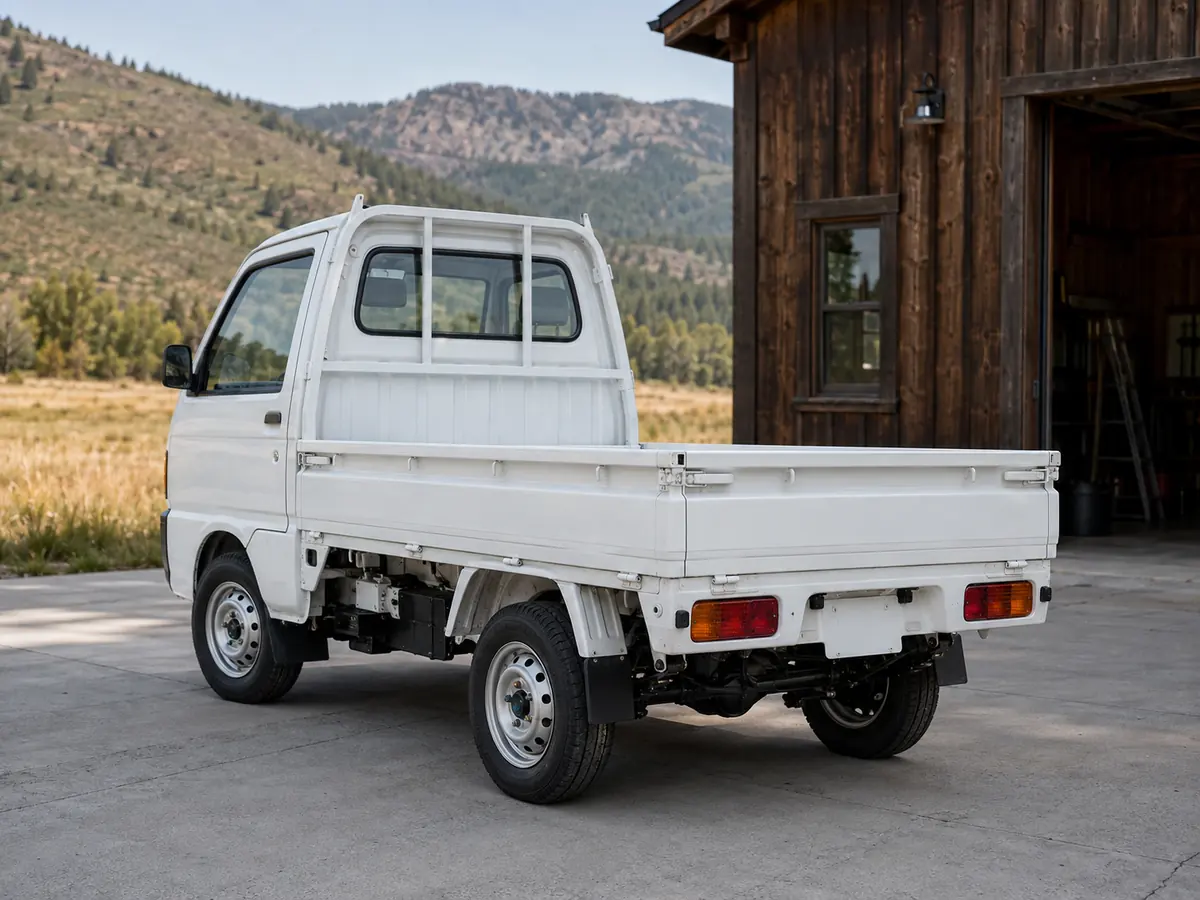
Illustrative vehicle: inspect the bed, chassis and mechanical condition of the actual truck before purchase.
Inspect for the work you expect
Ask for underside photographs, corrosion and repair history, fluid leaks, tire condition and a cold start. Check brakes, steering, cooling, cabin heat and defrost operation. For mountain or winter use, discuss the actual route and operating conditions with the inspector; four-wheel drive does not remove the road restrictions.
Start model research in the kei truck buying hub, then compare the Suzuki Carry, Honda Acty, Daihatsu Hijet, Subaru Sambar and Mitsubishi Minicab. Specifications vary by chassis and generation.
Use the chassis code when discussing kei truck parts sourcing. Build an initial service list from inspection findings instead of assuming every small Japanese pickup shares the same parts.
| Cost category | Get this in writing |
|---|---|
| Vehicle and Japan-side work | Truck price, sourcing or auction charges, inland transport and export preparation. |
| Shipping and US arrival | Named port, shipping method, destination handling, broker charges and current duty/tax estimate for the actual vehicle. |
| Delivery to Colorado | Transport from the seller or arrival port. Do not assume you can collect it and drive home on a freeway. |
| State and ownership costs | County tax, title and registration estimate when available, plus vehicle-specific insurance and any applicable emissions costs. |
| Waiting and maintenance | Storage, preservation and initial servicing if buying before the intended registration date. |
If the truck must replace a daily road vehicle immediately, the future pathway does not meet that need in 2026. Establish a workable use and timing before paying a deposit. If buying ahead for a later application, agree in writing what the seller is providing and what remains your responsibility; a future legal pathway is not a seller’s registration warranty.
Federal import age still follows the manufacture date
Colorado’s future application date and federal import eligibility are separate checks.
NHTSA’s age-based safety exemption applies when a vehicle is at least 25 years old, measured from manufacture. For example, a truck manufactured in March 2003 reaches that age in March 2028. The start of Colorado’s new application framework in January does not move that truck’s federal eligibility date forward.
EPA’s older-vehicle treatment is separate and includes an engine-configuration condition. Have the broker check the applicable declaration and evidence, especially for a replaced or modified engine. Customs release alone is not Colorado road approval.
Use the USA kei truck import guide for the national process and document handoff. Use the state timing and route checks here alongside that national process, and have the broker and receiving title office review the actual file before shipment or application.
Colorado kei truck FAQs
Direct answers for buyers planning around the future law.
Are kei trucks legal in Colorado in 2026?
No—not for new road registration through HB25-1281. That pathway applies to applications from January 1, 2028. If a seller claims an existing-title exception, ask the DMV to review the actual chassis and history before relying on it.
Can I apply under the new law in July 2027?
No. July 1, 2027 is the act’s effective date, while section 13 makes it applicable to applications submitted from January 1, 2028. Recheck the DMV’s implementation instructions before applying.
Will the new law allow kei trucks on freeways?
No. The future rule prohibits limited-access highways regardless of posted speed. Ordinary roads posted at 55 mph or less are a separate category and still require lawful vehicle registration and other applicable requirements.
Can a kei vehicle cross a road posted above 55 mph?
Yes, the future law provides an at-grade intersection crossing exception. It does not permit driving along the faster road. Confirm the actual crossing and connecting route; this is not current road permission in 2026.
Does being 25 years old guarantee Colorado registration?
No. The future definition also includes size, engine or motor limits, tires, cab, speed capability, import status and age/title history. Federal import compliance and the final state application requirements remain separate checks.
Will an out-of-state title transfer automatically?
No. A prior US title can be relevant to the future age-and-history definition, but it does not guarantee acceptance of your Colorado application. Have the receiving office review the title, identity and import records.
Are kei vehicles exempt from Colorado emissions testing?
No, not simply because they are kei vehicles. The future act specifies a two-speed idle test instead of a dynamometer test and requires the relevant model-year standards. Whether the program applies also depends on location and use.
Does the new law remove every inspection requirement?
No. It prevents an inspection requirement based solely on kei status or design/manufacturing parameters. It does not create a blanket exemption from vehicle identity, ownership or condition checks.
Can I assume an OHV permit makes a kei truck trail-legal?
No. Ask Colorado Parks and Wildlife about the actual vehicle’s eligibility and permitted locations. The separate future kei off-road category does not automatically provide trail access or public-road registration.
How much will Colorado kei registration cost in 2028?
Request an itemized estimate from the receiving county when the application process is available. This guide does not quote a finalized kei-specific total. Include tax, title, registration, insurance, applicable testing and delivery in the buying budget.
What should I prepare before buying?
Collect ownership records, chassis identification, manufacture and import dates, any US title history, federal entry documents and evidence of the future vehicle criteria. Review timing, the full route and insurance before committing to a road-use purchase.
Can Mirai help with a Colorado purchase plan?
Yes. Mirai Trading LLC can discuss sourcing from Japan using your county, intended use, application timing and total budget. Colorado authorities determine registration eligibility, and a sourcing discussion does not guarantee a plate or road access.
Primary sources and research method
Official references for the dates, vehicle criteria and preparation steps in this guide.
- HB25-1281 — original signed act
- Colorado General Assembly — bill history
- Department of Revenue — DRIVES implementation update, revised October 21, 2025
- Colorado DMV — posted Rule 3, non-traditional vehicle eligibility
- Colorado General Assembly — general county titling guidance
- Colorado General Assembly — emissions program geography
- NHTSA — vehicle importation and certification FAQs
- EPA — importing vehicles and engines
- Colorado Parks and Wildlife — OHV registration information
Research method and scope
Prepared by Mirai Trading LLC from official sources accessed on September 4, 2026. The signed act controls the distinction between its effective and application dates. Existing DMV rules describe the current administrative position; future vehicle, road and emissions provisions are labeled separately.
The document and inspection suggestions are buyer preparation, not finalized 2028 office instructions. Images are illustrative and do not advertise a specific truck in stock. No vehicle inspection, insurer acceptance or professional legal review is claimed.
Plan a truck around your Colorado use
Tell Mirai your county, planned application date, property or road use, preferred body and total budget. We can discuss a Japan sourcing shortlist while you resolve Colorado eligibility and timing.