
Are Kei Trucks Legal in Alaska? Registration, Roads & Rules
Are kei trucks legal in Alaska? Yes. Current Alaska DMV guidance says a legally imported vehicle that is at least 25 years old can receive a standard Alaska title and registration without meeting current Federal Motor Vehicle Safety Standards. That creates a clear on-road route for qualifying kei trucks in Alaska, provided the owner proves lawful importation, completes the state VIN inspection, obtains insurance and submits the required title file. Back to all state laws.
A 25-year-old, lawfully imported Japanese kei truck is eligible for ordinary Alaska title and registration under the DMV’s current foreign-vehicle procedure. It is not automatically an ATV, all-purpose vehicle or 25 mph low-speed vehicle. A truck under 25 years old generally needs a U.S. FMVSS certification label or manufacturer compliance letter to qualify for standard on-road registration.
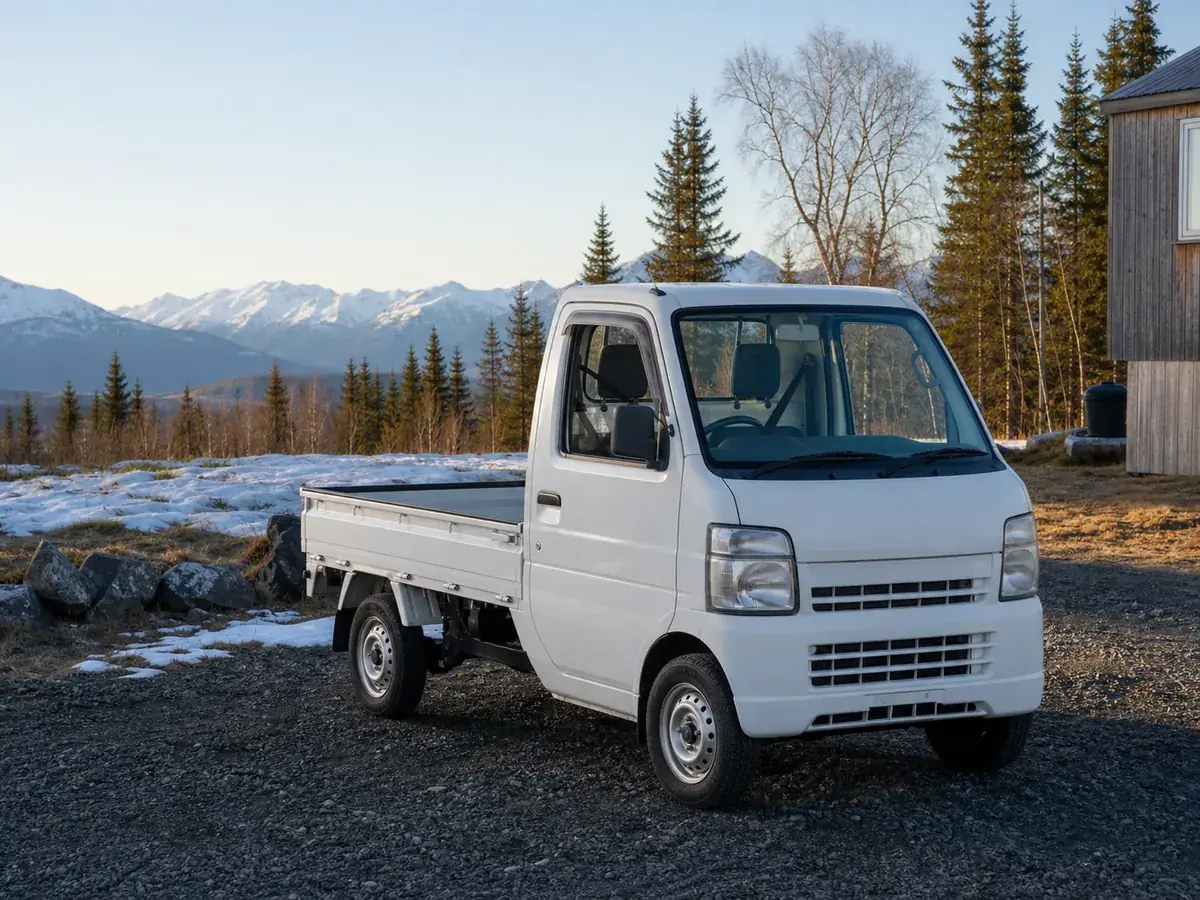
1Are Kei Trucks Legal in Alaska?
For a qualifying 25-year-old import, the current answer is yes—through Alaska’s standard foreign-vehicle title and registration procedure.
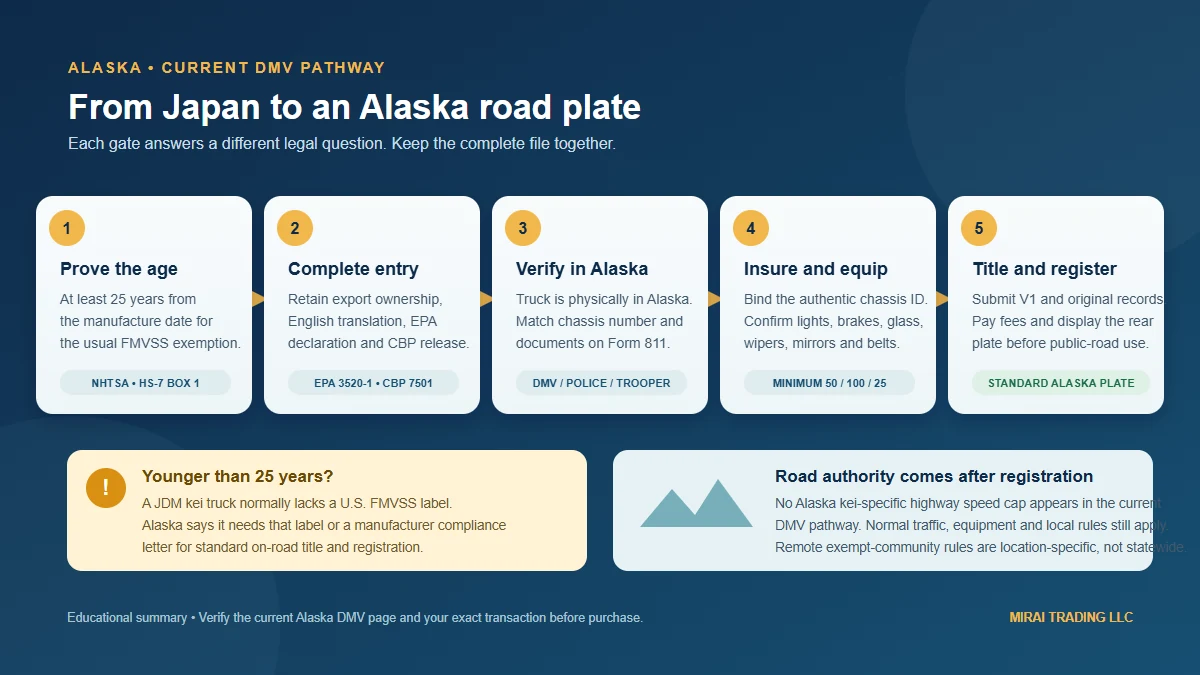
Meet the age test
The common route is a vehicle at least 25 years old, measured from its actual manufacture date for federal import purposes.
NHTSAEnter the U.S. lawfully
Ownership, DOT, EPA and customs records must show that the truck was formally entered and released.
CBP · EPA · DOTPass Alaska verification
The chassis identifier and foreign documents must be checked on Form 811 by an authorized Alaska inspector.
DMV · POLICE · TROOPERInsure and register
Submit Form V1, the ownership/import file, inspection and fees, then display the issued rear plate.
ALASKA DMVThe decisive source is the Alaska DMV’s current Foreign Vehicles page. It states that Alaska law—AS 28.10.068 and AS 28.10.221(e)—allows a vehicle that is at least 25 years old and was legally imported into the United States to be titled and registered without current FMVSS compliance. If the applicant provides the ownership and importation records, DMV says it will issue a standard Alaska title and registration.
This is materially different from the older advice still visible on some third-party state-law charts. Alaska changed its treatment of qualifying imports in 2026. Pages that still say all kei trucks are off-road-only or must use an APV registration are stale unless they clearly account for the current DMV foreign-vehicle procedure.
The rule does not make every kei truck legal. It protects the age-qualified, legally imported vehicle from rejection merely because it lacks a modern FMVSS label. Fraudulent documents, an unreadable or mismatched chassis number, an unlawful entry, missing ownership evidence, unsafe equipment or an insurer’s refusal can still stop the transaction.
What “standard registration” means
The DMV does not describe the qualifying 25-year import as a special low-speed vehicle. Once properly titled, insured and registered, it uses the normal motor-vehicle framework rather than an Alaska kei-specific 25, 35 or 45 mph road class. Ordinary traffic, equipment, licensing and local-use rules still apply.
Under 25 years is a different case
Alaska DMV says a foreign vehicle under 25 years old needs a permanently affixed FMVSS certification label under 49 C.F.R. Part 567 or a manufacturer letter confirming full FMVSS compliance. Most Japan-market kei trucks do not have either. Do not assume an out-of-state title, APV decal or seller’s “street legal” statement supplies the missing federal and Alaska proof.
2Standard Kei Truck, Low-Speed Vehicle, APV or OHV?
These labels have different design standards and road limits. Choose the legal class from the truck’s facts, not its size.
25+ imported kei truck
A Japan-market mini pickup that satisfies Alaska’s foreign-vehicle pathway. The DMV’s current result is a standard title and registration. Its original capability is usually above 25 mph, so it is not automatically an LSV.
Low-speed vehicle (LSV)
Alaska describes an LSV as a four-wheeled vehicle manufactured for 20–25 mph operation, generally with a low-speed/NEV MCO. LSVs cannot use highways posted above 35 mph except for narrow statutory exceptions. A normal kei truck is not converted into an LSV merely by driving slowly.
All-purpose or off-highway vehicle
APVs are ATV-type machines that may use qualifying roads posted 45 mph or less in communities that have not prohibited them. OHV registration is for off-road machines. Neither category is the substitute presented on the current DMV page for a 25-year-old foreign motor vehicle eligible for standard registration.
The distinction matters at the counter and at the roadside. Alaska’s LSV page requires an MCO identifying the vehicle as a low-speed or neighborhood electric vehicle and imposes the 35 mph-road rule. The APV/OHV page applies to ATV and off-road vehicle types, with community opt-out authority and limited road use.
A 25-year-old Suzuki Carry, Daihatsu Hijet, Honda Acty, Subaru Sambar or Mitsubishi Minicab that was manufactured as an on-road Japanese pickup and is processed under the foreign-vehicle rule should be documented as that imported motor vehicle. Avoid applications that casually call it a golf cart, ATV, side-by-side or homemade vehicle. A false classification can cause insurance, title-history and enforcement problems later.
Speed capability is not the legal classification
Kei trucks vary by generation, transmission, tires, load and condition. Alaska’s standard imported-vehicle pathway does not promise that a particular truck is safe or practical on every route. Plan around the actual truck’s braking, acceleration, tires and visibility—not a generic online top-speed claim.
3Federal Import Rules Before Alaska Registration
Alaska can title only a truck that entered the United States under a lawful federal basis.
Prove manufacture date
NHTSA’s 25 years runs from actual manufacture—not model year shorthand or auction date.
File HS-7
A vehicle at least 25 years old generally enters under Box 1 of the DOT/NHTSA declaration.
Resolve EPA status
EPA Code E generally applies at 21+ years if the vehicle remains in original unmodified configuration.
Make customs entry
Submit ownership and agency declarations, pay duty and obtain the CBP entry record.
Preserve originals
Keep the stamped/released file and matching chassis evidence for Alaska inspection and title.
The 25-year NHTSA rule
NHTSA’s official import FAQ says a motor vehicle at least 25 years old may be imported without regard to current FMVSS. The period runs from the vehicle’s manufacture date. If no original date label exists, bring reliable supporting evidence such as the first registration or original sale record. The importer normally checks Box 1 on Form HS-7.
EPA is a separate test
The EPA Form 3520-1 instructions describe Code E for a vehicle at least 21 years old in original unmodified configuration. Replacement engines or emissions modifications can change eligibility. A truck old enough for the usual 25-year NHTSA exception is normally old enough for the 21-year EPA test, but the paperwork and factual requirements remain separate.
CBP proof and pickup duty
CBP explains that the owner needs a formal entry and should retain CBP Form 7501 Entry Summary for state registration. CBP’s vehicle import guidance publishes general duty rates of 2.5% for automobiles and 25% for trucks, based on the price paid or payable. A kei pickup is commonly treated as a truck; confirm the classification, value, harbor charges and any exemption with the customs broker before shipping.
An out-of-state title does not cure an unlawful import
If a truck entered without the required customs filing or under an off-road declaration inconsistent with the requested Alaska road use, another state’s paper title does not rewrite that federal history. Ask for the complete HS-7, EPA and CBP file—not just a photocopy of a title.
Clean the truck before export
Remove soil, seeds and organic debris from the frame, wheel wells, bed, engine bay and underbody. Agricultural contamination can delay inspection or require cleaning at the port. Photograph the cleaned chassis before loading and retain the service record.
4How to Title and Register a Kei Truck in Alaska
The transaction is document-heavy but the DMV’s published pathway is direct.
Step 1: Pre-clear the exact fact pattern
Because Alaska’s 25-year imported-vehicle treatment is new in 2026, send the DMV or intended office a concise written summary before purchase: manufacture month, make/model, Japanese chassis number, present location, federal entry status, current title status and intended owner/use. Link the DMV’s current Foreign Vehicles page and ask whether the office wants any additional translation, weight or age evidence. Mirai Trading’s own walkthrough of how to import a kei truck from Japan covers the same federal and customs groundwork this pre-clearance step relies on.
Step 2: Build the ownership and customs index
Put a one-page index in front of the Japanese Export Certificate or comparable ownership record, certified or credible English translation, purchase invoice, bill of sale, HS-7, EPA 3520-1, CBP 7501, freight release and any prior U.S. title. Make, model, year and every chassis character must agree across the file. Explain harmless transliteration differences rather than changing the underlying document.
Step 3: Get the truck physically to Alaska
The Alaska DMV foreign-vehicle page says the vehicle must be physically located in Alaska on the application date under AS 28.10.201, unless the applicant is an Alaska resident presenting a valid MCO. An imported used kei truck normally relies on foreign ownership documents, so plan for the truck to be present. Do not drive it from the port or storage yard on public roads without valid registration or a suitable permit; use a carrier or trailer.
Step 4: Complete Form 811 vehicle verification
Every vehicle with foreign ownership documents requires inspection on Form 811. The current DMV page says an Alaska DMV representative, police officer or State Trooper may complete it, and the inspection is free at DMV offices. The inspection establishes the vehicle’s identity; it is not a promise that old brakes, tires, glass or lights are safe.
Step 5: Bind Alaska insurance
Give the insurer the exact Japanese chassis number, right-hand-drive layout, intended garaging address and personal or business use. Ask for a policy that identifies the actual truck, not a generic vehicle. Obtain written proof that the short chassis number is accepted before paying nonrefundable registration, port or transport costs.
Step 6: Submit Form V1 and original evidence
File the signed Vehicle Transaction Application (Form V1), proof of ownership and transfer, proof of legal importation, completed Form 811 and fees. The title fee is $15. Standard noncommercial passenger/pickup/van registration is generally $100 for 24 months under the 2026 DMV registration fee and MVRT chart; motor-vehicle registration tax, plate choices, lien recording and in-person charges can change the total.
Step 7: Verify the finished record before road use
Check the printed make, model, year, body style, use class and chassis number before leaving the counter. Alaska generally requires one plate on the rear of a passenger vehicle or truck, with the month/year tab. Carry current proof of insurance and the registration certificate whenever the truck is driven.
Temporary movement is narrow, not general road authority
Alaska offers limited trip permits for specific movements such as inspection, weighing or a single unladen trip. A permit’s route, duration and purpose control. It is not a substitute for completing the title and registration file.
5Alaska Kei Truck Document Checklist
Keep originals, color scans and a backup. Do not let the only customs or Japanese ownership record disappear into a resale file.
Japan and federal import file
- Japanese Export Certificate or comparable authentic ownership record
- Complete English translation, preferably with translator certification
- Purchase invoice and detailed bill of sale
- Manufacture-date evidence, not model-year assumption alone
- Clear chassis-number photographs and rubbing if practical
- DOT/NHTSA Form HS-7 with the correct import basis
- EPA Form 3520-1 and supporting engine/configuration evidence
- CBP Form 7501 Entry Summary or accepted customs-release record
- Duty, broker, harbor, freight and cargo-release receipts
- Prior U.S. title and registrations, if the truck was already in the country
Alaska title and registration file
- Government identification and physical/residence address
- Completed and signed Vehicle Transaction Application (Form V1)
- Original ownership and transfer documents
- Completed Alaska Vehicle Verification & Inspection (Form 811)
- Active Alaska-compliant liability insurance proof
- Any DMV-requested weight, body-style or use evidence
- Lien information and $15 lien fee when applicable
- Payment for $15 title fee, registration, MVRT and other charges
- Written DMV pre-clearance or correspondence for unusual facts
- One-page document index matching the chassis number throughout
Never manufacture a 17-digit VIN
Many Japanese vehicles use a shorter chassis identifier. Alaska’s Form 811 process exists to verify the actual identifier. Do not add zeros, invent a check digit, replace a plate or alter a source document to satisfy software. Ask the DMV and insurer to record the authentic chassis number consistently.
What a careful exporter should provide
The exporter can preserve the auction/ownership trail, Japanese Export Certificate, manufacture clues, chassis photographs, invoice and clean loading record. The U.S. importer and broker remain responsible for the federal declarations, while Alaska DMV and the insurer decide title, registration and coverage.
6Where Can You Use a Kei Truck in Alaska?
A standard plate removes the special-class barrier; the route and activity still need to be lawful and sensible.
City and state roads
A properly titled, insured and standard-registered 25-year import follows normal traffic and equipment rules. The current DMV pathway publishes no kei-specific posted-speed cap.
Higher-speed highways
No Alaska kei-specific highway ban appears in the current standard-registration guidance. Actual acceleration, tires, wind stability, braking, darkness and weather determine whether a route is prudent — see Mirai Trading’s guide to realistic kei truck highway speed before choosing a route.
Private property
Farms, homesteads, yards, campuses and work sites can be a natural fit. Owner permission, workplace safety, insurance and local nuisance rules still matter.
Trails and public land
A road plate does not grant ATV-trail, snowmachine-trail, park, beach or public-land access. Check the land manager’s vehicle type, season, width and closure rules.
Business operations
Delivery, landscaping, maintenance and contracting may trigger commercial registration or insurance. Vehicles titled to a company are treated commercially for Alaska registration fees.
Remote communities
DMV lists communities exempt from registration and mandatory insurance. The exemption is geographic, does not erase lawful import/ownership, and should not be assumed outside the listed area.
| Road or setting | Practical status | What to verify |
|---|---|---|
| Private farm, yard or facility | Generally usable with permission | Property rules, employer safety, passengers, load securement and liability coverage. |
| Anchorage, Fairbanks, Wasilla or Juneau street | Normal road use after standard registration | Registration, rear plate/tab, insurance, valid license, equipment, parking and local traffic rules. |
| State highway | Legally possible; route judgment required | No published kei-specific cap in the standard pathway, but assess traffic speed, grades, wind, winter conditions and stopping distance. |
| Limited-access or high-speed segment | No special ban found; often poor fit | Confirm the vehicle record is standard—not LSV/APV—and choose an alternative when performance margins are small. |
| ATV or snowmachine trail | Road plate alone is insufficient | Land-manager designation, vehicle class, width, weight, season, permit and local closure. |
| Public road before plate/permit | Do not drive | Use a trailer/carrier or obtain a trip permit that expressly covers the movement. |
Right-hand drive is not itself a ban
Alaska’s current foreign-vehicle procedure does not reject an age-qualified import merely because it is right-hand drive. The driver still needs safe sight lines for left turns, passing, snowbanks and parking-lot exits. Add properly adjusted mirrors, keep glass clear and avoid maneuvers that require blind exposure.
7Anchorage, Fairbanks, Mat-Su, Kenai, Juneau and Remote Alaska
The state title pathway is consistent; taxes, permanent registration, studded-tire dates and local road/property rules vary.
Anchorage
Standard Alaska title, registration and insurance apply. Anchorage participates in permanent registration for trailers only—not 8+ year vehicles. Local studded-tire rules delay fall installation within city limits until October 1.
Fairbanks North Star
The borough participates in permanent registration for vehicles at least eight years old. Winter route planning should account for extreme cold, darkness and longer stopping distances.
Mat-Su Borough
Mat-Su participates in permanent registration for 8+ year vehicles. Wasilla, Palmer and borough roads still apply normal traffic, parking and business rules.
Kenai Peninsula
The borough participates in permanent registration for 8+ year vehicles. On the paved Sterling Highway, the state’s north-of-60 studded-tire blackout dates apply.
Juneau and Southeast
Juneau is not listed on the current 8+ vehicle permanent-registration table. South of 60°N, the statewide studded-tire blackout runs April 15 through September 30.
Ketchikan and Sitka
Current DMV guidance lists 8+ vehicle permanent registration in Sitka and Ketchikan, with Ketchikan’s program effective January 1, 2026 and a published one-time local tax.
Unorganized borough
Many addresses can qualify for permanent registration of an 8+ vehicle. Eligibility depends on residence location, not where the truck is occasionally used.
Exempt communities
DMV publishes a specific list exempt from registration, mandatory insurance and certain road tests. Check the current list by exact community; do not generalize “remote Alaska.”
Permanent registration is an owner-location benefit
Alaska’s permanent registration program can cover a noncommercial vehicle at least eight years old in the unorganized borough or an organized borough that adopted the program. The owner pays the normal registration fee, applicable MVRT and a one-time $25 permanent fee for a “Z” tab. A new owner must qualify and pay again. Anchorage currently participates only for trailers.
Registration-exempt communities are not an import loophole
The DMV’s Exempt Communities list identifies locations where registration and mandatory insurance are not required under the cited statutes and regulation. The exemption does not create title to a truck, legalize a customs violation, authorize operation elsewhere or override a tribe, municipality, land manager, employer or property owner. A driver with certain recent high-point violations may still need insurance.
Local activity rules still apply
Parking, snow-removal routes, seasonal road closures, commercial licensing, port or airport access, campus policies and trail designations can apply to a kei truck just as they apply to other vehicles. A borough’s permanent-registration option is not broader driving permission.
8Insurance, Fees, Plates and Ownership Choices
The cleanest title file can still stall if the chassis number is not insurable or the use class is wrong.
Minimum liability
Alaska publishes $50,000 for one person, $100,000 per accident and $25,000 property damage.
AS 28.22.101Title fee
The standard title issuance fee is $15, plus another $15 when recording a lien.
ALASKA DMVRegistration fee
The 2026 biennial noncommercial passenger/pickup/van fee is $100. Local MVRT may be added.
24 MONTHSOne rear plate
Passenger vehicles and ordinary trucks display one plate on the rear with the current tab.
AS 28.10.171Ask the insurer before bidding
Some insurer systems expect a 17-character VIN and reject a Japanese chassis number automatically. Ask an Alaska-authorized carrier or broker to quote the exact identifier, model, year, right-hand-drive configuration and use. For a business, describe deliveries, employee drivers, work sites, tools and radius of operation. A personal policy may exclude paid or business use even if the title application succeeds.
Personal versus business ownership
Alaska DMV says vehicles owned by a business/company—including a company listed with an individual—are registered commercially for fee purposes. Leased vehicles are also treated as commercial. A typical kei truck is far below the heavy-vehicle thresholds, but the ownership name and use still affect classification and insurance.
Farm and historic plates are not casual discounts
A farm plate requires the statutory full-time residence, main-income and exclusive farm-transport statements published on Form V1. A historic plate is for a vehicle 30 years or older used primarily for historical exhibition and is not the right choice for a daily work truck. Use the standard plate when the intended operation is ordinary transportation or utility work.
Estimate the full landed and licensed cost
Budget for purchase price, inland transport in Japan, ocean freight, marine insurance, broker/customs bond, pickup-truck duty, port/terminal charges, Alaska delivery, cleaning, translation, tires, battery, coolant service, lighting repairs, title, registration, MVRT and insurance. A low auction bid can still become an expensive truck if the import file or cold-weather maintenance is neglected.
Published fees are not a quote
DMV’s 2026 schedule lists $100 for a 24-month noncommercial passenger/pickup/van registration and $15 for title issuance. Residence-based MVRT, a $10 in-person renewal/transaction charge where applicable, plate choices, permanent-registration charges, lien fees and taxes can change the total. Use the DMV calculator for the owner’s address and transaction date.
9Alaska Winter Equipment and Operating Checklist
Legal registration is the starting line; cold-weather reliability and visibility determine whether the truck is useful.
Before the first freeze
- Load-test the battery and confirm charging voltage
- Verify coolant concentration, thermostat and heater output
- Inspect block-heater installation and cord condition if equipped
- Use winter-grade engine oil appropriate to the engine and temperature
- Check tire age, load rating, tread and cold inflation pressure
- Service brakes, parking brake and wheel bearings
- Confirm defroster, wipers, washer fluid and all exterior lights
- Inspect cab seals, door latches and exhaust for cabin leaks
- Carry recovery gear suited to the route without overloading the truck
Route and load discipline
- Reduce payload for snow, ice, steep grades and long stops — check Mirai Trading’s kei truck towing and payload limits before loading gear or a trailer
- Secure every bed load; light trucks are sensitive to load placement
- Keep the windshield, mirrors, lamps and rear plate visible
- Avoid deep berms that can damage the low front structure
- Allow larger gaps behind full-size vehicles and snowplows
- Do not use four-wheel drive as a substitute for winter braking grip
- Check 511 Alaska, closures and weather before remote travel
- Carry warm clothing, communication and survival supplies outside urban areas
- Do not exceed the model’s published axle, payload or tire limits
Studded-tire dates depend on latitude and Anchorage rules
Alaska DOT&PF states that studded tires are prohibited on paved roads from May 1 through September 15, inclusive, north of 60°N, and from April 15 through September 30, inclusive, south of 60°N. The paved Sterling Highway uses the May 1–September 15 blackout regardless of latitude. Anchorage’s local rule does not allow studs within city limits until October 1, even though the north-of-60 state season begins earlier. Emergency extensions can occur, so recheck the current announcement each spring.
Imported tire sizes need careful sourcing
Do not assume every Japanese-market tire is appropriate for Alaska pavement, loads or winter speeds. Match the rim, diameter, width, load index and clearance; avoid a large diameter change that harms gearing, braking or body clearance. Keep all four tires consistent on four-wheel-drive models unless the manufacturer specifies otherwise.
Cab heat and defrost are safety equipment in practice
A kei truck’s compact cab can warm quickly, but a weak thermostat, restricted heater core, old coolant or air leak can make the windshield unsafe. Repair the system before road use. Portable unvented combustion heaters are not a safe substitute inside the cab.
Old-vehicle equipment still has to work
The 25-year rule removes current FMVSS as the reason for refusing title and registration; it does not excuse Alaska’s operational equipment rules. Confirm service brakes, parking brake, lamps, reflectors, horn, glazing, mirrors, wipers, defrost and belts before inspection or road use.
10Pre-Purchase Checklist for an Alaska Kei Truck
Resolve age, identity, import eligibility, insurance and winter condition before auction bidding.
Verify the truck
- Manufacture month is at least 25 years before planned U.S. entry
- Chassis number is original, legible and matches the export record
- Engine and emissions configuration support the intended EPA declaration
- No ownership, customs or auction document contains an unexplained mismatch
- Frame, cab mounts, bed, brake lines and fuel system show no critical corrosion
- Four-wheel drive, low range, differential lock and dump mechanism work if equipped
- Heater, defroster, wipers, washers, mirrors and all lights function
- Tires and wheels can be replaced with Alaska-suitable, properly rated parts
- Payload and towing claims come from the exact model documentation
Pre-clear the transaction
- Alaska DMV has reviewed the exact age/import/title fact pattern
- Insurer can bind the authentic chassis number and intended use
- Broker confirms HS-7, EPA 3520-1 and CBP treatment
- Pickup classification and estimated 25% duty are included in the budget
- English translation and manufacture evidence are arranged
- Truck will be transported—not driven—until plated or permitted
- Residence address is checked for MVRT, permanent registration or exemption
- Business ownership and commercial insurance consequences are understood
- Cold-weather service and parts lead time are included in the purchase decision
Best request to send a seller or exporter
Ask for the Japanese ownership/export record, full chassis number, manufacture evidence, engine code, odometer, underbody and cab-mount photographs, cold start video, four-wheel-drive demonstration, tire date codes, heater/defroster test and a written list of modifications. “Runs and drives” is not enough for Alaska. Browse Mirai Trading’s current Japanese kei trucks for export to compare age-eligible candidates before you build this file, or source an Alaska-eligible kei truck directly with our team.
11Kei Trucks Alaska FAQs
Concise answers for owners, importers and buyers using the current Alaska DMV pathway.
Are kei trucks legal in Alaska?
Yes, if the truck qualifies. Current Alaska DMV guidance says a vehicle at least 25 years old that was legally imported into the United States can receive a standard Alaska title and registration without current FMVSS compliance. The owner must provide the ownership/import file, complete Form 811 verification, insure the truck and register it.
Did Alaska change its kei truck law in 2026?
Yes. Alaska’s current Foreign Vehicles page cites AS 28.10.068 and AS 28.10.221(e) and says qualifying 25-year imported vehicles may receive standard title and registration. Older third-party pages describing all kei trucks as off-road-only may be outdated.
Must an Alaska kei truck be 25 years old?
Yes, for the usual non-FMVSS Japan-market truck. NHTSA measures 25 years from the actual manufacture date. Alaska says a younger foreign vehicle needs an FMVSS certification label or a manufacturer letter confirming full compliance for standard registration.
Can a newer-than-25-year-old kei truck be registered?
Only if it has a valid federal and Alaska pathway. Most newer JDM kei trucks lack a U.S. FMVSS label and cannot obtain a manufacturer compliance letter. Do not assume APV registration, an out-of-state title or off-road import status creates ordinary on-road eligibility.
Is an Alaska kei truck limited to 25 or 35 mph?
Not when it receives the standard title and registration described by the current foreign-vehicle procedure. The 25 mph design cap and 35 mph-road limit apply to Alaska’s separate low-speed-vehicle class. Normal traffic laws and safe route selection still apply to the standard-registered truck.
Can a registered kei truck use Alaska highways?
Yes. The current standard imported-vehicle pathway publishes no kei-specific highway ban, and a properly registered truck follows normal road rules. That does not make every highway prudent: assess traffic speed, grades, crosswinds, darkness, snow, tires, braking and the exact truck’s performance.
What documents does Alaska DMV require?
DMV lists proof of foreign ownership, proof of transfer when applicable, CBP Form 7501 plus EPA/DOT import documents, signed Form V1 and completed Form 811 inspection. Bring English translations, age evidence, chassis photographs, insurance and any prior U.S. title.
Does Alaska inspect the VIN or chassis number?
Yes. All vehicles with foreign ownership documents require Alaska verification on Form 811 by an authorized DMV inspector, police officer or State Trooper. DMV offices perform the inspection without a fee according to the current guidance.
How much does Alaska kei truck registration cost?
The 2026 schedule lists a $15 title fee and $100 for a 24-month noncommercial passenger/pickup/van registration. A lien costs $15 to record. Residence-based MVRT, plate choices, permanent registration and other transaction charges may change the total.
What insurance is required?
For a vehicle subject to registration, Alaska’s minimum liability limits are $50,000 for injury or death to one person, $100,000 per accident and $25,000 for property damage. Keep proof in the truck. Higher limits and commercial coverage may be appropriate.
Is a kei truck an Alaska APV or low-speed vehicle?
Not automatically. APVs are qualifying ATV-type machines with limited community road use. LSVs are manufactured for 20–25 mph and normally have an LSV/NEV MCO. A 25-year imported kei pickup can instead qualify for standard registration under the foreign-vehicle procedure.
Do remote Alaska communities require registration?
Some do not. DMV publishes a specific exempt-community list for registration, mandatory insurance and certain road tests. The exemption is location-specific and does not erase ownership/import requirements or authorize operation outside the exempt area.
Can I register an old kei truck permanently?
Yes, if the owner resides in a participating area. A noncommercial vehicle at least eight years old may qualify for a permanent “Z” tab in the unorganized borough or a participating organized borough. Anchorage participates only for trailers. Normal fees, applicable MVRT and a $25 permanent fee are due.
Can an Alaska kei truck be used for business or farm work?
Yes if the use, registration and insurance are correct. A business-owned truck is commercially classified for Alaska fee purposes, and a personal policy may exclude work use. Farm plates have strict residence, main-income and exclusive farm-transport conditions; ordinary farm use does not automatically qualify.
Primary Sources and Editorial Method
Official sources were checked on July 18, 2026, with the title/registration fee figures independently reconfirmed on July 28, 2026 directly against Alaska DMV’s own published fee chart. Alaska’s imported-vehicle policy changed recently, so recheck before publication or purchase.
- Alaska DMV — Foreign Vehicles: 25-year standard title/registration pathway and required documents
- Alaska Legislature — SB 239 history and text concerning legally imported vehicles
- Alaska DMV — general registration, two-year period, insurance and MVRT
- Alaska DMV — official 2026 Registration Fees & Biennial MVRT chart: confirms $15 title issuance fee and $100 biennial (24-month) registration fee for non-commercial passenger/pickup/cargo van vehicles
- Alaska DMV — current Form V1 and Form 811 links
- Alaska DMV — mandatory insurance limits, proof and exceptions
- Alaska DMV — one rear plate rule and plate information
- Alaska DMV — separate low-speed-vehicle definition and road restrictions
- Alaska DMV — separate APV and OHV definitions and operation
- Alaska DMV — current exempt-community list
- Alaska DMV — permanent registration locations, eligibility and $25 fee
- Alaska DMV — historic plate age and exhibition-use condition
- Alaska DOT&PF — studded-tire dates and Anchorage difference
- NHTSA — 25-year manufacture-date rule and HS-7 Box 1
- CBP — customs proof, HS-7, EPA 3520-1 and Form 7501 for DMV
- CBP — general vehicle duty rates, including 25% for trucks
- EPA — Form 3520-1 and Code E 21-year original-configuration language
How this guide handles a newly changed rule
We give priority to Alaska DMV’s current operational page over older third-party summaries, then separate federal import admission, Alaska identity verification, title, registration, insurance, equipment and local use. We do not infer that a standard plate makes every route safe, and we do not treat an LSV, APV, OHV or remote-community exception as a substitute for the standard foreign-vehicle pathway.
How this content was prepared
Research, drafting and original visual production were AI-assisted using the cited primary sources, which were cross-checked against current sources before publication. This guide was reviewed by Mirai Trading’s editorial team, who have direct experience exporting and documenting Japanese vehicles for U.S. buyers, but no team member holds formal Alaska legal, DMV/title-compliance or insurance-licensing certification. The purpose is to help Alaska buyers make a safer, document-led decision—not to replace agency or legal advice; confirm your specific situation with the Alaska DMV, a licensed Alaska insurance agent or a qualified import-compliance professional before importing or registering a vehicle.
About this guide
This guide was prepared and reviewed by Mirai Trading LLC’s editorial team, who have direct Japanese vehicle export and document-handling experience but do not hold Alaska legal or DMV certification; the “checked” date and primary-source links above reflect that review. Mirai Trading LLC is a licensed Japan-based vehicle exporter, not an Alaska law firm or DMV agency—consult an Alaska attorney or DMV specialist before relying on this guide for any statement that expands road access or changes the required file.
Source an Alaska-ready kei truck file
Mirai Trading LLC can help identify age-eligible Japanese trucks and organize the export-side ownership, manufacture and chassis records your broker, insurer and Alaska DMV office will need.
Editorial notice: Official sources were checked on July 18, 2026. This educational guide is not legal advice, an insurance opinion or a guarantee that Alaska DMV will approve a particular truck or document set.