
Kei Trucks Florida: Buying, Registration & Road Rules
The kei trucks Florida buyers consider can suit short local trips and property work. Before buying, check the truck’s classification, your actual roads and the documents needed for a Florida title. Are kei trucks legal in Florida? Yes, conditionally: under Florida Statutes §316.2122, a titled, registered and insured mini truck may use streets posted at 35 mph or less, subject to local or state road restrictions. Back to all state laws. Neighboring state guides: Alabama and Georgia.
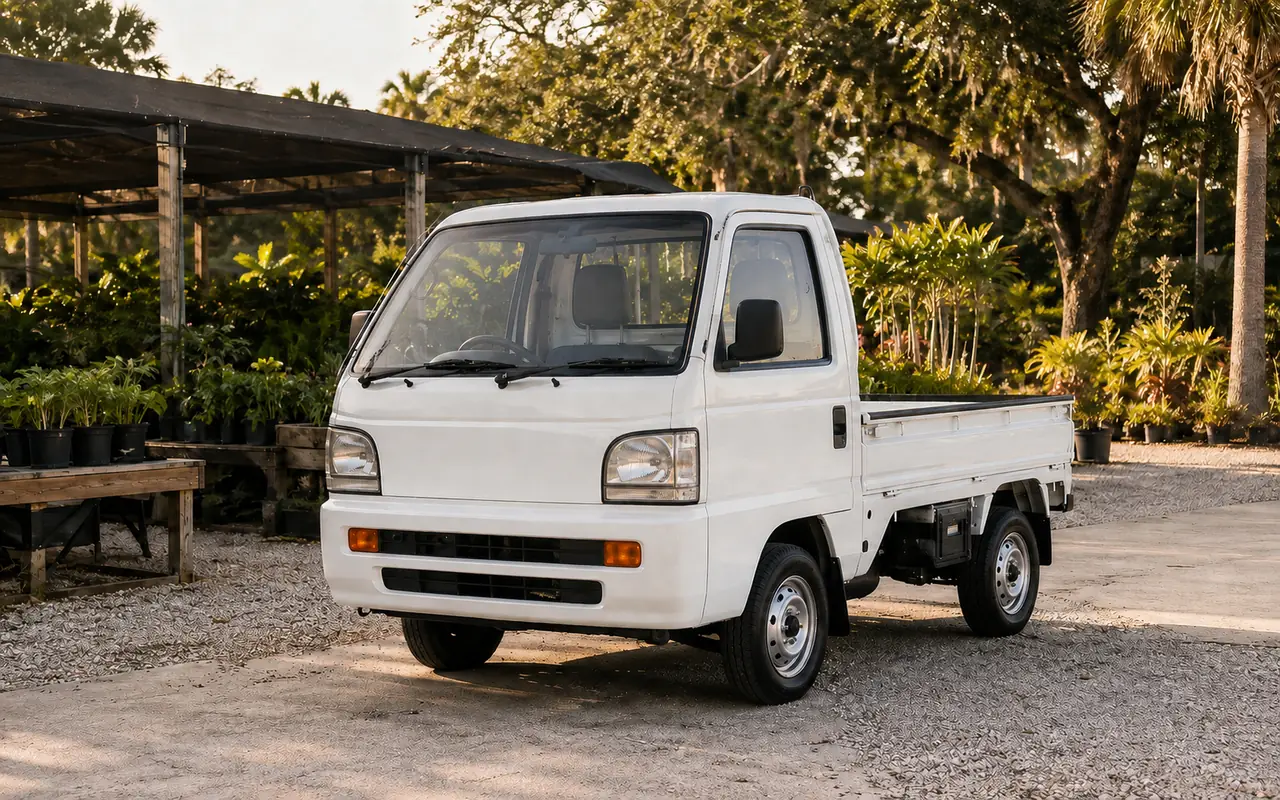
For the Florida mini-truck route rule; local prohibitions can still apply.
Measured from manufacture; separate from Florida road permission.
Registration, insurance and a valid driver’s license are required.
A nearby destination does not prove a usable mini-truck route.
Kei Trucks Florida: Are They Street Legal?
Yes, conditionally. Florida has a road-use framework for qualifying mini trucks; it does not give every Japanese kei truck unrestricted access to public roads.
Under Florida Statutes §316.2122, a mini truck may operate on streets posted at 35 mph or less, subject to local or state road restrictions. The vehicle must be titled, registered and insured, and the driver must have a valid driver’s license. The intersection-crossing exception is explained below.
“Kei truck” describes the Japanese vehicle category. Florida’s legal classification must be checked for the actual vehicle. An advertisement saying “street legal,” an existing plate or successful federal importation does not, by itself, answer where you may drive it.
Confirm the classification
Give the title office the chassis identifier, manufacture evidence and current ownership documents. Ask how Florida will classify that truck.
Map the complete journey
Include the short connecting road, the turn into a shopping center and the way home. Check posted limits and restrictions with the road authority.
Prepare the actual documents
Have the original ownership and import records checked before paying for a truck that depends on Florida road use.
Florida mini truck laws: 55 mph is a definition detail
§320.01(44) describes a reduced-dimension, four-wheel truck without a National Highway Traffic Safety Administration truck classification, using the phrase “with a top speed of 55 miles per hour.” That wording is not permission to drive along a street posted at 55 mph. The separate road rule remains 35 mph or less for a mini truck.
The mini-truck definition also lists headlamps, stop lamps, turn signals, tail lamps, reflex reflectors, parking brakes, mirrors, a windshield and seat belts. Check their presence and condition on the individual truck. The separate low-speed vehicle definition in §320.01(41) covers a four-wheel vehicle with a top speed above 20 mph and no more than 25 mph, complying with federal standards in 49 CFR §571.500. Do not assume a speed governor automatically converts a kei truck into an approved low-speed vehicle.
If a seller relies on a pickup body code, the truck’s age or a different classification to claim broader road access, ask FLHSMV for a vehicle-specific determination. Resolve that point before purchase; this guide applies the mini-truck rules where that classification is confirmed.
Where can you drive a mini truck in Florida?
Use the street’s posted limit. Driving slowly on a faster road does not change that road’s eligibility.
| Road or situation | Mini-truck rule | Before the trip |
|---|---|---|
| Street posted at 25, 30 or 35 mph | Within the statutory speed threshold. | Still check prohibitions, vehicle paperwork and driver eligibility. |
| Street posted at 40, 45 or 55 mph | Outside the threshold for driving along it. | Find a compliant alternate route or transport the truck. |
| Crossing a faster road at an intersection | The statute provides a crossing exception. | Check the actual intersection, signs and any applicable restriction. |
| Interstate or expressway journey | Do not plan it using the mini-truck allowance. | Arrange suitable transport instead of relying on the truck’s mechanical top speed. |
| Street where an authority prohibits mini trucks | A qualifying posted speed does not override the prohibition. | Confirm the restriction with the county, municipality or FDOT responsible for that road. |
Basis: §316.2122(1), (3) and (4). The 45 mph provision in subsection (2) concerns autonomous delivery vehicles; it is not a general mini-truck exception.
For example, a nursery might connect to a neighborhood by a 30 mph street but require a turn onto a 45 mph road for the final half-mile. Under the mini-truck rule, that faster segment changes the answer even if the truck can keep up with traffic. Crossing the faster road at an intersection is a different situation from turning onto it and continuing along it.
For property-only work, discuss access and operating conditions with the landowner and insurer. Do not assume every road inside a private community is outside traffic law: Florida’s definition of a road includes ways open to public vehicular traffic. Keep a written record of the specific roads and authorities you checked.
Screen your planned route before buying
This tool identifies the next question to resolve. It does not issue permission or check live road restrictions.
Florida route check
Choose what you have confirmed for the actual truck and journey. Unknown answers stay unknown.
Start with the vehicle
Information neededConfirm Florida’s classification for the actual chassis, then check every road segment and local restriction.
Vehicle approval, current local restrictions, insurance eligibility, driving conditions or the safety of a particular crossing.
The statutory screen uses §316.2122. Title and registration decisions belong to Florida authorities. Use a WhatsApp button to open a message with your selected options and result; you can edit it before sending.
How to prepare a Florida title and registration file
Ask the tax collector or motor vehicle service office that will handle your application to review the document list for your situation.
A truck already carrying a Florida title and a truck arriving directly from Japan start with different files. For an existing Florida title, verify the seller, ownership chain, liens, chassis identifier and transfer requirements. For an out-of-country vehicle, official Hillsborough County title guidance gives a useful preparation checklist:
- Original ownership evidence. Obtain the foreign title or registration showing the vehicle and owner. Do not substitute a photograph or a seller’s listing for the original record.
- An acceptable English translation. For non-English documents, Hillsborough specifies a translation certified and signed by the translator with notarization. Confirm the requirements for your Japanese documents before the appointment.
- Purchase and ownership chain. Keep the invoice or bill of sale, purchase value and any dealer or importer transfers. Names and the chassis identifier should agree across the file.
- Customs and federal entry records. Hillsborough lists CBP Form 7501 and the HS-7 declaration with the vehicle identification number. Keep the EPA entry documentation and other import records with them.
- Vehicle identification verification. Arrange the verification required by the office, using HSMV 82040 MV or 82042 as applicable. Confirm who may complete it and whether the vehicle must attend.
- Application and identification. Prepare the title application, acceptable applicant ID and any necessary power of attorney. Ask which owners must attend or sign.
- Florida insurance for registration. Obtain vehicle-specific confirmation from the insurer and bring the required evidence if applying for a plate. Our guide to kei truck insurance in the USA covers quotes, coverage and chassis-number problems.
- Tax, title and plate instructions. Ask for an itemized estimate, payment requirements and appointment arrangements. Check whether an existing plate or another exemption changes the initial registration fee.
Resolve identifier questions before the visit
Have the office explain how your Japanese chassis identifier should appear on each document. Do not alter it to imitate a 17-character US VIN. Manatee County’s import guidance also requires original ownership evidence, customs clearance and VIN verification, and describes completing that verification before the visit. Use your own office’s instructions for the appointment.
Before paying a deposit, send the office a concise vehicle summary: make, model, chassis identifier, manufacture date evidence, current title jurisdiction and copies of the available ownership and import documents. Ask what is missing and how the vehicle will be classified. Retain the response with the purchase file. A seller’s assurance that another customer registered a similar truck is weaker evidence than a review of your documents.
Import a kei truck to Florida: check the actual build date
The federal entry decision and the Florida road-use decision answer separate questions.
NHTSA’s import guidance allows the age-based federal safety exemption when the vehicle is at least 25 years old, measured from its manufacture date. A model-year label alone is not enough. For example, a truck built in October 2001 reaches that age in October 2026; calling it a “2001 model” does not make it eligible earlier in the year.
EPA treatment is separate. Its older-vehicle guidance includes an engine-configuration condition. Ask the importer or broker to confirm the relevant exemption and evidence, especially if the engine has been replaced. Do not assume the NHTSA age exemption settles emissions paperwork.
Use our USA kei truck import guide for the national process, federal declarations, customs planning and state handoff. Then bring that completed file back to the Florida checklist. Customs release does not itself provide a Florida title or approval for your intended roads.
Insurance and the real buying budget
Price the complete purchase and the intended use before deciding that a truck is affordable.
For a typical private-vehicle registration, Florida’s insurance framework includes $10,000 in property-damage liability and $10,000 in personal injury protection. See §324.022 and §627.736. Those are statutory reference amounts, not a recommendation that minimum cover is sufficient for your circumstances.
Ask an insurer to accept the exact chassis and intended use before purchase. Explain whether the truck will be used privately, for deliveries or for other business work; confirm liability, damage cover and any restrictions. Maintain the required coverage while registered, consistent with §627.733.
| Budget item | What to request |
|---|---|
| Vehicle and Japan-side charges | Separate the truck price, auction or sourcing charges, inland transport and export preparation. |
| Ocean shipment and arrival | A dated quote naming the port, shipping method, included charges and destination handling responsibilities. |
| Customs and brokerage | A broker’s current classification, duty/tax estimate and entry-service quote for the actual vehicle. |
| Florida tax, title and registration | An office estimate based on purchase records, vehicle class and any eligible plate transfer or exemption. |
| Insurance and transport home | Vehicle-specific cover and a transport plan that works before registration or where the route is unsuitable. |
| Initial maintenance | An inspection-based allowance for tires, fluids, brakes, cooling, air conditioning and documented defects. |
No flat landed-price claim is made here. Freight, customs treatment, tax and condition depend on the individual transaction.
The $225 fee is conditional
§320.072 establishes an additional $225 initial registration fee for covered registrations, with exemptions. A qualifying transferred plate or another statutory exemption can change whether it applies. This is not the total cost of titling and registering a truck. Ask the office to calculate your file.
Our Japanese auction price guide helps separate the vehicle purchase from the rest of the budget. Compare quotations using the same destination, scope and condition assumptions; a low auction price and an already-imported asking price include different things.
Kei trucks for sale in Florida: what to check
Start with a route and document review. Then compare trucks on evidence from the individual unit.
When buying in Florida, ask to see the current title, the seller’s right to transfer it, any lien release and the vehicle’s identifier before arranging payment. Ask what registration classification and road-use claims the seller is making. A domestic location makes inspection easier to arrange, but it does not settle the legal questions for you.
When sourcing from Japan, request the auction sheet, export/ownership records, manufacture evidence, clear underside photographs and a condition report. Use how to read Japanese auction sheets to understand the written findings, then ask for close-ups of anything unclear. Make the purchase decision only after the route, title file and insurer have been checked.
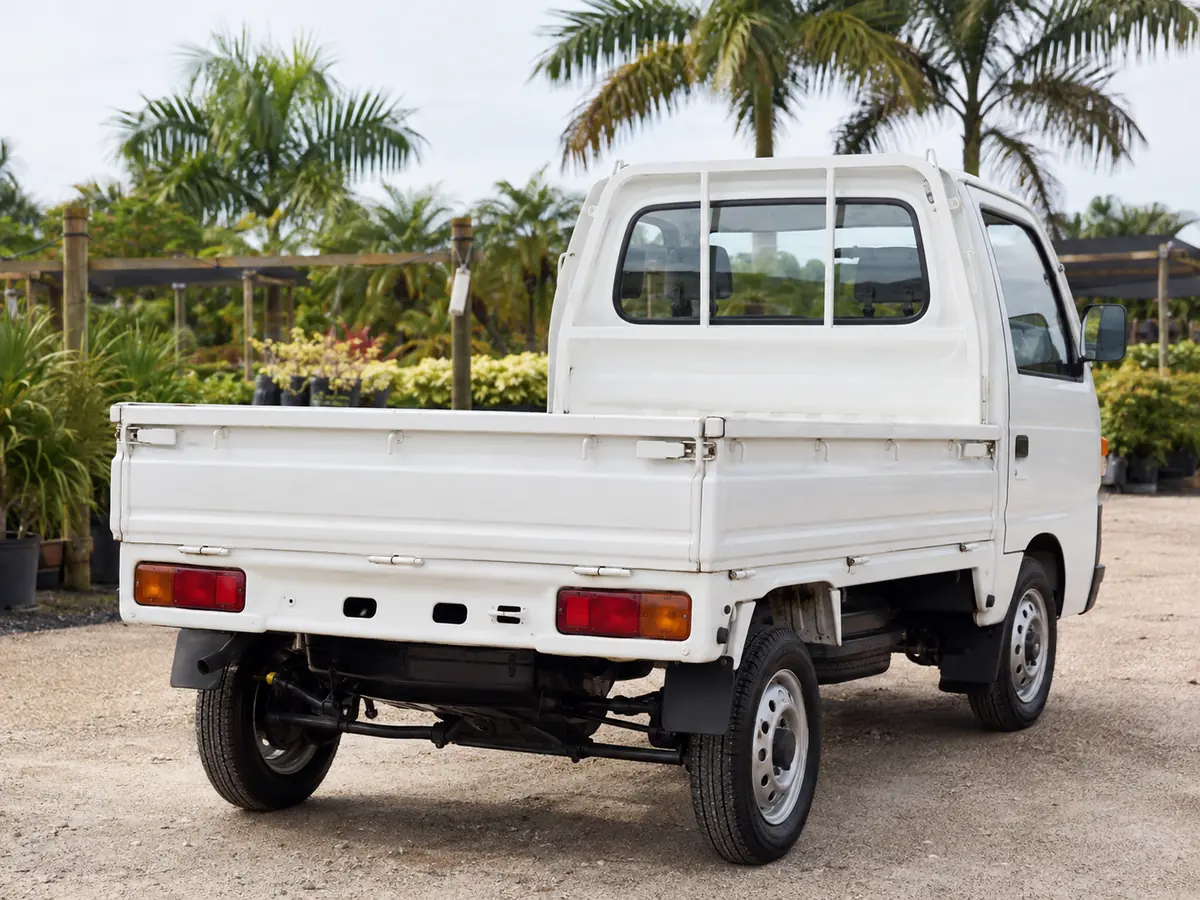
Inspect the parts your work will depend on
A tidy bed is only one part of the condition check. Ask for evidence of the frame, cab floor, brake lines, cooling system and electrical condition on the truck you will buy.
- Run the air conditioning and cooling system through a proper inspection; a dashboard button does not prove either works.
- Look for corrosion, prior water intrusion, patch repairs and freshly coated areas that need closer examination.
- Check tires, brakes, steering, seat belts, lighting and the parking brake before road use.
- Test bed latches and any fitted dump or four-wheel-drive equipment; confirm the exact payload and operating limits from vehicle evidence.
For model research, compare the Suzuki Carry, Honda Acty, Daihatsu Hijet, Subaru Sambar and Mitsubishi Minicab guides. The nameplate alone does not establish import age, equipment or Florida classification.
Use the kei truck buying hub to narrow body and drivetrain requirements, and plan kei truck parts sourcing using the exact chassis and engine details. Prefer the truck whose condition and documents support your intended job over a model chosen only for its reputation.
Florida kei truck FAQs
Direct answers, read alongside the official sources and the vehicle-specific checks above.
Are kei trucks legal in Florida?
Yes, qualifying mini trucks can use permitted streets posted at 35 mph or less when titled, registered and insured, with a validly licensed driver. Confirm the actual vehicle classification and any local or FDOT road prohibition before relying on that allowance.
Can I drive a Florida mini truck along a 45 mph road?
No. The mini-truck road rule is based on a posted limit of 35 mph or less. Driving at 35 mph on a road posted at 45 mph does not satisfy it. The statute separately allows crossing a faster road at an intersection.
Does the 55 mph definition allow 55 mph roads?
No. The 55 mph wording appears in the vehicle definition. It does not replace the separate 35 mph posted-street restriction in §316.2122 for mini trucks.
Can a 25-year-old kei truck use Florida highways without restrictions?
No. The federal age exemption concerns import safety compliance. It does not itself determine Florida registration classification or road access. A truck classified as a Florida mini truck remains subject to that category’s road restrictions.
Does a pickup body code prove unrestricted road use?
No. A body code or an advertisement alone does not establish the legal basis for unrestricted use. Ask FLHSMV to confirm the classification and applicable restrictions for the actual vehicle before relying on the seller’s claim.
Do I need a driver’s license and insurance?
Yes. Florida’s mini-truck provision requires a valid driver’s license and a titled, registered and insured vehicle. Ask the insurer to accept the exact chassis and intended private or business use before purchase.
Can every 2001 kei truck be imported during 2026?
No. NHTSA measures the 25-year threshold from manufacture, not just the model year. A truck manufactured in October 2001 reaches 25 years in October 2026. Confirm the actual date and the separate EPA requirements.
What documents should I prepare for an imported truck?
Prepare original foreign ownership evidence, an acceptable English translation, purchase and transfer records, customs clearance including CBP 7501, the HS-7 declaration, required vehicle identification verification, application and ID, plus insurance for registration. Keep EPA entry records in the file and have the receiving office confirm the complete requirements.
Does the federal age exemption eliminate VIN verification?
No. Import age and Florida vehicle identification verification are separate matters. Confirm the accepted verifier, form and vehicle-presentation requirements with the office handling your title application.
Is $225 the total Florida registration cost?
No. The $225 initial registration fee is an additional fee for covered applications and has exemptions. Tax, title, plate and other applicable charges must be calculated separately for the actual transaction.
Can I assume a neighborhood route is allowed?
No. Check every segment’s posted speed and any applicable prohibition. A nearby destination may require a faster connecting road. The route checker cannot discover current local restrictions or approve a particular journey.
Can Mirai help me source a truck for Florida?
Yes. Contact Mirai Trading LLC about sourcing from Japan with your county, intended use, route requirements and budget. Florida authorities decide title and registration eligibility, and your insurer must accept the vehicle and use. Confirm those points before committing to a purchase.
Primary sources and research method
Official legal and procedural references used for this guide.
- Florida Statutes §316.2122 — mini-truck road use, driver requirements and restrictions
- Florida Statutes §320.01 — mini-truck, low-speed vehicle and road definitions
- Hillsborough County Tax Collector — title transfers, including out-of-country vehicles
- Manatee County Tax Collector — out-of-country title transfer
- NHTSA — vehicle importation and certification FAQs
- EPA — importing vehicles and engines
- Florida Statutes §320.072 — additional initial registration fee and exemptions
- Florida Statutes §324.022 — property-damage liability security
- Florida Statutes §627.736 — personal injury protection
- Florida Statutes §627.733 — required security during registration
Research method and scope
Prepared by Mirai Trading LLC using official Florida statutory text, county title-office guidance and federal import guidance accessed on September 3, 2026. The guide separates legal requirements from practical buyer checks. County instructions illustrate document preparation; the office handling the actual application must confirm its requirements.
The illustrations show a typical compact pickup and are not an offer of a specific vehicle. No inspection of a buyer’s truck, insurer acceptance or local route approval is implied.
Build a shortlist around your Florida use
Tell Mirai your county, intended trips, body and drivetrain needs, and total budget. We can discuss sourcing from Japan while you confirm the title, road and insurance requirements.