
Are Kei Trucks Legal in Alabama? Registration, Roads & Rules
Are kei trucks legal in Alabama? Yes, but the clearest Alabama pathway is a restricted mini-truck registration—not unrestricted use like a conventional pickup. A qualifying truck must carry the proper restricted low-speed tag, may not use interstate highways, and Alabama’s statutory mini-truck definition requires a governor that prevents speeds above 25 mph. Back to all state laws. Neighboring state guides: Florida, Georgia, and Tennessee.
A lawfully imported Japanese kei truck can be registered in Alabama if the vehicle and paperwork satisfy the applicable pathway. The state expressly provides a mini-truck tag, exempts qualifying mini-trucks from Alabama titles and bans them from interstates. A separate ALDOR rule says imported vehicles at least 25 model years old may be titled and registered, but ALDOR does not say that rule automatically converts a kei truck into an unrestricted pickup. Get the county licensing office’s classification in writing before buying or modifying the truck.
1Are Kei Trucks Legal in Alabama?
Alabama law recognizes mini-trucks, but “legal” depends on which state classification the licensing official applies.
Lawful federal entry
For the usual nonconforming JDM truck, confirm it is at least 25 years old to the manufacture date and retain the federal import declarations.
NHTSA · EPA · CBPAlabama classification
A statutory mini-truck is title-exempt and receives a restricted low-speed tag. A 25-year imported-vehicle rule also exists, creating a classification question.
ALDOR · COUNTY OFFICEVehicle compliance
The restricted pathway requires the definition’s width, weight, metal cab, equipment, nonconforming VIN and 25 mph governor.
PHYSICAL INSPECTIONInsurance and tag
Obtain Alabama liability insurance, pass the ownership/VIN inspection and display the proper plate before entering a public road.
OIVS · LICENSING OFFICIALAlabama Code §32-6-59 expressly authorizes registration of a mini-truck. It sets the annual fee at the private-passenger rate, prohibits interstate operation and requires a tag showing restricted low-speed use. Section 32-8-31 separately exempts a mini-truck from the state certificate-of-title system.
There is an important wrinkle. Current ALDOR Rule 810-5-1-.238 says motor vehicles 25 model years old or older are not subject to FMVSS and may be titled and registered with proper ownership documents. Rule 810-5-75-.03 says the same for imported vehicles, while also saying vehicles 35 model years old or older are title-exempt.
Do not assume “25 years old” means unrestricted Alabama plates
The published rules do not clearly explain when an imported kei pickup is handled as an ordinary 25-year-old motor vehicle instead of a statutory mini-truck. County practice cannot safely be inferred from a forum post or another owner’s tag. Send the chassis number, manufacture date, dimensions, unladen weight, photographs and import documents to the county licensing office—and, where needed, ALDOR Motor Vehicle—before purchase.
2Does a Japanese Kei Truck Fit Alabama’s Definition?
The definition is narrower than “small Japanese pickup.” Every listed element matters.
ALDOR’s official Mini-Trucks and Low Speed Vehicles memorandum summarizes the definition in §40-12-240. A qualifying mini-truck is a four-wheel reduced-dimension truck meeting the following criteria.
A typical Suzuki Carry, Daihatsu Hijet, Honda Acty, Subaru Sambar or Mitsubishi Minicab is wide enough, has an enclosed metal cab and uses a Japanese chassis identifier rather than a conventional U.S. 17-character VIN. Weight can be close to the threshold and must be documented for the actual truck. Most road-going Japanese kei trucks were not factory-limited to 25 mph, so the Alabama restricted route normally requires a properly installed governor—see Mirai Trading’s kei truck top speed guide for stock speed ranges before assuming how much a governor will need to reduce.
The governor is not optional wording
Alabama’s definition says the vehicle is equipped with an installed speed governor preventing it from attaining more than 25 mph. Merely promising to drive slowly is not the same thing.
Mini-truck is not the same as an FMVSS low-speed vehicle
Alabama’s memo distinguishes the two. An LSV must satisfy 49 C.F.R. §571.500 and normally has a conforming 17-character VIN and certification documentation. A Japanese kei truck ordinarily follows the mini-truck analysis, not an LSV shortcut.
3Federal Import Process From Japan
State registration starts only after the truck has been lawfully admitted to the United States.
Verify manufacture date
Count 25 years from the actual month and year, not merely the model year.
Secure Japanese originals
Obtain the Export Certificate, complete translation, invoice and chassis photographs.
Clean for shipment
Remove soil and plant material from tires, wheel wells, underbody, cab and bed.
Declare the vehicle
Use DOT HS-7, EPA 3520-1 and the entry documents appropriate to the shipment.
Retain the release file
Keep CBP Form 7501, stamped declarations, duty evidence and broker records.
NHTSA: 25 years to the date of manufacture
NHTSA’s official FAQ says a vehicle at least 25 years old may be imported without conforming to all applicable Federal Motor Vehicle Safety Standards. The period runs from the manufacture date, and the importer declares the exemption under Box 1 of Form HS-7. Build-month evidence should be resolved before the vessel is booked.
EPA: generally 21 years with the original configuration
CBP’s current vehicle-import guidance explains that the EPA exemption generally applies after 21 years when the vehicle remains in its original, unmodified configuration. A replacement engine can break that route unless the substitute qualifies. File EPA Form 3520-1 using the correct declaration code.
CBP: entry proof and duty
CBP says Form 7501 is the evidence that a vehicle entry was filed. Its general vehicle guide lists a 25% duty rate for trucks, based on the price paid or payable, although the actual classification and any applicable treatment belong to CBP and the customs broker. Alabama’s imported-vehicle rule specifically lists customs-release forms, HS-7, EPA documentation when applicable, the foreign ownership document and English translations. For the general federal picture beyond Alabama specifically, see Mirai Trading’s guide to importing a kei truck to the USA.
Do not buy a truck already in the U.S. without its entry file
A Japanese Export Certificate and bill of sale do not replace customs proof. Match the chassis number across the vehicle, export record, bill of sale, HS-7, EPA declaration and CBP release before paying.
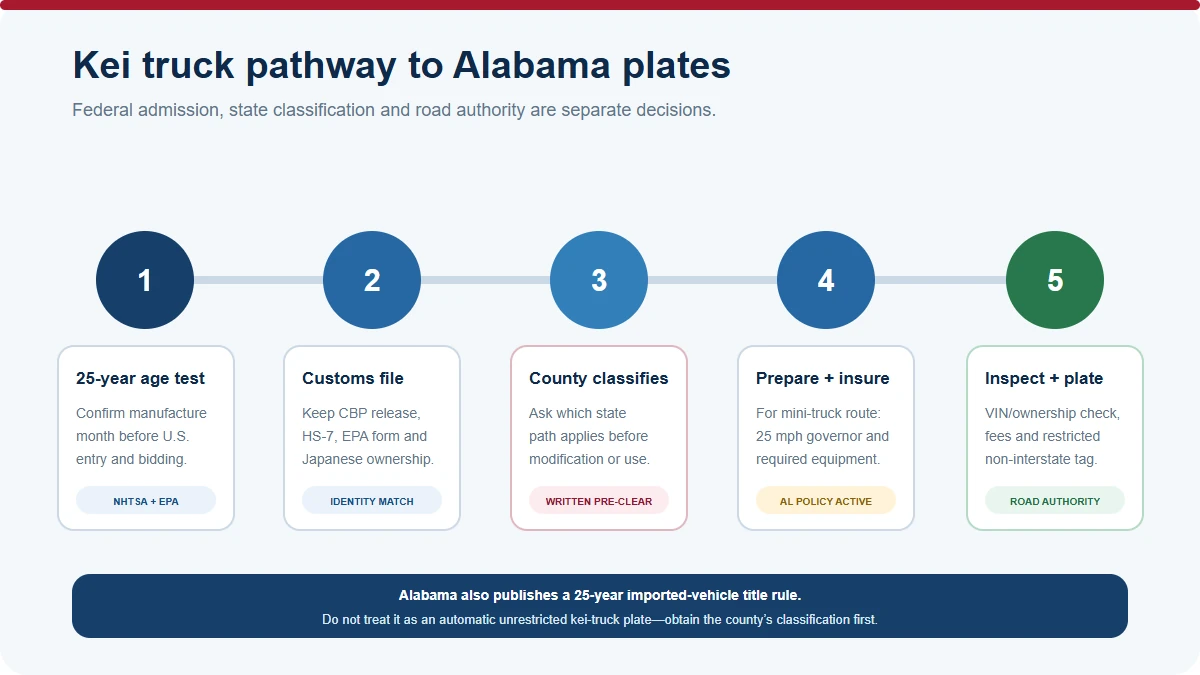
4How to Register a Kei Truck in Alabama
Use a pre-clearance-first workflow because the final classification controls the title, equipment and plate.
Ask the county first
Register in the county where the owner resides; a business registers where the vehicle is used.
Send a fact sheet
Provide age, chassis number, width, weight, cab, equipment and import-document details.
Confirm the pathway
Ask whether the office will issue the restricted mini-truck tag or process a 25-year title application.
Prepare and insure
For the mini-truck route, document the governor and equipment; bind Alabama liability coverage.
Inspect and register
Present the truck and originals for VIN/ownership inspection, taxes, fees, registration and plate.
Restricted mini-truck route
- Confirm eligibility: the truck must satisfy Alabama’s definition, including the minimum width and unladen weight, complete equipment and installed 25 mph governor.
- Resolve insurance: obtain an Alabama policy before registration. The office normally checks the Online Insurance Verification System and may request an insurance card.
- Bring the truck: when no title is required, the licensing official or deputy physically inspects the vehicle and ownership documents at each change of ownership. Confirm the inspection location and whether an appointment is needed.
- Present the ownership file: bring the assigned ownership document, bill of sale, translation, customs release and federal declarations. The chassis identifier must match.
- Pay the charges: ALDOR publishes a $23 mini-truck/LSV registration fee. County issuance fees, ad valorem tax and sales or use tax may apply.
- Display the correct plate: Alabama’s 2012 memorandum says a mini-truck may only receive the mini-truck plate. Keep the Motor Vehicle Registration Tag and Tax Receipt in the vehicle.
The 20-day purchase deadline
ALDOR says an owner has 20 calendar days after purchase or acquisition to obtain a license plate without penalty or interest. That deadline makes pre-clearance important: classification, insurance or missing customs paperwork can take longer than expected.
Possible 25-year imported-vehicle title route
Rules 810-5-75-.03 and 810-5-1-.238 state that vehicles 25 model years old or older may be titled and registered with proper documents. If a county says this route applies to the exact truck, follow its title instructions; ALDOR’s imported-vehicle FAQ currently lists a $15 title charge plus a $3 licensing-official fee, followed by registration costs. Do not remove a governor, use a standard tag or drive above 25 mph merely because the truck is old. Obtain written classification and plate instructions first.
Best practice: obtain a written yes/no before shipment
Ask the county to answer three separate questions: Will it classify this chassis as a §40-12-240 mini-truck? Which documents and inspection evidence will it require? Which exact plate and operating restrictions will apply after registration?
5Alabama Kei Truck Document Checklist
Keep originals, clean scans and a one-page index. Do not let a broker retain the only stamped copy.
Import and ownership file
- Japanese Export Certificate or other authentic ownership record
- Complete English translation of every foreign-language document
- Purchase invoice and detailed bill of sale
- CBP Form 7501 or another customs-release form accepted by ALDOR
- DOT/NHTSA Form HS-7 showing the federal import basis
- EPA Form 3520-1 and any applicable supporting evidence
- Freight, broker and duty-payment records
- Manufacture-month evidence and chassis-number photographs
Alabama registration file
- Government-issued identification and proof of Alabama residence
- Alabama liability insurance card or OIVS-verifiable policy
- Assigned ownership document and bill of sale
- Physical truck for VIN/ownership inspection when required
- Certified or credible unladen-weight evidence including fluids
- Width measurement and photographs of the enclosed metal cab
- Governor installation invoice/specification and functional evidence
- Photographs or inspection evidence for required lights, mirrors, belts and brake
- Payment for fees, local charges and applicable taxes
A Japanese chassis number is not automatically a defect
Alabama’s mini-truck definition anticipates a nonconforming vehicle identification number. The practical requirement is consistency: every character must match the truck, export document, translation, bill of sale, customs entry and insurance record. Never add digits to imitate a 17-character VIN.
6Where and How Can You Use a Kei Truck in Alabama?
Registration is not a blanket promise that every road is sensible or lawful for a vehicle capped at 25 mph.
Private farms and property
Use on land you own or occupy is the simplest case. Permission, workplace safety, child safety and civil liability still matter.
Local public-road errands
Possible after registration, insurance and display of the correct tag. Choose genuinely low-speed routes that do not impede traffic.
Interstate highways
Alabama Code §32-6-59 expressly prohibits mini-trucks on interstates. A ramp or short connector is still interstate operation.
Agricultural work
Useful in orchards, nurseries and on farms. Public-road travel does not automatically become exempt merely because the load is agricultural. Check the truck’s real towing and payload capacity before loading it for farm work.
Business and campus use
Landscaping, facilities and delivery work can fit the vehicle, but commercial insurance, employer rules and local operating permits may apply.
Shoulders and off-road labels
A shoulder is not a general bypass around registration or interstate restrictions. “Off-road use only” paperwork can prevent public-road registration.
| Road or setting | Practical status | What to verify |
|---|---|---|
| Private land | Generally usable with permission | Property rules, insurance, occupational safety and any local nuisance restrictions. |
| City neighborhood street | Conditional | Restricted tag, insurance, valid driver’s license, traffic flow, parking and any city business rules. |
| County or state road | Conditional but often unsuitable | No statewide posted-speed-road cap appears in §32-6-59, but the truck is governed to 25 mph and Alabama prohibits impeding normal traffic. |
| Interstate or interstate ramp | Prohibited | Do not use I-10, I-20, I-22, I-59, I-65, I-85, I-459 or any other interstate segment. |
| Public road before registration | Not permitted | Transport by trailer or carrier until the inspection, insurance and tag are complete. |
Alabama does not publish a 35 mph-road rule for mini-trucks in current §32-6-59
Some online charts repeat a 25 or 35 mph posted-road restriction from older proposals or other states. The current section prohibits interstates and requires a restricted tag; the 25 mph limit enters through the statutory vehicle definition and governor. Separate minimum-speed law prohibits driving so slowly as to impede normal and reasonable traffic, so route selection still matters.
7Birmingham, Huntsville, Mobile and Montgomery
No separate city kei-truck legalization pathway was found in the official materials reviewed; state registration remains the foundation.
Birmingham
Use the Alabama tag and insurance rules. Businesses operating low-speed vehicles may also encounter city business-compliance requirements; ask before paid transport or organized service.
Huntsville
Plan around high-speed arterials and limited-access connections. A 25 mph governed truck is better suited to private facilities and carefully selected local streets.
Mobile
I-10 and I-65 are prohibited. Port, terminal and private industrial property can impose separate access, insurance and safety requirements.
Montgomery
I-65 and I-85 are prohibited. State offices do not replace the county licensing office that handles the owner’s registration transaction.
Local parking, truck-route, noise, business-license, campus, port and private-property rules can still apply even when the vehicle has a state plate. Because municipal codes change and may regulate a specific business activity rather than the truck itself, confirm the proposed route and use with the city or property operator.
8Insurance, Driver Licensing, Taxes and Renewals
A plate application should not be the first time an insurer sees the chassis number.
Alabama liability policy
Insurance must be active before registration. Minimum financial-responsibility limits are 25/50/25, but higher limits may be sensible.
OIVS VERIFICATIONValid driver’s license
Alabama requires a driver’s license to operate a motor vehicle on its highways unless a specific exemption applies.
ALEATaxes and local charges
Expect the $23 published base registration fee plus possible county issuance fees, ad valorem tax and sales or use tax.
COUNTY LICENSING OFFICERecords in the truck
Keep the Registration Tag and Tax Receipt in the vehicle, along with current insurance evidence and the driver’s license.
ROADSIDE COMPLIANCEInsurance before purchase
Ask an Alabama-authorized insurer to quote the exact chassis number and intended use. Explain that it is a Japanese right-hand-drive mini pickup and whether it will have the restricted mini-truck plate. Some systems reject short chassis numbers automatically, so manual underwriting may be necessary. Obtain written confirmation that the vehicle—not merely the driver—is covered for the proposed road and business use.
Minimum coverage is not necessarily adequate coverage
Alabama’s financial-responsibility amounts are $25,000 for one person’s bodily injury or death, $50,000 for two or more people, and $25,000 for property damage. Consider the value of other vehicles, medical costs, uninsured/underinsured motorist protection and commercial exposures.
Renewal and sale
Registration renewals normally do not require another physical inspection, but insurance remains verifiable through OIVS. Alabama plates stay with the registrant when a vehicle is sold. Give the buyer a complete ownership and import file; do not imply that your registration guarantees the next county transaction.
9Pre-Purchase Checklist for an Alabama Buyer
The safest truck is the one whose age, identity, state pathway and insurance are resolved before auction bidding.
Before bidding, compare recent kei truck auction prices so your Alabama landed-cost budget reflects real Japanese auction outcomes rather than asking-price listings.
Verify before bidding
- Manufacture month is at least 25 years before U.S. entry
- Japanese chassis identifier is legible and matches the export record
- Original engine/configuration supports the intended EPA declaration
- Unladen weight including fuels and fluids is at least 1,500 lb for the mini-truck route
- Width is at least 48 inches and cab is fully enclosed metal
- All lights, mirrors, windshield, belts and parking brake are present
- No document says “off-road use only” without the county first approving registration
Pre-clear the ownership plan
- County licensing office has reviewed the exact fact pattern
- Written answer identifies restricted tag versus title application
- Governor installation and evidence requirements are known
- Insurer can bind the exact chassis number and intended use
- Broker confirms HS-7, EPA and CBP entry treatment
- Total budget includes freight, duty, port charges, transport, taxes and modifications
- A trailer or carrier is arranged until Alabama road authority exists
What Mirai Trading can document
A careful exporter can help preserve the Japanese ownership record, manufacture evidence, chassis photographs, invoice and translation workflow. Alabama registration, insurance, legal classification and road-use permission remain decisions of U.S. agencies, the county licensing official and the insurer.
10Kei Trucks Alabama FAQs
Concise answers to the questions buyers most often ask before importation.
Are kei trucks legal in Alabama?
Yes, with conditions. Alabama expressly authorizes a restricted mini-truck plate. The truck must be lawfully imported, satisfy the applicable state definition and inspection, be insured and registered, and may not operate on interstate highways.
Does an Alabama mini-truck need a title?
A mini-truck as defined in §40-12-240 is exempt from an Alabama title. ALDOR also publishes a rule allowing 25-year-old imported motor vehicles to be titled and registered, so obtain the county’s classification for the exact truck instead of assuming either route.
Must the kei truck be 25 years old?
Yes, for the normal permanent import of a non-FMVSS Japanese-market truck. NHTSA measures 25 years from the actual manufacture date. A newer vehicle generally needs a different lawful federal basis and should not be purchased on the assumption that Alabama registration cures federal ineligibility.
Is an Alabama kei truck limited to 25 mph?
Yes, under the explicit mini-truck pathway. The Alabama definition requires an installed speed governor that prevents the truck from attaining more than 25 mph.
Can a kei truck drive on Alabama interstates?
No. Alabama Code §32-6-59 prohibits mini-trucks on interstate highways, including ramps and short interstate segments.
Can I drive a kei truck on a 35 or 45 mph road?
Current §32-6-59 does not state a separate posted-road-speed cap, but the statutory mini-truck itself is governed to 25 mph. Alabama also prohibits unnecessarily impeding normal traffic. Use genuinely low-speed routes and confirm local restrictions.
Where do I register a kei truck in Alabama?
At the license plate issuing office in the owner’s county of residence. A firm, corporation or association generally registers in the county where the truck is used or operated.
What documents should I bring?
Bring the authentic foreign ownership record, English translation, bill of sale, customs release such as CBP Form 7501, HS-7, EPA 3520-1 when applicable, proof of age, chassis photographs, Alabama insurance and the vehicle for inspection. Ask the county for its exact list.
How much does Alabama mini-truck registration cost?
ALDOR’s mini-truck/LSV plate page publishes a $23 registration fee. County issuance charges, ad valorem tax, sales or use tax and other transaction-specific amounts may be added.
Do I need insurance before registration?
Yes. Alabama requires liability coverage before registration and normally checks the policy through OIVS. If electronic verification fails, the office may ask for an insurance card or other evidence.
Can I use a kei truck on a farm without registration?
Yes, on private property with the owner’s permission—that’s the simplest scenario. But once the truck enters a public road, agricultural use does not automatically replace the registration, insurance, driver-license and plate requirements.
Can an Alabama kei truck be used commercially?
The mini-truck statute does not create a universal commercial-use exemption or ban. Commercial insurance, business licensing, employer safety rules, port/campus requirements and other carrier rules may apply. The 25 mph cap also limits practical routes.
Will Alabama accept a short Japanese chassis number?
The statutory mini-truck definition anticipates a nonconforming VIN. Acceptance still depends on a legible identifier that matches every ownership, customs and insurance record. Never fabricate or pad a chassis number.
Can I register a newer-than-25-year-old kei truck?
Generally, no. Most Japanese-market kei trucks lack a U.S. FMVSS certification label. A vehicle under 25 years generally needs another lawful federal import route, and state registration cannot repair an unlawful import.
Primary Sources and Editorial Method
Official sources were checked on July 18, 2026. Laws, administrative practice and fees can change.
- Alabama Code §32-6-59 — mini-truck registration and interstate restriction
- Alabama Code §32-8-31 — title exemptions, including mini-trucks
- ALDOR Memorandum 2012-8 — mini-truck definition, inspection and plate guidance
- ALDOR Rule 810-5-1-.238 — registration of vehicles not subject to titling
- ALDOR Rule 810-5-75-.03 — imported-vehicle title documents and 25-year rule
- ALDOR mini-truck/LSV plate page — published fee
- ALDOR registration FAQs — county office, insurance, inspection and deadlines
- NHTSA importation FAQ — 25-year manufacture-date rule
- U.S. EPA vehicle import forms and guidance
- CBP — customs entry proof for state registration
How this guide handles the Alabama ambiguity
We separate federal admission, Alabama titling, mini-truck classification, registration, insurance and road operation. Where official Alabama rules describe both a restricted mini-truck pathway and a general 25-year imported-vehicle pathway without publishing a kei-specific priority rule, we do not invent one. The guide recommends written county/ALDOR pre-clearance and avoids promising an unrestricted plate.
Source an Alabama-ready kei truck file
Mirai Trading LLC can help identify eligible Japanese trucks and organize the export-side ownership, age and chassis records your broker and Alabama licensing office will need.
Editorial notice: Official sources were checked on July 18, 2026. This educational guide is not a legal opinion or a guarantee that a county office or insurer will approve a particular vehicle.