
How to Insure a Kei Truck in the USA in 2026
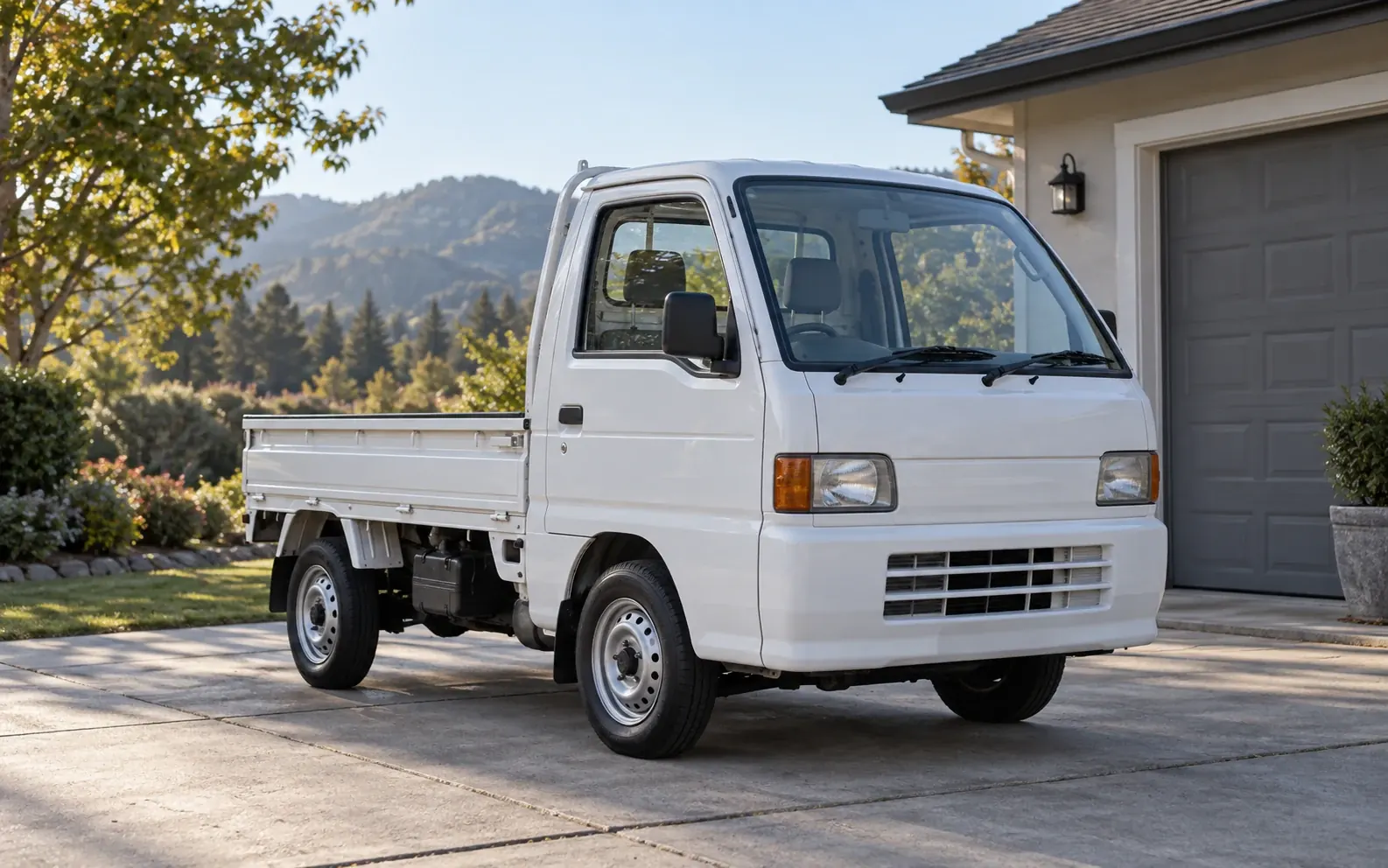
How to Insure a Kei Truck in the USA starts with the truck’s legal use in your state, its exact Japanese chassis identity, and a truthful description of how you will drive it. This guide turns those facts into a quote-ready file.
Road, collector, commercial, or off-road class.
Use the stamped Japanese identifier.
Review limits, exclusions, and effective date.
Match DMV requirements and keep cover active.
How to Insure a Kei Truck in the USA: the direct answer
Insurability depends on a real insurer’s acceptance of the specific vehicle and planned use.
Yes, a kei truck can be insured in the United States. There is no single national kei-truck policy or universal carrier. A licensed insurer must classify the truck correctly and issue a policy for the actual chassis number, garaging state, driver, and use. Ask for a written quote or binder, then compare the declaration and exclusions with your application.
Insurance and road permission are different decisions. NHTSA’s federal 25-year safety-standard exemption is measured from the date of manufacture; it is an import rule, not a state registration approval. A state can still limit or deny on-road registration, and a carrier can decline a truck that the DMV accepts. NHTSA import FAQ, current page checked September 27, 2026.
Start with the intended use
A truck used for paid delivery, farm work, personal errands, private-property work, or collector trips presents different policy questions. Do not call commercial use “personal” to fit an online quote form. If the vehicle is not eligible for public-road registration where you live, a road auto policy does not change that.
Which coverage belongs in the quote?
Use the state minimum as a floor for a permitted road vehicle, then decide what losses you want covered.
| Coverage | What it addresses | Kei-truck question to ask |
|---|---|---|
| Bodily injury and property-damage liability | Injury or property damage you cause to others, subject to terms and limits. | Is this truck accepted as a road vehicle in its actual registration class? |
| PIP or medical payments | Medical costs under the state and policy rules. | Is it mandatory or optional in my state and vehicle class? |
| Uninsured / underinsured motorist | Specified losses involving an uninsured or inadequately insured driver. | What limits, rejection rules, and forms apply? |
| Comprehensive and collision | Covered damage to the truck itself, such as theft/weather or a collision. | How will an imported truck be valued and repaired? What deductible applies? |
| Collector, off-road, or commercial form | A different use or vehicle classification. | Are commuting, delivery, farm tasks, storage, trailers, and mileage allowed? |
| Transit cargo coverage | Loss during Japan inland movement, ocean freight, or U.S. delivery. | Who covers each leg, when does risk transfer, and what is excluded? |
Coverage descriptions follow the NAIC’s June 11, 2026 consumer overview; policy wording controls. Transit is a separate contract question.
Six steps from auction candidate to insured truck
Gather the same identity and use facts for every insurer so quotes are comparable.
Screen the state path
Identify whether the truck can be titled and registered for the intended roads and what class or equipment applies. Use the USA import guide and your state guide.
Build the identity file
Record make, model, build month/year, stamped chassis number, photos, export certificate, bill of sale, CBP entry, HS-7 and EPA 3520-1 as relevant. Match every identifier.
Describe use honestly
Give garaging ZIP, drivers, annual miles, public-road versus private-property use, paid work, modifications, and estimated value. Mention right-hand drive and imported parts.
Apply by phone, not online
Online quote systems check the vehicle against a database of U.S. 17-character VINs. A Japanese kei truck chassis number is shorter, so online applications are often rejected. Call the insurer or a licensed agent, give the number exactly as stamped, and ask them to add the truck manually. Never add characters to make it fit.
Compare written terms
Compare equivalent limits and deductibles, declared vehicle ID, physical-damage value method, exclusions, roadside/towing terms, and effective date. A verbal “yes” is not the policy.
Bind, register, maintain
Arrange the state-accepted proof at the required time, then keep the policy active while registered. Update the insurer if the use, driver, garaging state, or truck changes.
Short chassis number, real paperwork
Japanese vehicles may use an identifier shorter than the U.S. 17-character format. Keep a photograph of the physical stamping and a consistent document chain. If an online form rejects it, phone the insurer and ask for the truck to be entered manually; never invent a VIN. A CBP ruling of April 5, 2023 identifies an imported Daihatsu Hijet mini dump truck by chassis number S510P-0494531, a typical short Japanese format.
What changes by state?
These are sourced examples, not a claim that one rule applies to every kei truck or every policy form.
| State | Published insurance rule | Why the workflow changes |
|---|---|---|
| Florida | For ordinary Florida registration, $10,000 PIP and $10,000 property-damage liability. Florida DFS Automobile Insurance Toolkit, current site-linked PDF (undated), checked Sep. 27, 2026. | Quote PIP and property-damage liability; verify the correct registration class and any added requirement for the use. |
| Michigan | Michigan No-Fault insurance is required for registration. Its SOS says a kei vehicle 25+ years old and made for on-road use may be titled and registered on-road; under-25 trucks are off-road only. SOS current FAQ, checked Sep. 27, 2026. | Age, original road design, import papers, and Michigan policy type must line up. |
| Connecticut | Minimum 25/50/25 liability plus 25/50 UM/UIM. Continuous insurance is required while registered. Insurance Dept. and DMV, current pages checked Sep. 27, 2026. | Do not cancel coverage while CT registration remains active; DMV proof rules matter. |
| Colorado | Minimum liability 25/50/15. Colorado General Assembly, current page checked Sep. 27, 2026. | Coverage minimum does not settle the truck’s registration or road-use route; check the Colorado kei guide. |
| Montana | Minimum liability 25/50/20 on public roads; a registered vehicle must keep minimum liability. Montana MVD current page, checked Sep. 27, 2026. | Quote the correct road or off-highway path; do not use an older manual’s lower property-damage figure. |
| California | Minimum liability 30/60/15 for private passenger, commercial, and fleet vehicles. Comprehensive or collision alone does not satisfy financial responsibility. California DMV current page, checked Sep. 27, 2026. | Resolve imported-vehicle registration first; coverage by itself does not make the truck road-eligible. |
Figures are dollars in thousands for bodily injury per person / per accident / property damage. Florida’s PIP/PDL structure is different and is shown separately. These published minimums are not a recommendation for adequate limits.
Kei-truck insurance preparation planner
Choose your state and use. The result identifies the next documentation and quote step; it does not calculate a premium or grant road permission.
Your next step
Quote preparationMichigan requires Michigan No-Fault coverage for registration; confirm the truck’s on-road eligibility and records.
Disclose occasional personal road use and request a written road policy quote.
Gather the exact chassis stamp, export certificate, and import records.
For other states, the tool deliberately avoids inventing insurance limits. Use the state insurance department and DMV as the controlling sources.
Why quotes fail, and what to do next
| Problem | Useful response |
|---|---|
| Online form rejects a short chassis ID | Phone the insurer or a licensed agent and ask them to add the truck manually, using the stamped number and matching export, customs, and title records. |
| Carrier calls it an ATV or farm implement | Show the actual design, registration class, plates or DMV response, and intended roads; do not accept a mismatched policy label. |
| Collector form excludes your use | Request ordinary or commercial coverage matching commuting or paid work, or change the planned use. |
| Physical-damage value is unclear | Discuss actual cash value versus agreed value, appraisal requirements, imported parts, and repair or total-loss handling in writing. |
| Coverage starts after delivery | Map the Japan, ocean, port, and U.S. inland legs; obtain separate transit cover where needed. |
The NAIC’s June 2026 coverage guide distinguishes liability, physical damage, and specialty vehicle coverage; actual policy terms decide the result.
What moves a 2026 quote?
There is no honest national kei-truck premium to publish.
Insurers price the combination of state and garaging ZIP, drivers and claims history, annual use, public-road or business exposure, desired liability limit, physical-damage value, deductible, and carrier appetite for an imported right-hand-drive truck. A rare clean example may require better value evidence; a work truck may need a different policy form. Compare two or more written quotes with the same coverages, not just the monthly payment.
A documented auction grade, condition report, photos, service history, originality, and repair or parts availability help explain the truck’s value to an underwriter. They do not guarantee an agreed value or a low rate. Keep the purchase invoice and landed-cost records for the discussion.
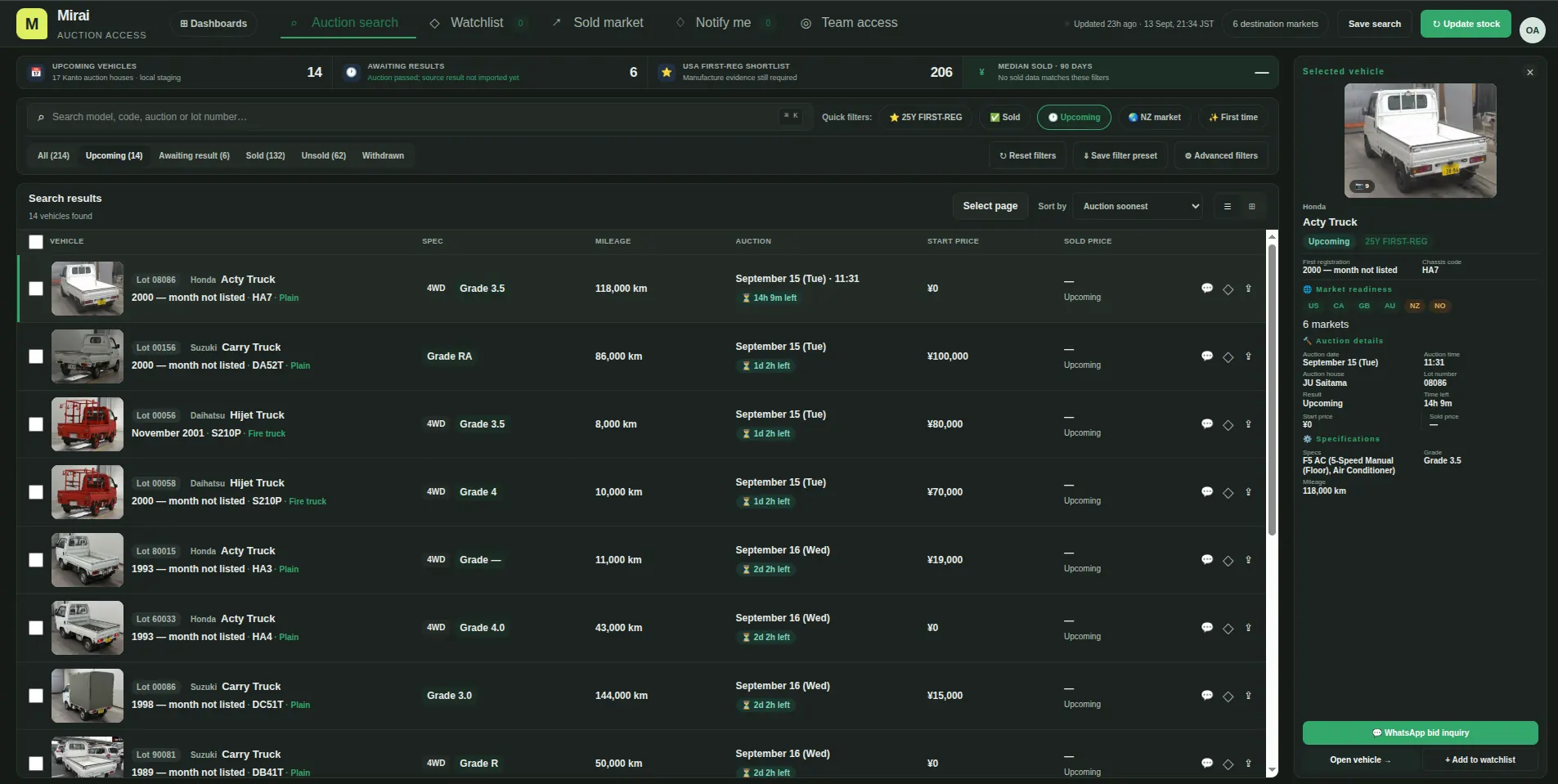
Find a quote-ready candidate through the Mirai Auction Portal
Customers get exclusive access after inquiry to search major auctions across Japan with robust filters for a U.S. buying brief.
The Mirai Auction Portal helps you shortlist kei trucks by age, model, drivetrain, condition, grade, and available identity details. Mirai can then help assemble the candidate’s chassis, auction, export, and shipping file so your insurer can evaluate the exact vehicle. A “USA-ready” filter is a screening aid, not a guarantee of federal entry, state registration, or insurance acceptance; the auction listings are not Mirai-owned public inventory.
Tell us your state, intended use, and preferred truck before we narrow candidates. If the insurance path is uncertain, ask a licensed U.S. agent to assess a representative candidate or its final chassis ID before bidding.
Kei truck insurance FAQs
Direct answers to the questions buyers raise while planning a U.S. import.
Can you insure a kei truck in the USA?
Yes, when an insurer accepts the specific truck, state, registration class, and intended use. Coverage does not by itself authorize public-road driving.
Does the 25-year import rule make a kei truck street legal?
No. NHTSA’s 25-year rule concerns federal safety-standard import eligibility; a state still decides title, registration, equipment, and road use.
Can a short Japanese chassis number be insured?
Yes, some insurers can add a non-17-character chassis number manually, usually by phone rather than through an online form. Give the exact stamped number and matching export and import records; never pad or invent a VIN.
Is liability insurance enough for a kei truck?
Generally no. Liability may meet an applicable state minimum, but it does not cover damage to your own truck; ask about comprehensive and collision if that loss matters to you.
Does a personal auto policy cover business use?
Generally no. Delivery, paid work, and other commercial use may be excluded from a personal policy. Tell the agent precisely how the truck will be used and request the appropriate written coverage.
Can I use collector or antique insurance for daily driving?
Generally no. Collector policies often restrict mileage, use, storage, or commuting. Read the actual policy terms and choose a form that fits the planned driving.
Does a policy cover the truck while it is shipped from Japan?
Generally no. Domestic auto coverage should not be assumed to include ocean or inland cargo transit. Ask the exporter and freight provider what transit cover is in force and when risk transfers.
Can I insure an off-road-only kei truck?
Yes, physical-damage or specialty coverage may be available, but an off-road policy is not a public-road liability policy. Describe private-property use, transport, and storage to the insurer.
Do I need insurance before registering the truck?
Generally yes when the state requires proof for registration, but the exact proof and timing vary. Obtain a written quote or binder that identifies the vehicle and verify what your DMV accepts.
What if an online quote form rejects the chassis number?
Call the insurer or a licensed agent instead of applying online, and ask them to add the truck manually. Online systems expect a 17-character VIN, so a shorter Japanese chassis number often fails. Have clear photos of the chassis stamp and vehicle, the export certificate, customs entry, and any existing title ready.
How much does kei truck insurance cost in 2026?
There is no reliable national price. Quotes change with state, ZIP code, use, driver, vehicle value, coverage, deductible, and carrier appetite; compare written quotes on the same terms.
Can Mirai arrange my US insurance?
No. Mirai can provide vehicle identity, auction, export, and shipping records for your application. A US-licensed insurer or agent decides whether and how to insure the truck.
Primary sources and method
Checked September 27, 2026. Dated sources are identified by their latest available edition or date; undated agency pages are marked as current live pages.
- NAIC, “What Does Auto Insurance Cover?”, June 11, 2026.
- NHTSA, Importation and Certification FAQs, current live page; CBP, kei-truck classification ruling N331411, April 5, 2023.
- Florida DFS, Automobile Insurance Toolkit, current site-linked PDF (undated); Florida DFS auto-insurance overview.
- Michigan SOS, Titles FAQ and insurance FAQ, current live pages.
- Connecticut Insurance Department, Auto Insurance; CT DMV, compliance, current live pages.
- Colorado General Assembly, Mandatory Automobile Insurance, current live page.
- Montana MVD, Vehicle Insurance and Verification, current live page.
- California DMV, Insurance Requirements, current live page.
- USA.gov, state motor-vehicle services directory.
Editorial method
Mirai compared current U.S. regulator and DMV materials for the six examples above and separated federal import eligibility from state road-use and insurance rules. The article explains purchasing and documentation workflow, not individualized legal or insurance advice. A licensed insurer issues the policy; the relevant DMV controls registration.
Source a truck with an insurance-ready file
Share your state, intended use and model preferences. Mirai can narrow auction candidates and prepare the vehicle records you can take to a U.S. insurer.