
Are Kei Trucks Legal in Arizona? Registration, Roads & Rules
Are kei trucks legal in Arizona? A qualifying kei truck can be legal for Arizona road use, but the answer is not an unconditional yes. The practical route is a vehicle at least 25 years old that was lawfully imported, has an ownership and federal-compliance file Arizona MVD accepts, completes any required VIN and emissions checks, and receives an Arizona title, registration, plate and insurance. Back to all state laws. Neighboring state guides: California.
Arizona has no kei-truck-specific blanket ban in the current statutes and MVD materials reviewed for this guide. Instead, Arizona applies its foreign-vehicle title law. A direct-from-Japan applicant should expect to prove lawful federal entry, ownership and applicable federal safety/emissions status under A.R.S. § 28-2052. Arizona MVD says the precise requirements for an out-of-country vehicle vary by circumstance, so confirm the file with MVD before buying or shipping.
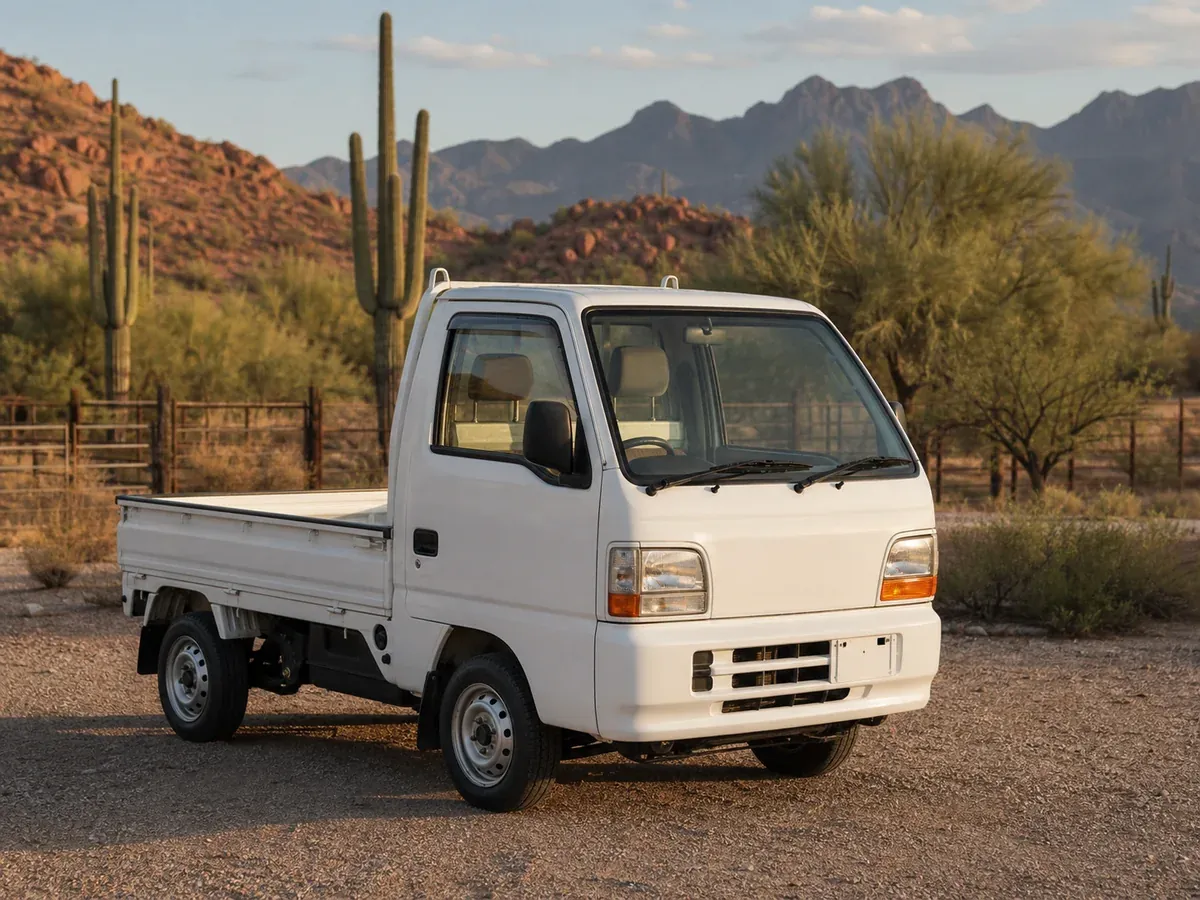
1Are Kei Trucks Legal in Arizona?
Arizona uses a document-and-classification analysis rather than a simple list saying “kei trucks allowed” or “kei trucks prohibited.”
A kei truck is a compact Japanese-market pickup originally built for Japan’s kei vehicle class. Its small size, 660cc-or-smaller engine and short chassis do not decide Arizona legality. The decisive questions are whether the truck entered the United States under a lawful federal route and whether Arizona MVD issues the truck a title and registration appropriate for public-road use. Mirai Trading LLC sources Japanese kei trucks for export and can help identify an age-qualified chassis before you start the Arizona paperwork.
A.R.S. § 28-2052 expressly addresses vehicles previously registered in another state or country. The owner must provide foreign registration/ownership evidence, and MVD may inspect the vehicle. Before Arizona titles a vehicle imported into the United States, the statute also requires a certificate or evidence establishing compliance with applicable federal vehicle-equipment and emissions requirements.
What this means for a normal 25-year kei import
The strongest file pairs NHTSA’s 25-year route with EPA’s age-based route: proof of the actual manufacture date, HS-7 declaring Box 1, EPA Form 3520-1 using the correct eligibility code, CBP entry documentation, the Japanese export certificate, a reliable English translation and the purchase/transfer documents. Because Arizona MVD publicly says out-of-country requirements vary, get a case-specific document confirmation before the truck ships. Mirai Trading LLC’s guide on how to import a kei truck from Japan walks through the same document sequence in more detail.
An out-of-state title is not a cure
A title from another state can simplify proof of ownership, but it does not legalize a vehicle that was imported under an off-road-only, temporary, racing or false federal declaration. Arizona may inspect a foreign vehicle and may refuse a title when the applicant is not entitled to one.
Why the answer online is often inconsistent
Some summaries mix three different things: Japanese kei classification, federal import eligibility and Arizona registration class. Others assume every small truck is an OHV or low-speed vehicle. Arizona’s definitions depend on how a vehicle was designed and registered—not merely its width, engine size or top speed. Treat a standard road kei truck, an OHV and a neighborhood electric vehicle as separate paths.
2Which Arizona Vehicle Class Fits?
Use the vehicle’s original design and the title path. Choosing an easier-sounding category can create a registration problem later.
Standard imported motor truck
A Japan-market kei pickup manufactured for on-road use and admitted under the applicable federal motor-vehicle rules. This is the relevant route for ordinary street use when Arizona accepts the title file.
Neighborhood electric vehicle
An electric low-speed class meeting federal LSV standards. Arizona caps it at 25 mph and bars it from roads posted above 35 mph, except to cross. A gasoline kei truck is not an NEV.
Off-highway vehicle
A vehicle designed, modified or purpose-built primarily for recreational nonhighway all-terrain travel. A road-designed kei truck does not become an OHV simply because it is compact or useful on dirt.
Do not use an OHV declaration to bypass the import file
Arizona’s OHV system covers machines designed primarily for unimproved terrain and weighing 2,500 pounds or less. Street-legal OHV registration and the annual decal can apply to qualifying ATVs and side-by-sides, but that is not a general conversion program for an on-road Japanese truck. An HS-7 off-road declaration also carries a different federal premise: it says the machine was not primarily manufactured for public-road use. That premise normally conflicts with later presenting the same kei truck as an ordinary road motor vehicle.
3Federal Import Rules Before Arizona Registration
Arizona cannot fix an unlawful federal entry. Verify the federal route before negotiating price or freight.
NHTSA safety eligibility
A nonconforming vehicle at least 25 years old may be imported without current FMVSS compliance. Age runs from the actual manufacture date.
NHTSA • HS-7 BOX 1EPA emissions eligibility
EPA Code E generally covers a vehicle at least 21 years old in original unmodified configuration. A replacement engine can change the result.
EPA • FORM 3520-1Customs entry
CBP processes the entry and duty. Form 7501 is central evidence that the specific chassis entered lawfully.
CBP • ENTRY SUMMARYArizona acceptance
MVD reviews ownership, foreign registration and federal equipment/emissions evidence and may inspect the vehicle before title or registration.
ARIZONA MVDThe 25-year clock is exact
NHTSA states that 25 years runs from the date of manufacture. On July 18, 2026, a truck built in August 2001 is not yet 25 even though someone may advertise it as a “2001 model.” Ask for the export certificate and chassis records showing the month and year. Do not clear customs under Box 1 early.
EPA’s rule is separate
EPA’s age calculation and configuration condition are different. The Code E route applies to a vehicle at least 21 years old and in original unmodified configuration. A swapped engine, altered emissions configuration or incomplete declaration can defeat that route even when the truck satisfies NHTSA’s 25-year rule.
Budget customs conservatively
CBP’s general vehicle guidance lists a higher general duty rate for trucks than for passenger cars, but the tariff classification, origin, entry type and any applicable treatment control the actual amount. Obtain a written landed-cost estimate from a licensed customs broker using the specific chassis and invoice; do not budget from an auction price alone.
Never import a road kei truck as “off-road” just to avoid the age rule
NHTSA’s off-road route applies when the vehicle was not primarily manufactured for public streets, roads and highways. A Japanese road truck imported under that declaration may later be impossible to support as a standard on-road vehicle in Arizona.
4How to Register a Kei Truck in Arizona
Use this as a preparation sequence. MVD may request additional evidence for a specific chassis or ownership history.
Confirm eligibility
Verify the manufacture month, original engine/configuration and the federal declaration route before purchase.
Build the title file
Collect the export certificate, translation, transfer documents, CBP 7501, HS-7 and EPA 3520-1.
Pre-check with MVD
Ask which documents satisfy § 28-2052 for this out-of-country vehicle and whether an inspection appointment is required.
Emissions & inspection
Test first when the registered address or commute is in an emissions area; complete the required VIN inspection.
Title and register
Submit Form 96-0236, ownership/federal evidence, insurance information and fees; mount the rear plate.
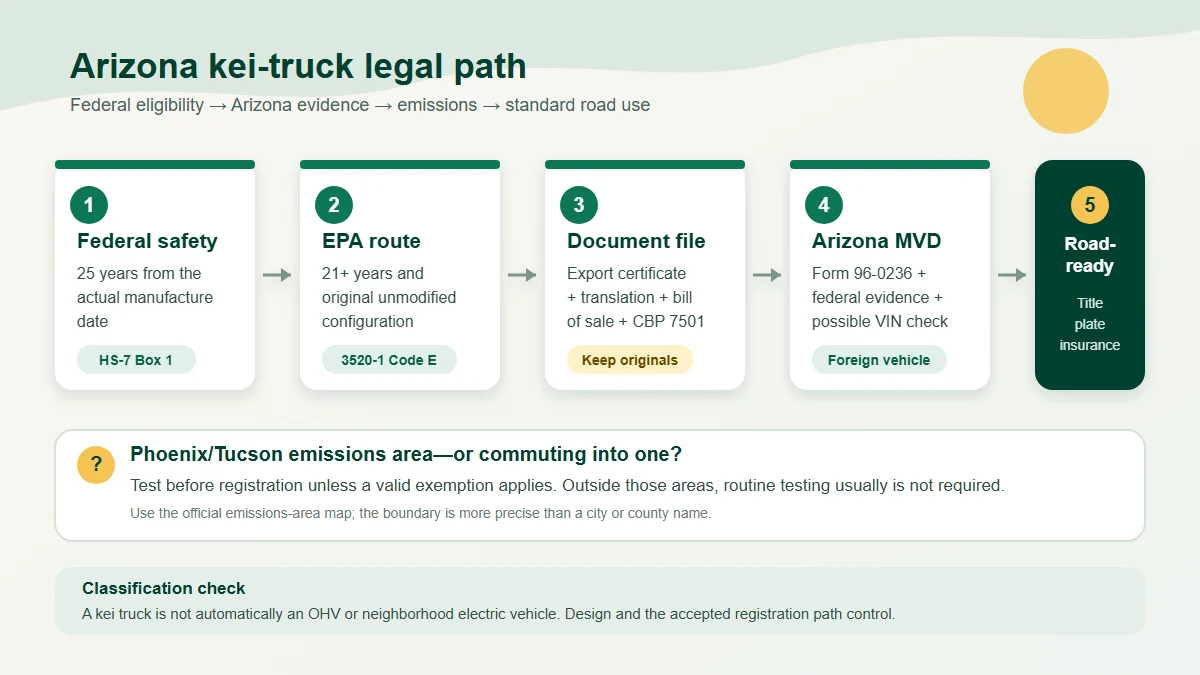
Step 1: Contact MVD before the truck arrives
Arizona MVD’s current FAQ says additional requirements for out-of-country vehicles vary with the circumstances and directs owners to contact MVD. That is especially important for a short Japanese chassis number, an export certificate rather than a U.S.-style title, or a truck arriving directly from a port. Ask whether the selected office handles foreign-vehicle work and what it expects as the federal “certificate of compliance” evidence under § 28-2052(D).
Step 2: Arrange the correct inspection
A Level I inspection matches the serial/VIN to ownership documents and is used for some out-of-state or out-of-country vehicles without ordinary proof of title or registration. MVD says Level I at an MVD office has no state fee; an authorized third party may charge. Unusual identifiers or secondary VIN concerns can send the case to Level II, which is performed by an ADOT officer and carries a $20 fee plus $5 if Arizona assigns a number. Do not stamp, replace or “convert” the Japanese chassis number yourself.
Step 3: Apply promptly
Arizona generally requires a buyer to apply for title within 15 days of purchase or transfer. Use the current Title and Registration Application, Form 96-0236. A direct foreign import is not a routine online eTitle transfer; plan an office transaction and bring originals plus organized copies.
Step 4: Treat approval as case-specific until issued
A trip permit lets an eligible unregistered vehicle travel for stated purposes; it does not guarantee title approval. The $1 restricted-use three-day permit is limited to emissions testing, inspection, registration work or repairs needed for compliance. A 90-day resident permit may be available when documentation is incomplete, but it is not a substitute for obtaining the missing lawful-import or ownership evidence.
5Arizona Kei Truck Document Checklist
Keep an original packet, a working copy and a secure digital scan. Chassis-number consistency matters across every page.
Federal import and foreign ownership file
- Japanese export certificate or deregistration certificate
- Accurate English translation identifying the same chassis
- Invoice and signed bill of sale or chain of transfer
- CBP Form 7501 entry summary and release evidence
- DOT/NHTSA HS-7 declaration showing the lawful entry basis
- EPA Form 3520-1 and supporting configuration evidence
- Proof of actual manufacture month and year
- Broker, importer and port records tied to the chassis
Arizona title and registration file
- Completed and signed Form 96-0236
- Government-issued identification and Arizona address
- Foreign plates/registration surrendered when required
- MVD vehicle-inspection result when required
- Emissions pass, waiver or valid exemption when applicable
- Arizona insurance information from an authorized carrier
- Lien release or lienholder documents when applicable
- Payment for title, registration, VLT and transaction fees
Short Japanese chassis numbers are normal—but must be verified
Many kei trucks do not have a 17-character North American VIN. Arizona law uses the vehicle’s manufacturer serial number, and MVD can inspect or assign an identification number when appropriate. Make sure the number stamped on the chassis matches the export certificate, translation, customs entry and purchase documents character for character.
What if a document is missing?
Do not assume a bonded title erases a customs or federal-compliance problem. Arizona’s bonded-title process addresses insufficient proof of ownership or undisclosed interests; it does not rewrite how the vehicle entered the United States. If the CBP entry, HS-7 or EPA declaration is missing, recover it from the importer, customs broker or responsible agency before purchase. If the seller refuses to provide it, walk away.
6Emissions Testing in Phoenix and Tucson
Arizona’s metro emissions program is one of the most important practical differences for kei truck owners.
ADOT says testing is required in the Phoenix and Tucson metropolitan emissions areas, including for some vehicles registered outside those boundaries but used to commute into them. The official boundary map—not a broad city or county label—controls. A 25-year-old kei truck is not automatically exempt merely because it qualifies for federal import.
For a gasoline kei truck from the late 1990s or 2000–2001, expect the assigned test protocol to depend on model year, fuel, weight and the emissions area. Arizona law also provides for a tampering inspection on vehicles manufactured after the 1974 model year. Missing or disabled original emissions components can therefore become a registration obstacle.
Federal age exemption does not equal an Arizona emissions pass
EPA Code E determines the federal import route. Arizona’s vehicle emissions inspection is a separate in-use registration requirement. A truck can be lawfully imported and still fail the Arizona test.
Collector-vehicle exemption is narrow
Arizona law defines a collectible vehicle as at least 15 years old or otherwise rare/limited, maintained mainly for club activities, exhibitions, parades or a private collection, used only infrequently for other purposes, and covered by collector/classic insurance that restricts mileage or use and requires another personal-use vehicle. That can help a genuine collection truck, but it does not fit a daily driver, delivery truck or regular work vehicle. Losing the qualifying insurance can cancel both registration and the exemption.
Outside the emissions areas
Routine emissions testing usually is not required for a vehicle registered and used outside the Phoenix and Tucson program areas. However, commuting into an emissions area can trigger testing. Verify the exact address and work pattern in the current ADOT/ADEQ map before assuming a five-year registration is available.
7Where and How May an Arizona Kei Truck Be Used?
A standard Arizona registration permits normal road use, subject to ordinary traffic, equipment, insurance, cargo and land-access rules.
City and local road driving
A properly titled, registered, insured and equipped kei truck follows the ordinary rules for its registered vehicle class. Route choice must remain safe for actual traffic speed and conditions.
State highways and freeways
No kei-specific freeway ban appears in the state materials reviewed, but Arizona prohibits driving so slowly that normal traffic is impeded. High-speed, steep or windy routes may be unsuitable.
Farm, ranch and property work
Private-land work is a natural use. Public-road trips still require registration and insurance; business or farm classification and coverage must match the actual operation.
Forest and desert roads
Use the controlling Motor Vehicle Use Map and land-manager rules. Street registration does not open closed trails, cross-country travel or routes limited by vehicle class.
Delivery and business use
Arizona requires commercial registration for certain light-duty vehicles used commercially 1,000 or more hours in a registration year, and generally for a business-titled vehicle unless noncommercial use is certified.
OHV-only trails
A road-designed kei truck is not automatically an OHV and may be too wide, heavy or wrong-class for a trail. An OHV decal is not universal access permission.
| Use | Standard-registered kei truck | Key Arizona condition |
|---|---|---|
| Neighborhood streets | Generally lawful | Valid license, registration, insurance and required equipment; obey local restrictions. |
| Interstate/freeway | Legally possible, often imprudent | Do not impede traffic; evaluate actual sustained speed, heat, grades, braking and crosswinds. |
| Two-lane highway | Route-dependent | A driver below normal flow must use a safe turnout when five or more vehicles queue behind. |
| Private farm/ranch | Owner permission controls | Registration rules may not apply wholly on private land; ownership, import and safety still matter. |
| National Forest road | Check the MVUM | Route designation, vehicle class, season and closures control. |
| Arizona State Trust land | Permit/access rules apply | Travel stays on existing roads/trails; recreation, staging or parking may require a permit. |
| OHV trail | Not assumed | Verify trail vehicle class and whether the truck legally qualifies as an OHV. |
| Regular delivery/work route | Commercial review needed | Registration class, commercial insurance, cargo securement and business rules must match use. |
Arizona’s slow-traffic rule matters
A kei truck may be capable of 50–65 mph depending on model, gearing, load, grade and condition, but maximum speed is not the same as comfortable sustained speed — see Mirai Trading LLC’s realistic kei truck highway speed breakdown for model-specific figures. A.R.S. § 28-704 prohibits driving so slowly as to impede normal traffic. On a two-lane road where passing is unsafe, a driver with five or more vehicles queued behind must use the nearest safe turnout. Plan routes around this rule rather than treating the accelerator as a safety strategy.
Desert heat and elevation change the risk
Arizona combines extreme low-desert temperatures with long grades and high-elevation routes. Before road use, service the cooling system, pressure-test hoses and cap, verify fan operation, fit load-rated tires, check brake fluid and shoes/pads, and confirm the spare. Air conditioning adds load to a small engine; heavy cargo, headwinds and elevation can reduce speed materially. Carry water for people, but never open a hot cooling system.
8Phoenix, Tucson and Other Arizona Locations
No separate city kei-truck registration class was found in the official materials reviewed. The largest practical difference is emissions geography.
Phoenix metro
Many addresses in the metro emissions area require testing. This can include Phoenix, Scottsdale, Tempe, Mesa, Glendale and nearby communities, but always use the official boundary map.
Tucson metro
Area B testing applies within the designated Tucson emissions boundary. Verify the exact address and the test cycle assigned to the truck.
Flagstaff & northern Arizona
Routine metro emissions testing usually does not apply. Snow, elevation, grades and cold starts make route and maintenance planning different from the low desert.
Prescott & Prescott Valley
Usually outside the metro emissions program. Hills, faster arterials and summer heat still demand realistic performance and cooling checks.
Yuma & western desert
Extreme heat and long high-speed distances are the main ownership constraints. Verify cooling, tires and insurance before relying on a kei truck for daily travel.
Kingman & Route 66 region
Older road networks can suit short local trips, but I-40 and long grades are a separate safety decision. Avoid routes the truck cannot safely match.
Sierra Vista & Cochise County
Usually outside Phoenix/Tucson testing boundaries. Local registration, insurance and equipment rules still apply, as do federal land route designations.
Rural and tribal lands
State registration does not override tribal, federal, county or private access rules. Obtain permission and check the controlling road authority.
Municipal rules can still affect operation
Cities and counties control parking, loading, neighborhood restrictions, road closures and local traffic engineering. A standard Arizona plate does not create a right to use closed roads, park commercial equipment where prohibited or ignore an HOA/private-property rule.
9Equipment, Insurance and Driver Requirements
Federal age eligibility does not waive Arizona’s in-use safety rules.
Road-equipment inspection
- Adequate service and parking brakes
- Headlamps, tail lamps, stop lamps and turn signals
- Required reflectors and a working license-plate light
- Audible horn and lawful muffler/exhaust
- Adequate windshield and working wiper
- Rearview mirror with a clear view
- Seat belts/restraints required for the vehicle and occupants
- Load-rated tires without cracking or dangerous age
Insurance and operating file
- Arizona liability policy from an authorized company
- Minimum 25/50 bodily injury and 15 property damage
- Proof available during traffic stops or crashes
- Business-use disclosure when the truck earns income
- Correct listed chassis/VIN and garaging address
- Driver license valid for the operation
- Registration kept current and rear plate legible
- Cargo tied down within bed and axle limits
Insurance before purchase
Specialty insurers vary on short VINs, right-hand drive, commercial work and physical-damage coverage. Send the carrier the exact chassis, year, make/model, photos, appraisal or invoice and intended use. Obtain a written quote before the truck is nonrefundable. Arizona requires coverage through a company authorized to do business in the state and gives 30 days after initial registration for electronic proof to reach MVD; that reporting window is not permission to drive uninsured.
Right-hand drive is not the legal problem
Right-hand drive is not itself prohibited. The practical issues are sightlines for left turns, passing, drive-throughs and roadside stops. Adjust mirrors, avoid blind passes and consider a passenger-side camera only as a supplement—not a substitute for safe positioning.
Cargo and towing
Use the truck’s verified chassis plate, Japanese manual and axle/tire ratings. Kei trucks commonly have a Japan-market bed payload rating around 350 kg (about 770 lb), but the exact truck controls, and accessories or occupants reduce available capacity. Review Mirai Trading LLC’s kei truck towing and payload limits guide before assuming a number. Do not infer a towing rating from payload; many kei trucks lack a manufacturer-approved North American towing specification. An unverified hitch can create braking, frame and insurance problems.
10Arizona Fees, VLT, Plates and Historic Status
The small statutory fees are only part of the total. Vehicle License Tax and transaction-specific costs vary.
Arizona statute lists a $4 certificate-of-title fee and an $8 motor-vehicle registration fee. The registration bill can also include the Vehicle License Tax, air-quality charges, postage, inspection/assigned-number fees, special-plate charges and authorized-third-party convenience fees. VLT depends on the value and age data in the state record, so obtain an MVD estimate for the specific truck instead of publishing a single “kei truck registration price.”
Arizona generally issues a rear plate, which must be secure, legible, unobscured and at least 12 inches above the ground. A standard plate adds no special fee. Special and personalized plates have additional annual costs.
Historic plate
A.R.S. § 28-2484 defines a historic vehicle to include one whose original model year is at least 25 years old, subject to MVD approval. That makes many federally age-qualified kei trucks old enough to apply. The historic plate is an optional plate category after the underlying title eligibility is satisfied; it does not replace the import documents, emissions analysis or insurance.
Historic plate is not the same as collectible-emissions exemption
These are separate programs. The emissions exemption depends on restricted collector/classic insurance, infrequent other use and another personal-use vehicle. Do not advertise a historic plate as an automatic emissions waiver or as permission for unrestricted daily work use.
Commercial registration
Arizona’s MVD says a passenger car, three-quarter-ton-or-less pickup or van used commercially for 1,000 or more hours in a registration year must be registered commercially. A vehicle titled to a commercial enterprise is generally commercial unless the applicant certifies it will not be maintained and used commercially. A kei truck’s light weight does not eliminate this analysis.
11Arizona Pre-Purchase Checklist
Resolve title, emissions and insurance questions while the seller still has an incentive to provide evidence.
Eligibility and paperwork
- Verify actual manufacture month; require at least 25 full years
- Match chassis number across vehicle and every document
- Confirm HS-7 Box 1 and EPA 3520-1 eligibility
- Inspect the original CBP 7501 and importer identity
- Require export certificate and professional translation
- Reject an off-road-only, racing or temporary import for road plans
- Ask Arizona MVD what it will require for this file
- Obtain an Arizona insurance quote in writing
Mechanical and use suitability
- Compression, smoke, leaks and timing-belt history
- Cooling-system pressure test and fan operation
- Brake, steering, wheel-bearing and CV-joint inspection
- Tire date codes, load rating and Arizona heat condition
- All lights, horn, wiper, belts and mirrors working
- Emissions equipment intact for the declared configuration
- Test route speed, grade, cargo and climate honestly
- Price parts supply, specialty labor and recovery/towing
Do not pay a “street legal” premium for a seller’s promise
Ask for the current title, registration record and complete import file. If the truck is not yet Arizona-titled, make the purchase contingent on document review and understand who bears the risk if MVD requests unavailable federal evidence.
Best fit for Arizona
A kei truck is most convincing for short local trips, ranch/property work, campus or facility operations, light hauling and lower-speed routes. It is a weaker fit for daily Phoenix freeway commuting, long I-10/I-40 distances, repeated heavy loads or an owner who cannot obtain specialty parts. Legal eligibility and use suitability are different decisions. Contact Mirai Trading LLC to source an Arizona-eligible kei truck once you have confirmed the document requirements with MVD.
12Kei Trucks Arizona FAQs
Concise answers based on the current federal and Arizona sources reviewed July 18, 2026.
Are kei trucks legal in Arizona?
They can be. The realistic route is a lawfully imported truck at least 25 years old, supported by ownership and federal compliance evidence that Arizona MVD accepts, plus any required inspection/emissions pass, title, registration, insurance and road equipment.
Does Arizona have a kei-truck-specific law?
No. The current statutes and MVD materials reviewed do not publish a special kei-truck class or blanket ban — Arizona applies its foreign-vehicle title law, normal registration rules, emissions geography and vehicle-design classifications instead.
Must a kei truck be 25 years old?
Yes, for a normal Japan-market truck without U.S. FMVSS certification — 25 years from the actual manufacture date is the practical NHTSA route. A younger nonconforming truck generally requires an eligible Registered Importer pathway, not an ordinary purchase.
Can a 2001 kei truck be imported in 2026?
Only after the specific truck reaches 25 years from its manufacture month. A December 2001 truck does not qualify under NHTSA’s age route until December 2026.
What documents does Arizona MVD need?
Plan for Form 96-0236, foreign ownership/registration, English translation, bill of sale, CBP Form 7501, HS-7, EPA Form 3520-1, age evidence, identification, emissions proof when applicable and any inspection record. MVD says exact out-of-country requirements vary.
Will Arizona inspect the Japanese chassis number?
It may. Level I verification is used for some out-of-country vehicles to match the serial/VIN to ownership evidence. Unusual or secondary identifiers can require a higher inspection level.
Does a kei truck need emissions testing in Phoenix?
Usually yes if registered or used to commute within the designated Phoenix emissions area, unless a specific exemption applies. Being 25 years old does not by itself create an emissions exemption.
Does a kei truck need emissions testing in Tucson?
Yes, within the designated Tucson emissions area, subject to the assigned vehicle test and valid exemptions. Verify the precise boundary and vehicle record before registration.
Can collector insurance exempt a kei truck from emissions?
Yes, but only if the truck meets Arizona’s collectible-vehicle definition, is used mainly for collection, club or exhibition purposes, is infrequently used otherwise, has restricted collector coverage and the owner has another personal-use vehicle.
Can an Arizona kei truck drive on the freeway?
Yes — a standard-registered truck is not subject to a kei-specific freeway ban found in the reviewed sources. Arizona still prohibits impeding normal traffic, and many kei trucks are a poor safety fit for fast freeways, heat, grades and crosswinds.
Is a kei truck an Arizona OHV?
Not automatically. Arizona’s OHV definition centers on vehicles designed or purpose-built primarily for recreational nonhighway all-terrain travel. A Japan-market road pickup should not be relabeled as an OHV merely because it is small.
How much does Arizona registration cost?
The base statutory fees include $4 for title and $8 for motor-vehicle registration, but Vehicle License Tax, air-quality charges, inspection or assigned-number fees, postage, plates and third-party fees can change the total.
What insurance is required?
Arizona’s minimum liability limits are $25,000 for injury/death to one person, $50,000 for two or more people and $15,000 for property damage. The policy must come from a company authorized in Arizona and must reflect actual personal or business use.
Can I use a kei truck for business or farm work?
Yes if the truck is properly titled, registered and insured for the use. Arizona can require commercial registration based on business ownership and use hours. Farm/ranch access, cargo, employee operation and public-road trips may add separate requirements.
13Sources, Scope and Editorial Method
Primary government sources were prioritized. The legal conclusion is deliberately qualified where Arizona publishes case-specific rather than kei-specific instructions.
- Arizona Legislature: A.R.S. § 28-2052, title and registration of foreign vehicles
- Arizona MVD Vehicle Services FAQ: out-of-country vehicles, inspections, insurance and permits
- Arizona MVD: Level I, II and III vehicle inspections
- Arizona MVD: vehicle registration, emissions and out-of-state requirements
- Arizona MVD: Phoenix and Tucson emissions testing
- Arizona Legislature: A.R.S. § 49-542 emissions program and collectible-vehicle exemption
- Arizona MVD: mandatory insurance and 25/50/15 limits
- Arizona Legislature: A.R.S. § 28-704 slow-speed and turnout rule
- Arizona Legislature: A.R.S. § 28-2484 historic vehicles
- Arizona MVD: commercial registration for light-duty vehicles
- Arizona Game and Fish: OHV decals and street-legal OHV requirements
- Arizona State Land Department: recreational permit and motorized access conditions
- NHTSA: 25-year import rule and manufacture-date evidence
- EPA Form 3520-1: Code E age and original-configuration requirements
- CBP: entry documentation commonly needed for state registration
How this guide was prepared
Research, drafting and original visual production were AI-assisted under Mirai Trading LLC’s editorial workflow. Government pages and statutes were checked on July 18, 2026, and cross-checked against current sources before publication; federal import, Arizona title, emissions, insurance, road operation and land access were treated as separate gates. This guide was reviewed by Mirai Trading’s editorial team, who have direct experience exporting and documenting Japanese vehicles for U.S. buyers, but no team member holds formal Arizona legal, DMV/title-compliance or insurance-licensing certification. This is general information, not legal, DMV, insurance or import-compliance advice—confirm your specific situation with the Arizona MVD, a licensed Arizona insurance agent or a qualified import-compliance professional before importing or registering a vehicle.
Source an Arizona-eligible kei truck
Mirai Trading LLC can help identify an age-qualified Japanese kei truck and organize the export-side vehicle documents. Arizona title approval, emissions, insurance and road-use decisions remain with the applicable agencies and providers.