
Are Kei Trucks Legal in Minnesota? Local Permit and Road Guide
Yes, with limits: under Minn. Stat. §169.045 (2025 text), a qualifying mini-truck may use roads that a county, city or town has designated by ordinance, after that authority issues a permit. Private-land use is separate; this is not a statewide plate. Back to all state laws.
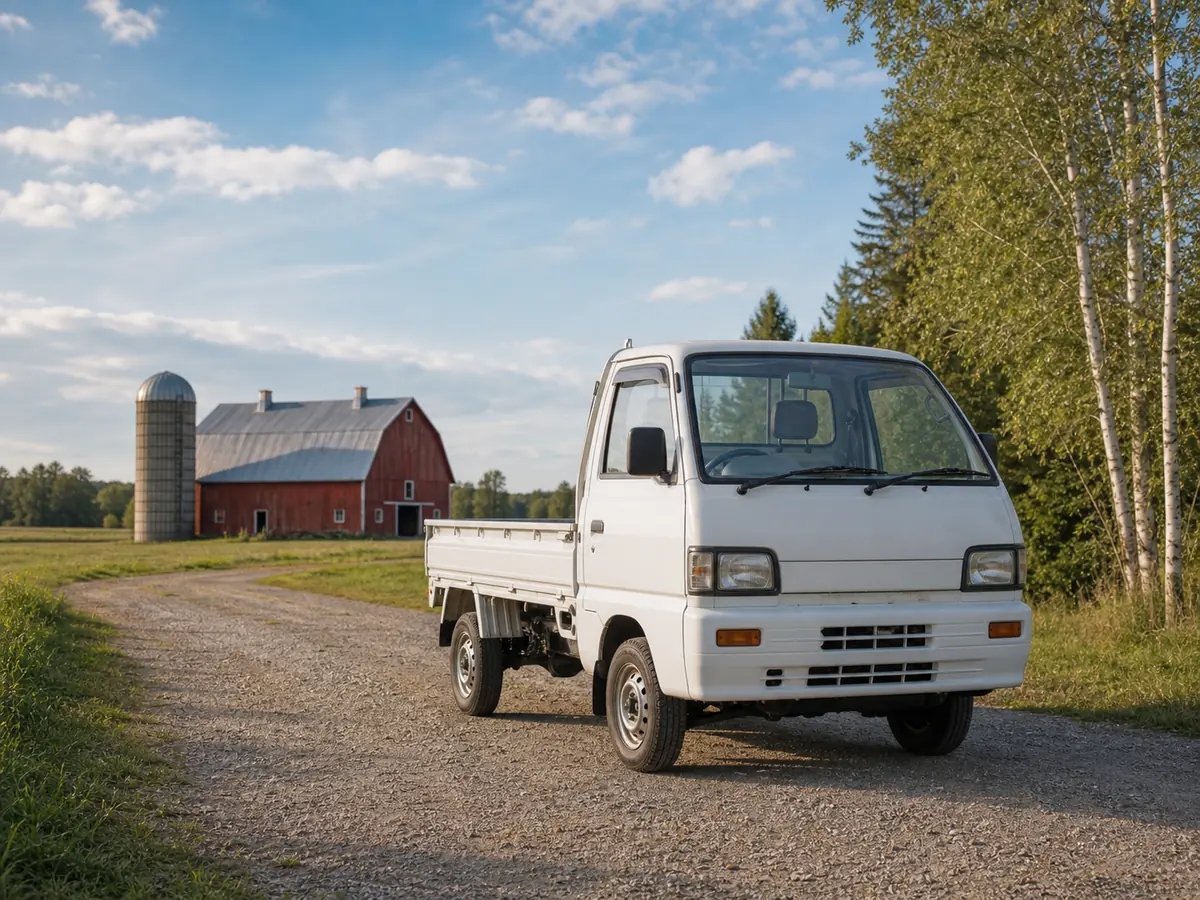
Only on designated roads.
Current published statutory text.
House Research, February 2026.
A locality may use a shorter term.
Are kei trucks legal in Minnesota? The route table
The intended use matters, but the owner of the road makes the permit decision.
| Route | What it allows | Who decides | Basis |
|---|---|---|---|
| Private property | Use with landowner permission; public-road permit does not apply while the truck stays on the property. | Landowner and applicable property rules | House Research, February 2026, p. 6 |
| Designated local road | Operation under an issued mini-truck permit, on the road or portion named in an ordinance. | City, town or county with jurisdiction | §169.045, subds. 1–2, 2025 |
| Intersecting highway crossing | Direct crossing where it intersects the designated road; not travel along the highway. | State statute and permitted route | §169.045, subd. 5, 2025 |
| Other roads or trails | The local permit alone does not authorize them. | Other road authority or trail manager | House Research, February 2026, pp. 16–17 |
A city permit does not automatically carry onto a county road. Minnesota has no statewide mini-truck speed cap or statewide mini-truck sunrise-to-sunset rule in §169.045; read the actual local ordinance for additional conditions.
Does the truck fit Minnesota’s mini-truck definition?
A kei badge or 25-year import age alone is not the classification test.
Minn. Stat. §169.011, subdivision 40a (2025) requires four wheels; an electric motor rated at no more than 7,500 watts or an internal-combustion engine of no more than 660 cc; dry weight from 900 to 2,200 pounds; an enclosed cabin and operator seat; a pickup- or van-like rear cargo space; and original manufacture without the specified federal motor-vehicle or low-speed-vehicle standards. It excludes neighborhood electric vehicles and medium-speed electric vehicles. Check engine displacement, dry-weight evidence, cabin and cargo configuration, and chassis identity against the actual candidate.
The February 2026 House Research brief (pp. 16–17) says a mini-truck under this route is not titled or registered with DPS in the ordinary on-road manner and needs no ordinary license plate. Minnesota’s foreign-import title-document statute, §168A.085 (2025) describes ownership paperwork for vehicles that do enter the title system; it does not turn a mini-truck local permit into statewide registration. An out-of-state title or plate likewise does not expand the Minnesota permit.
Minnesota local-permit route checker
Choose the trip and road authority. This plans the next inquiry; it does not approve a vehicle or route.
Select the road’s actual jurisdiction, not merely the mailing address.
Private-property plan
The public-road permit does not apply while the truck stays on private land.
Next step: Ask the landowner about allowed use and your insurer about coverage.
Minnesota mini-truck permit: what to request
Start with the road name and the authority that controls it.
- Ask the city, town or county clerk for the current mini-truck ordinance, designated-road map and permit form. A county route needs county authority even if it passes through a city.
- Match the truck to §169.011, subdivision 40a and collect chassis, engine, dry-weight and ownership evidence. Keep Japanese export and import records together.
- Request liability coverage that identifies the truck and local-road purpose. §169.045, subd. 2 (2025) requires evidence meeting §65B.48, subd. 5 (2025); the underlying §65B.49, subd. 3 (2025) liability minimum is 30/60/10 in thousands of dollars. Our insurance guide explains the agent conversation.
- Check two headlamps, two taillamps, front and rear turn signals, driver exterior mirror plus passenger exterior or interior mirror, windshield, driver and front-passenger belts and parking brake. These are the exact §169.045, subd. 7a (2025) items.
- Apply under the local form and driver rules. State chapter 171 licensing applies to mini-truck operators; local permits last no more than three years and may be shorter. Carry the issued permit and insurance evidence for the approved route.
Three real local examples
Dodge Center identifies a city permit and excludes county, state and U.S. highways from its designated city routes. Redwood Falls publishes a mini-truck permit application, regulations and map. Swift County publishes a county special-vehicle route, with no authority over city, township or state roads. Its page also calls these lifetime permits, while §169.045 caps permit terms at three years, so confirm renewal terms with the issuing office. These examples illustrate different road owners; none grants permission elsewhere.
Farm, worksite, trail and commuting use
The same truck can have different rules as it crosses a property line.
Farm or worksite
On private land, agree the use with the owner. Driving from field to field on a public road still needs the designated local-road permit; “farm truck” is not a blanket mini-truck exception.
Trails
The road permit is not trail access. Minnesota’s DNR classifications and the trail manager determine whether this specific truck can be registered or operated there. Ask for a vehicle-specific determination.
Errands or commuting
Map every leg, including county and state roads. A legally imported truck can still have no continuous lawful route. Compare practical pace using the kei-truck speed guide.
Buy for the route, then verify the import
Start with actual roads and documents, then compare auction candidates.
Federal import eligibility and Minnesota use answer different questions. Use the USA import guide for NHTSA’s 25-year safety route and EPA’s emissions rules. Request build-date, original-engine, export-certificate and chassis evidence for the specific vehicle. A Suzuki Carry guide can help compare a common model, but its name does not prove every example fits Minnesota’s statutory definition.
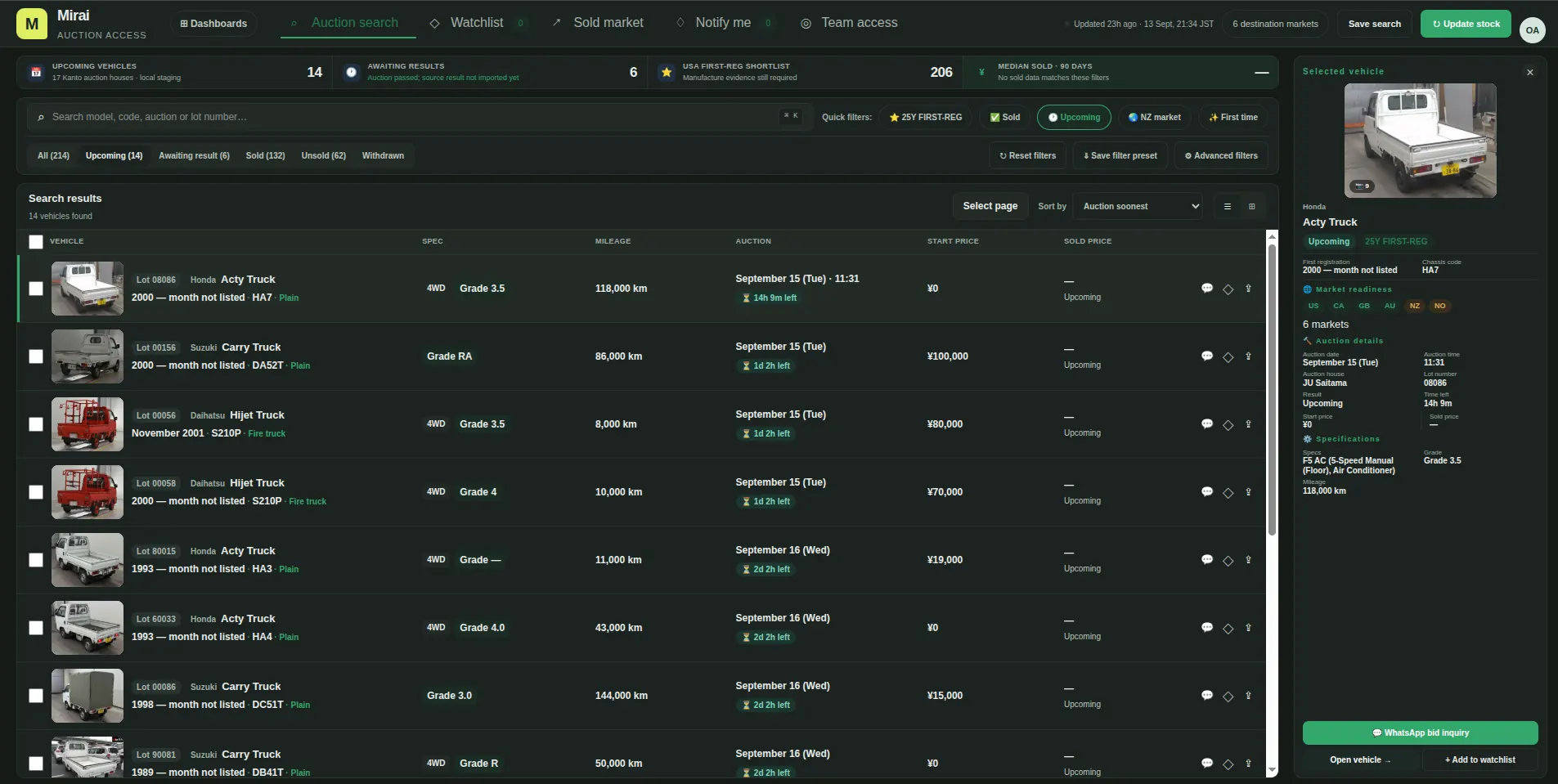
Mirai Auction Portal access is exclusive to Mirai customers after inquiry. It surfaces candidates from major auctions across Japan with robust filters for a U.S. brief: age, identity, engine, documents, condition and destination-state requirements. This is curated auction access, not a public inventory or a promise of customs entry, insurance or Minnesota permit approval.
What drives value in a Minnesota kei-truck candidate?
Compare evidence and usable condition after the route is known. This guide publishes no fixed price.
Grade and specification
Four-wheel drive, bed style and factory equipment change usefulness; an auction grade is only a starting signal.
Originality and matching identity
Clear chassis, engine and export records make age and configuration easier to verify. Unexplained changes add diligence.
Mileage evidence
Read odometer entries alongside auction sheets and service records; a low display alone cannot prove low use.
Documented history
Service history and ownership records reduce unknowns about maintenance and prior repairs.
Condition tier
A preserved truck, usable driver and repair project carry different inspection and preparation work. Compare like with like.
Minnesota kei-truck questions
Direct answers to common permit, title and road questions.
Are kei trucks legal in Minnesota?
Yes, with limits. A qualifying mini-truck may use only roadways designated by a county, city or town ordinance after that authority issues a permit under §169.045.
Can I register a kei truck for ordinary statewide road use?
No. Minnesota House Research’s February 2026 brief says mini-trucks are not registered with DPS like ordinary motor vehicles and do not need ordinary titles or plates for the local-permit route.
Does a city permit cover a county road?
No. A city permit reaches only designated roads under city jurisdiction; a county road needs its own county authorization.
Can I drive a permitted mini-truck on a state highway?
No. The local permit does not cover Minnesota trunk highways or interstates. Section 169.045 allows only a direct crossing where one intersects a designated road.
Can I cross a highway in a mini-truck?
Yes. Section 169.045, subdivision 5, allows a permitted driver to cross a street or highway intersecting a designated roadway.
Does Minnesota impose a 35-mph mini-truck road cap?
No. Section 169.045 does not set a statewide mini-truck speed threshold; the local ordinance identifies the actual roads and may add consistent conditions.
Are mini-trucks barred from driving after sunset?
No. The statewide sunrise-to-sunset language in §169.045, subdivision 3, names golf carts, ATVs and UTVs, not mini-trucks. A local ordinance can still impose conditions.
Do I need a driver’s license for a permitted mini-truck?
Generally yes. Section 169.045, subdivision 7, applies chapter 171, so a valid license or qualifying instruction permit is needed; a local ordinance may set stricter permit conditions.
Do I need insurance for the local permit?
Yes. The ordinance must require evidence of liability insurance conforming to §65B.48, subdivision 5. Ask an insurer to identify the truck and permitted road use on the policy.
Is a kei truck automatically an ATV on Minnesota trails?
No. The mini-truck permit is a road rule, not a trail pass. DNR vehicle classification and site-specific access rules need a separate review.
Does a foreign or out-of-state title authorize Minnesota roads?
No. Ownership documents may support provenance, but Minnesota road operation under the mini-truck scheme still depends on a local ordinance and permit.
Can Mirai guarantee my permit or insurance?
No. Mirai can screen vehicle identity, condition and documents; the issuing local authority and insurer decide permit and coverage questions.
Sources and verification method
Editorial primary-source check: October 7, 2026.
- Minn. Stat. §169.045 — 2025 published text; local permits, roads, equipment, insurance and licensing. The Revisor page shows no 2026 amendment to this section as checked October 7, 2026.
- Minn. Stat. §169.011, subd. 40a — 2025 published mini-truck definition. The displayed 2026 amendment is to subd. 71, not 40a.
- Minnesota House Research, Low-Power and Unconventional Vehicles — February 2026, pp. 16–17, current mini-truck summary and title/registration explanation.
- Minn. Stat. §65B.48, subd. 5 and §65B.49, subd. 3 — 2025 published insurance text.
- Minn. Stat. §168A.085 — 2025 published foreign-vehicle title-document rule, cited only for the ownership-document distinction.
- Dodge Center, Redwood Falls, Swift County — official local permit pages, read October 7, 2026.
- NHTSA import FAQ and EPA import guidance — federal entry context, checked October 7, 2026.
How we checked this
We compared the current Revisor text with the February 2026 House Research brief and official local permit pages. No 2026 enacted change to §169.045 or the mini-truck definition appeared in the Revisor’s current history. We did not verify every pending bill or every local ordinance. Trail classification and access were not established by this road-law review, so this guide does not claim a statewide trail-registration outcome. The road authority, DVS, insurer and trail manager make their respective vehicle-specific decisions.
Source for a Minnesota use case
Send the road names, intended use and any local ordinance. Mirai can filter Japanese auction candidates and document evidence around that brief.