
Are Kei Trucks Legal in Hawaii? Registration, Documents & Island Rules
Are kei trucks legal in Hawaii? They are legal to own and can be used on private property, but a typical Japanese-market kei truck is not automatically eligible for Hawaii road registration. Federal import age, Hawaii’s registration statute, county approval, safety inspection and insurance are separate gates. Back to all state laws.
Kei trucks are legal to own and use privately in Hawaii, but a typical JDM truck is not automatically eligible for road registration under HRS §286-42. Federal import, county registration and inspection/insurance are three separate gates — passing one does not mean you pass the next. Get the receiving county’s written pre-clearance for the exact chassis before you buy or ship.
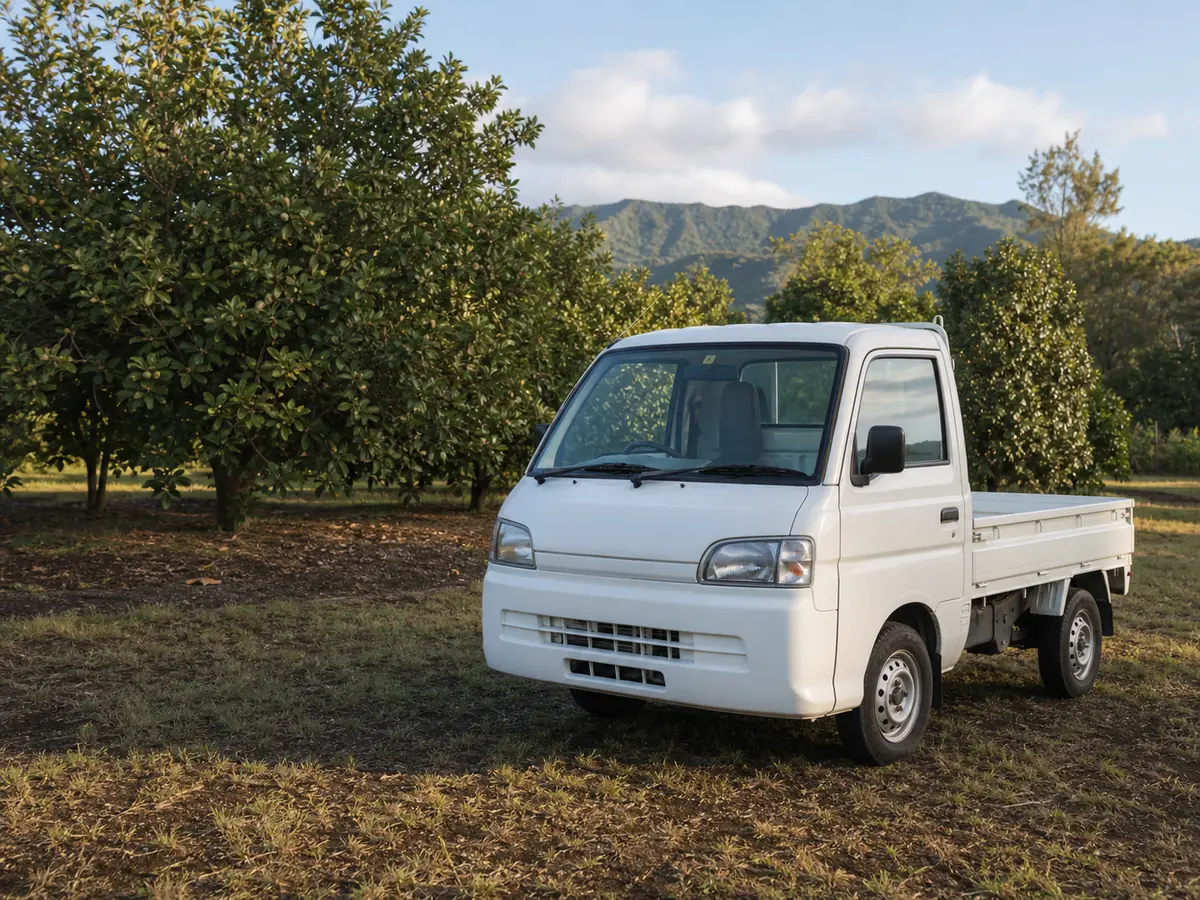
Honolulu, Hawaiʻi, Maui and Kauaʻi process vehicle registrations under state law.
NHTSA’s age exemption does not override Hawaii Revised Statutes section 286-42.
Road vehicles generally need a current periodic motor vehicle inspection and Hawaii insurance.
1 Are Kei Trucks Legal in Hawaii? The Verdict
Legal import, ownership, county registration and lawful operation are not the same thing.
Hawaii has no kei-truck statute that creates a simple statewide mini-truck permit or low-speed road category. Instead, the ordinary registration rules apply. Under HRS §286-42(a), a motor vehicle that was not certified by its manufacturer to all applicable Federal Motor Vehicle Safety Standards (FMVSS) at manufacture shall not be registered unless it fits one of the listed exceptions: certain aftermarket-frame motorcycles, a special interest vehicle, or a reconstructed vehicle.
Most older right-hand-drive kei trucks were built for Japan and lack a U.S. FMVSS certification label. Reaching 25 years of age can make one eligible for federal import under NHTSA’s rule, but Hawaii’s statute does not contain a general “25-year imported vehicle” registration exception. That is why a customs-cleared truck can still be refused Hawaii registration. Mirai Trading’s 25-year kei truck import rule guide covers the federal side of this process in detail.
Hawaii’s inspection rules do recognize how to inspect an uncertified imported vehicle that is at least 25 years old. That matters only after the registration classification is resolved. A passable safety inspection category is not, by itself, authority for the county to register the truck.
Pre-clear before you ship
Send the county the truck’s chassis number, manufacture month/year, Japanese Export Certificate and translation, photos of every identification/certification label, model and intended use. Ask whether it qualifies for registration and under which statute and classification. Keep the answer in writing.
2 The Three Legal Gates
Passing one gate never guarantees the next.
Federal import entry
NHTSA, EPA and Customs decide whether the truck may enter the United States. Age is calculated from manufacture date, not model-year advertising.
NHTSA + EPA + CBPCounty title and registration
The county director of finance applies Chapter 286, verifies identity and ownership, and decides whether an FMVSS exception or other valid classification applies.
Honolulu, Hawaiʻi, Maui or KauaʻiInspection, insurance and use
The exact vehicle must pass Hawaii’s periodic inspection, remain insured and obey equipment, license, cargo and road rules.
HDOT rules + county processThe circular inspection sequence is normal
For many first registrations, an inspection station issues a temporary failed/void inspection result because registration is missing. The owner takes that document to the county, completes an approved registration transaction, then returns to the station for the final sticker. This sequence does not waive the registration eligibility decision.
3 Hawaii Kei Truck Rules by County
State law is common, but forms, inspectors and public instructions differ by island county — Honolulu (Oʻahu), Hawaiʻi County (Big Island), Maui County and Kauaʻi County each publish their own process.
| County / island | Published position and process | Kei-truck takeaway | Status |
|---|---|---|---|
| Hawaiʻi County / Big Island | The out-of-state transfer page expressly says applicants must comply with applicable FMVSS under HRS §286-42 and that noncompliant imported vehicles may not be registered. It directs unusual vehicles to Motor Vehicle Control Inspectors. | A typical non-FMVSS JDM kei truck should be expected to fail the ordinary transfer path unless the county confirms a statutory exception for the exact vehicle. | Explicit warning |
| Maui County / Maui, Molokaʻi, Lānaʻi | The new-vehicle registration page also states that all applying vehicles must comply with FMVSS under HRS §286-42 and lists the local title, bill of lading, safety inspection and G-27 requirements. | Do not treat federal age eligibility as Maui registration eligibility. Request a written classification review before shipment. | Explicit warning |
| Kauaʻi County | The out-of-state checklist requires title/registration, application, safety check, G-27, shipping proof and plates. A vehicle with a VIN shorter than 17 characters needs an appointment with a Motor Vehicle Control Inspector. | The short-chassis appointment is identity review, not an assurance of registration. Pre-clear the non-FMVSS classification with the inspector. | Inspector review |
| City & County of Honolulu / Oʻahu | Customer Services publishes general out-of-state and safety-inspection procedures but no vehicle-specific page promising registration of Japanese-market kei trucks. | Ask Honolulu Motor Vehicle Control/CSD for a written determination. A general document checklist is not approval for the specific chassis. | Pre-clear case |
Moving a vehicle between counties does not erase its classification. HRS §286-41 generally recognizes an existing Hawaii county registration until expiration after a move, but a first Hawaii registration still must be lawfully issued.
Hawaiʻi County inspector contact published for unusual vehicles
The county page lists Motor Vehicle Control Inspectors at (808) 640-7339 and (808) 640-7342. Kauaʻi’s checklist lists (808) 241-4197 for the short-VIN appointment and kauaimvr@kauai.gov for registration questions. Verify current contact details on the county site before relying on them.
4 Possible Classifications—and What They Do Not Do
Labels must match the statutory facts. They are not interchangeable workarounds.
| Claimed path | Hawaii rule | Practical answer |
|---|---|---|
| Ordinary motor vehicle | HRS §286-42 generally requires the manufacturer’s applicable FMVSS certification. | A typical Japan-market kei truck lacks it, so ordinary registration is generally unavailable. |
| Special interest vehicle | HRS §286-2 defines this as a vehicle of any age being collected, preserved, restored or maintained by a collector because of its significance; §286-42 lists it as an exception. | Potentially case-specific, not automatic at 25 years. Obtain county approval before purchase. Daily delivery or work use may be inconsistent with a collector representation. |
| Reconstructed vehicle | A vehicle assembled by a nonmanufacturer or materially modified in identity or essential systems may qualify under the detailed definition. | A stock imported kei truck is not reconstructed merely because it came from Japan. Do not alter or misdescribe it to force this category. |
| Neighborhood electric vehicle | Must be electric, emission-free, four-wheeled, under 3,000 lb GVWR, designed/operated at 25 mph or less and conform to FMVSS 500. | A speed governor or electric conversion does not create the manufacturer conformity needed for FMVSS 500. It is not a simple kei-truck loophole. |
| ATV/UTV farm rule | HRS §286-12 creates limited street use for vehicles that actually meet the ATV/UTV definitions and conditions. | A cab-over truck is not automatically an ATV/UTV. Farm use does not transfer that exception to a kei truck. |
| Farm tractor / implement | HRS §286-2 defines a farm tractor by design and primary use drawing farm implements; §286-41 exempts implements of husbandry only while temporarily moved on highways. | A pickup designed to carry property does not become an implement solely because a farmer owns it or carries produce. |
Ask for the classification, not just “Can I register this?”
A useful county response identifies the accepted classification, necessary inspection, title document, VIN/chassis treatment, limitations and required forms. A verbal “bring it in and we will look” is not enough protection against freight, port and storage costs.
5 Registration Process If the County Pre-Approves the Truck
Exact ordering varies. Follow the written instructions of the receiving county.
Build the evidence file
Collect original export/ownership records, certified translation, purchase record, manufacture-date evidence, federal entry forms and chassis photographs.
Get written county review
Disclose that it is a short-chassis, right-hand-drive, non-U.S.-certified import and state its intended use. Obtain the applicable classification and checklist.
Import and ship lawfully
Complete NHTSA, EPA and CBP entry, then retain the ocean bill of lading, arrival date and freight receipts for county and tax records.
Bind Hawaii insurance
Have the insurer accept the exact Japanese chassis number and intended private, collector or road use. Obtain a valid Hawaii insurance card.
Start the safety check
Take the truck and insurance card to a licensed inspection station. If registration is the only missing item, keep the station’s temporary failed/void document.
Complete tax and county forms
Resolve Form G-27/use-tax evidence where required, identity/VIN inspection, title application, ownership surrender and county fees.
Receive title/registration
Do not drive merely because an application was submitted. Wait for the county’s issued registration, plates or other required credentials.
Finish inspection
Return to the inspection station for the completed certificate/sticker, then carry proof of insurance and registration when operating.
A registration attempt can still end in refusal
Pre-clearance reduces risk but cannot replace inspection of original documents and the truck. Budget for secure storage, correction of minor equipment defects or lawful re-export/transfer if a material fact differs from what the county reviewed.
6 Hawaii Kei Truck Document Checklist
Carry originals and clean copies. Make every chassis number and owner name consistent.
Vehicle, import and ownership
- Original Japanese Export Certificate or deregistration/ownership record
- Complete certified English translation
- Signed bill of sale and payment record
- Manufacture month/year evidence—not only first-registration year
- Photos/rubbings of the full chassis number and all labels
- NHTSA HS-7 declaration and EPA Form 3520-1
- CBP Form 7501 or other released entry summary
- Ocean bill of lading, shipping receipt and island arrival date
Hawaii and county transaction
- County title/registration application
- Written county classification or inspector instructions
- Hawaii motor vehicle insurance identification card
- Temporary failed/void or completed safety inspection report
- Stamped Form G-27 and attachments when required
- Out-of-state title/registration and plates if transferring one
- Lien release or lienholder documents if applicable
- Certified weight slip when requested
Short Japanese chassis numbers
Many kei trucks do not have a 17-character North American VIN. Never add digits, reuse another vehicle’s VIN or alter the stamped chassis number. The county may require a Motor Vehicle Control Inspector appointment and may assign an identification number only through its lawful process.
Use tax and Form G-27
HRS §286-41 bars issuance without proof of use-tax payment. Counties commonly request State of Hawaii Form G-27 for imported or out-of-state vehicles. Tax treatment can depend on purchase, shipping, duty, insurance, arrival and prior tax paid. Ask the Department of Taxation and county what evidence applies to the particular import; do not rely on a seller’s flat estimate.
7 Hawaii Safety Inspection and Equipment
Registration classification comes first; mechanical condition still matters after approval.
HRS §286-26 generally requires vehicles in this class to be inspected every 12 months and before first temporary/permanent registration or transfer, subject to statutory exceptions. A valid Hawaii insurance card is required for the inspection certificate and sticker. HDOT’s Periodic Motor Vehicle Inspection rules govern licensed stations.
HAR §19-133.2 includes an inspection provision for uncertified imported vehicles at least 25 years old. It relaxes requirements tied to FMVSS components or markings, but requires headlamps to be aimed for U.S. right-side-of-road operation. Original equipment that lacks some domestically required markers may be treated under that rule. The vehicle must still be safe and satisfy all applicable non-exempt inspection items.
| Inspection area | Prepare before the appointment | Kei-truck issue to check |
|---|---|---|
| Identity and documents | Chassis stamping, ownership record, insurance and application must match. | Short chassis number and translated Japanese model data. |
| Headlamps and signals | All lamps, high/low beam, turn signals, hazards and reflectors work. | Japan-market headlight beam must be aimed for driving on the right. |
| Brakes | Service and parking brakes operate evenly and hold the truck. | Inspect aged hoses, cylinders, drums/discs and brake warning system. |
| Tires, steering, suspension | Correct load rating, legal tread, no unsafe play or damage. | Small tires must be properly rated; avoid unsupported lift kits. |
| Glass, wipers and mirrors | Safe glazing, clear view, functioning wipers and secure mirrors. | Right-hand drive is not itself a ban, but visibility must be safe. |
| Body, bumper and restraints | Secure doors/bed/tailgate, safe body, bumpers and working seat belts. | Rust, improvised bumpers and non-original seats/anchors invite scrutiny. |
| Exhaust, intake and fuel | No dangerous leaks, excessive noise or insecure components. | Keep the original engine configuration for the EPA age exemption. |
| Speed/odometer display | Confirm the station’s current interpretation; a readable mph reference is prudent. | Japanese clusters usually emphasize km/h. Do not misrepresent mileage. |
Inspection eligibility is not registration eligibility
HDOT created inspection criteria for older uncertified imports and special-interest vehicles, but HRS §286-42 still controls whether a county may register the vehicle. Do not quote the inspection rule alone as proof that every 25-year-old kei truck can receive plates.
8 Insurance, Driver and Cargo Rules
A rare short-chassis import can be harder to insure than an ordinary U.S.-market pickup.
Hawaii minimum coverage
For policies issued or renewed from January 1, 2026, the statutory liability minimums are $40,000 per person, $80,000 per accident and $20,000 property damage. $10,000 PIP per person continues.
DCCA Insurance DivisionExact vehicle acceptance
Ask the carrier to list the full Japanese chassis number and confirm collector, farm, commercial, delivery and public-road uses in writing. A quote for “small pickup” is not enough.
Bind before inspectionDriver and occupants
Use an appropriate current license, seat belts and lawful seating. Hawaii restricts passengers in pickup beds and prohibits children 12 or younger there except narrow statutory situations.
HRS §291-14Insurance can be the practical stopping point
A county’s willingness to inspect documents is not an insurance commitment. Obtain a written quote before purchase and disclose right-hand drive, chassis number, value, modifications, cargo and business use. Statutory minimums are not a recommendation of adequate protection.
9 Allowed Uses in Hawaii
The safest use depends on location, registration status, landowner rules and insurance.
Private farm or ranch
Hauling tools or produce entirely on private property with permission is generally the clearest use. Zoning, workplace safety and insurance still apply.
Closed private site
Private resorts, campuses, nurseries and industrial yards may allow a kei truck under their own access and safety rules. Keep it off public rights-of-way.
Public-road errands
Requires lawful Hawaii registration and plates, current inspection, Hawaii insurance, appropriate license and compliance with all ordinary traffic rules.
Trails and public lands
A kei truck is not automatically an ATV or UTV. Registration does not create access to DLNR, county, private or conservation roads. Obtain vehicle-specific permission.
Farm-to-market travel
Carrying farm products does not convert the truck into a farm tractor or implement of husbandry. Public-road travel needs the ordinary lawful pathway.
Unapproved road movement
If the truck is not registered, move it between properties on a properly rated, registered and insured trailer. Do not use an out-of-state permit as a substitute for eligibility.
Hawaiʻi County out-of-state permit
The published permit is for a vehicle that already has current out-of-state registration in the owner’s name. It must be obtained within 30 days of arrival, follows the existing plates/registration expiration or 12-month maximum, and requires a Hawaii safety check. It is not a path for an untitled, unregistered Japanese import.
Neighborhood electric vehicles are a separate class
A genuine FMVSS 500 neighborhood electric vehicle is limited to 25 mph and generally cannot travel along a highway posted over 35 mph, though it may cross at an intersection. Converting or limiting a kei truck does not automatically qualify it.
10 Island Shipping and Arrival Planning
Ocean freight makes a failed assumption more expensive.
Before loading
- Choose the receiving county and obtain its written classification response before loading
- Secure a Hawaii insurance quote for the exact chassis
- Verify manufacture date and chassis number match across every document
- Confirm port, carrier and broker acceptance of the vehicle and fuel/battery condition
After arrival
- Retain the bill of lading and record the actual island arrival date
- Do not drive until all required credentials and the final inspection are valid
- Complete any county inspector/VIN appointment first
- Follow the county’s inspection-registration sequence exactly
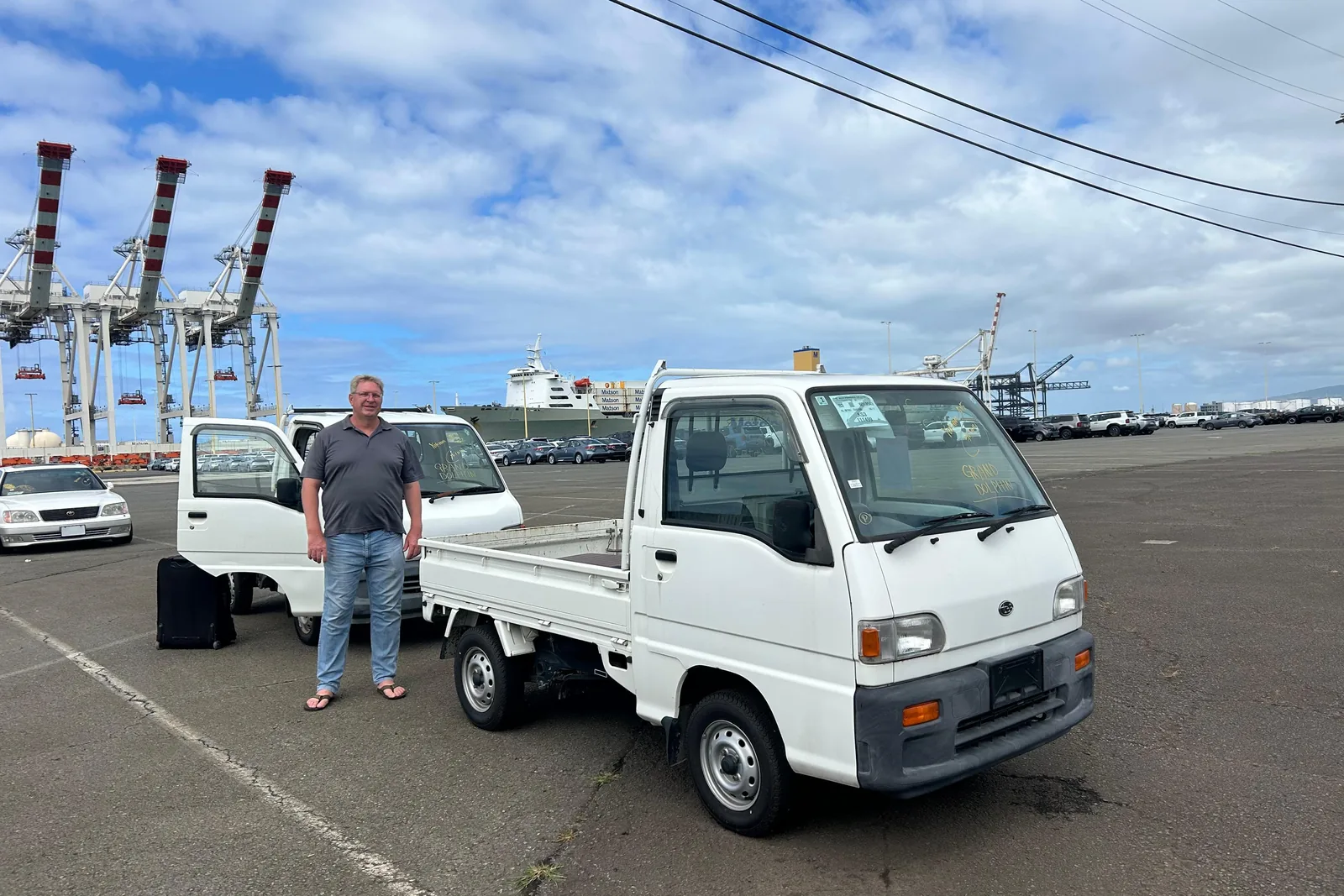
A Mirai buyer in Hawaii
Joseph collected his two kei trucks from Mirai at the port in Hawaii and is buying his third with us now. Our importer partner in Hawaii handles the U.S. side. See Joseph’s trucks and how we prepare trucks before shipping.
11 Federal Import Requirements
Federal eligibility is the first gate, not the second or third.
A kei truck must first clear NHTSA’s 25-year FMVSS exemption—age counted from the actual manufacture date and declared on Form HS-7—and, separately, EPA’s roughly 21-year original-configuration emissions pathway (Form 3520-1), before Customs will release it. See Mirai Trading’s full Japan-to-U.S. import guide for the federal process in detail. Clearing federal entry says nothing about whether Hawaii will register the truck once it lands—that decision belongs to the receiving county under HRS §286-42.
Do not import under a false off-road theory
A road-manufactured kei truck does not become exempt equipment because the buyer plans farm use. The federal declaration must truthfully describe the vehicle as manufactured, and an off-road entry record can create later title and enforcement problems.
12 Common Hawaii Kei Truck Myths
These claims skip one or more legal gates.
“Any 25-year-old kei truck is Hawaii street legal.”
No. Twenty-five years can resolve NHTSA import conformity; Hawaii registration remains controlled by HRS §286-42 and the county.
“The old-import inspection rule guarantees plates.”
No. It explains inspection treatment. It does not amend the separate statutory registration prohibition.
“A Japanese export certificate is a Hawaii title.”
No. It is important ownership evidence, usually with a certified translation, but the county must accept the complete application and classification.
“A short-VIN inspection means approval.”
No. The appointment can verify identity. It does not independently cure missing FMVSS certification.
“Farm use makes public roads legal.”
No. A kei pickup does not become a farm tractor, implement, ATV or UTV merely because it works on a farm.
“Another state’s title forces Hawaii to register it.”
No. Out-of-state papers prove history, but Hawaii applies its own eligibility, tax, inspection and identity rules. Alaska, the other state reached by sea, applies its own rules too: see whether kei trucks are legal in Alaska.
13 Hawaii Buyer Checklist
Resolve each item before money, freight and island storage begin. Considering a kei truck for everyday island use? Check Mirai Trading’s kei truck top speed guide, browse current kei truck inventory, then ask about Hawaii-ready documentation before you commit to a chassis.
Before purchase
- Identify the receiving county and precise intended use
- Verify manufacture month/year and original engine configuration
- Match chassis number across truck, export certificate and bill of sale
- Ask the county which HRS §286-42 classification, if any, it will consider
- Obtain insurer acceptance for the exact chassis and use
- Estimate use tax, freight, harbor, tow, inspection and contingency costs
Before public-road operation
- Complete lawful federal entry and preserve released forms
- Complete the county’s inspector and title/registration process
- Receive plates and current registration—not merely an appointment
- Finish the Hawaii safety inspection and display its sticker
- Carry Hawaii insurance proof and the correct driver license
- Secure cargo and use legal seats/seat belts only
Suggested pre-clearance wording
“I am considering a [year/month, make/model] Japan-market right-hand-drive 660cc truck, chassis [number], without a U.S. FMVSS label. It will be imported under the federal age provisions and used for [exact use]. Can your county register and title this exact vehicle? If yes, under which Hawaii classification and what original documents, inspections and limitations apply?”
14 Hawaii Kei Truck FAQs
Direct answers for owners, importers and island buyers.
Are kei trucks street legal in Hawaii?
Not automatically. A typical Japanese-market truck lacks U.S. FMVSS certification, and HRS §286-42 generally prohibits registration unless a defined exception applies. The receiving county must approve the exact vehicle before it can be lawfully registered and driven on public roads.
Can I register a 25-year-old kei truck in Hawaii?
Age alone is not enough. The federal 25-year rule concerns import safety conformity. Hawaii has a separate registration rule. A county may evaluate a genuinely qualifying special-interest or reconstructed vehicle, but neither category is automatic.
Why do Hawaii inspection rules mention 25-year-old imports?
The rule tells inspection stations how to inspect certain older uncertified imports, including headlamp treatment. It does not guarantee that the county can issue a registration under HRS §286-42.
Which Hawaii island is easiest for kei truck registration?
No official source establishes an “easy” island. Hawaiʻi and Maui counties publish explicit FMVSS warnings; Kauaʻi requires inspector review for short VINs; Honolulu provides general procedures. Obtain a written answer for the exact truck from the receiving county.
Can I use a kei truck on a private farm?
Generally yes, on private property with the owner’s permission—that’s the clearest fit. Stay off public roads and rights-of-way, and comply with zoning, workplace safety, landowner and insurance requirements.
Does farm use allow me to drive between fields?
Not automatically. A pickup-shaped kei truck is not necessarily an ATV, UTV, farm tractor or implement of husbandry. Any public-road segment needs the lawful vehicle registration and operation path.
Can I get an out-of-state permit?
That permit is for a vehicle already currently registered out of state in the owner’s name and is temporary. It does not create registration eligibility for an untitled direct import or override HRS §286-42.
Will right-hand drive fail the safety inspection?
Right-hand drive is not itself a categorical ban. Visibility and all applicable equipment must be safe, and Japan-market headlights must be aimed for U.S. right-side-of-road operation.
Can a speed limiter make my kei truck a low-speed vehicle?
No. Hawaii’s neighborhood electric vehicle definition requires an electric, emission-free vehicle that conforms to FMVSS 500 in addition to speed, wheel and weight criteria.
What insurance does Hawaii require in 2026?
For policies issued or renewed from January 1, 2026, minimum liability limits are 40/80/20, plus $10,000 PIP per person. The insurer must accept the exact chassis and use; higher coverage may be prudent.
Do I need a Hawaii safety check every year?
Most vehicles in this category require inspection every 12 months under HRS §286-26. Confirm the exact timing and process with the county and a licensed inspection station.
Can passengers ride in the bed?
Hawaii restricts pickup-bed passengers and prohibits children age 12 or younger there except narrow situations. The safer practice is to carry occupants only in manufacturer-designed, belted seats inside the cab.
15 Official Sources and Research Method
Primary Hawaii and federal materials reviewed for this guide.
- HRS §286-42 — manufacturer FMVSS certification requirement and listed registration exceptions.
- HRS §286-2 — definitions of truck, reconstructed vehicle, special interest vehicle, farm tractor and neighborhood electric vehicle.
- HRS §286-41 — county registration application, use-tax proof and excluded equipment.
- HRS §286-26 — periodic inspection timing, insurance evidence and pre-registration inspection.
- HAR Chapter 19-133.2 — Periodic Inspection of Motor Vehicles, including older uncertified imports and special-interest vehicles.
- Hawaii DOT: Motor Vehicle Registration — county-administered system and county links.
- Hawaiʻi County out-of-state transfer and out-of-state permit.
- Maui County: New Vehicle Registration — FMVSS statement and local document list.
- Kauaʻi County out-of-state registration checklist — documents and short-VIN inspector appointment.
- Honolulu Department of Customer Services and its safety inspection procedure.
- Hawaii DCCA: 2026 Auto Minimum Limits FAQs — current liability and PIP minimums.
- HRS §291-14 — pickup-bed passenger rules.
- NHTSA Importation and Certification FAQs and EPA import forms and procedures.
How this guide was checked
Mirai Trading reviewed the current online Hawaii Revised Statutes, HDOT inspection rules and guidance, current county registration pages/checklists, Hawaii’s January 2026 insurance-limit notice and official NHTSA/EPA import guidance. The article distinguishes published statewide law from county process and flags conclusions that require a vehicle-specific county decision. Last verified July 16, 2026.
Two Ways to Move Forward
Need help drafting a county pre-clearance request for the exact chassis? Or want Mirai Trading to verify manufacture date, chassis identity and export paperwork before you ship? Either way, Hawaii registration, inspection and insurance approval remain decisions for the responsible authorities.