
Kei Trucks for Sale: Buy & Import from Japan to the USA
Looking for kei trucks for sale in the USA? Mirai sources them from Japanese auctions, inspects them and ships them to U.S. buyers with export and 25-year import handling. Compare the Suzuki Carry, Honda Acty, Subaru Sambar, Daihatsu Hijet and Mitsubishi Minicab by the years U.S. buyers actually shop, then match each chassis family to the work it does best.

Carry, Acty, Sambar, Hijet and Minicab.
All 50 states under one 25-year import rule.
Approximately 770 lb for a standard kei truck.
The 25-year rule shapes which years U.S. buyers see.
Kei Trucks for Sale: Match a Truck to Your Job
Select an intended job. The results show common U.S. shopping years, relevant chassis families and the reason each model belongs on the shortlist.
Choose Your Purpose
This is a model-selection tool. It does not calculate legal eligibility.
Browse kei trucks for sale at Japanese auctions
Mirai customers get exclusive access to the Mirai Auction Portal after an inquiry. It covers kei trucks from major auctions across Japan, with filters for model, year, 2WD/4WD, transmission and condition, so your shortlist starts with trucks that suit a U.S. import. Portal listings are auction candidates, not Mirai-owned stock. Once bought, trucks come through our Noda yard, where we can prepare them before shipping with new tires, a battery, an oil change or basic repairs.
Request Auction Portal accessWhy Popular Kei Truck Years Cluster for U.S. Buyers
The colored bands summarize observed shopping patterns in July 2026. They are deliberately not presented as universal approval windows.
The Five Popular Kei Truck Families
Each family has a different reason to be shortlisted. Chassis codes narrow the search more reliably than model name alone.
Suzuki Carry
The Carry spans classic 1990s trucks through the current DA16T and has the deepest U.S. supply. It is the default starting point for buyers who prioritize supply depth, simple work specifications and multiple 2WD/4WD choices.
Best reasons to choose it
- Strong visibility across U.S. auctions and importers
- Wide spread of standard work, 4WD and comfort grades
- Deep classic-era and 2000–01 supply keeps it easy to source for the USA
- Large chassis-code knowledge base for sourcing
Honda Acty
The Acty’s mid-engine, rear-wheel-drive-based layout gives it a distinct mechanical identity. It has especially strong enthusiast visibility in the USA.
- Good fit for general property and compact delivery work
- Recognizable collector/enthusiast following
- Attack equipment must be verified; it is not a universal 4WD feature set
Subaru Sambar
Genuine Subaru-built KS and TT trucks use the rear-mounted EN07 “Clover 4.” That unusual architecture makes them a strong comfort and enthusiast choice.
- Distinct rear-engine balance and four-cylinder character
- Strong U.S. auction and importer visibility
- Later Sambar trucks must not be described as Subaru-built EN07 models
Daihatsu Hijet
The Hijet is a broad work platform with strong farm, rough-access and extended-cab visibility. It is the clearest work-focused alternative to the Carry.
- High visibility as a farm and rough-access work truck
- Standard and Jumbo cab choices in later generations
- Jumbo and Climber are separate concepts; do not merge their equipment
Mitsubishi Minicab
The Minicab is often the less obvious alternative, which can make a clean original truck attractive when Carry and Acty prices are stronger.
- Useful standard-work and fleet configurations
- Period U-series trucks appear steadily in U.S. auction evidence
- Current DS16T should be sourced as a Carry-platform truck, not a unique Mitsubishi design
What U.S. Buyers Are Likely to See
These summaries describe what U.S. buyers are likely to see, not what every state will register.
Classic 1990s and 2000–01 trucks
Public auction visibility supports Acty, Carry, Sambar and Hijet strongly, with Minicab as a useful alternative.
- HA4 and month-eligible HA6/HA7 Acty
- DD51T and DA52T/DB52T Carry
- KS3/KS4 and early TT1/TT2 Sambar
- S100P/S110P and early S200P/S210P Hijet
Condition beats the badge
A clean original chassis with documented manufacture date, sound cooling system and little corrosion is usually a better sourcing target than a fashionable badge with uncertain history.
- Confirm chassis and manufacture month
- Inspect frame, cab mounts and bed floor
- Test 4WD and any low-range or lock controls
- Match body type to intended work
Quick Comparison: Which Popular Kei Truck Fits You?
This matrix compares the core reason to shop each family. Equipment still varies by chassis, grade and individual truck.
| Truck family | Defining layout | Strongest buyer fit | Key chassis targets | Watch before buying |
|---|---|---|---|---|
| Suzuki Carry | Conventional compact work-truck evolution | Supply depth, farms, trades and general use | DD51T, DA52T/DB52T, DA63T/DA65T, DA16T | Do not infer diff lock or low range from 4WD alone |
| Honda Acty | Mid-engine, RWD-based | Compact handling, enthusiast interest, property use | HA4, HA6/HA7, HA8/HA9 | Attack availability is chassis/grade-specific |
| Subaru Sambar | Rear-engine four-cylinder through 2012 | Cab comfort, character and enthusiast ownership | KS3/KS4, TT1/TT2 | 2012+ trucks are Daihatsu OEM, not EN07 Sambars |
| Daihatsu Hijet | Front-engine work platform in later generations | Farm use, rough access and later comfort grades | S100P/S110P through S500P/S510P | Jumbo cab and off-road equipment are separate choices |
| Mitsubishi Minicab | Mitsubishi U-series, then Carry OEM | Value-led sourcing, fleet and standard work | U41T/U42T, U61T/U62T, DS16T | Identify whether it is Mitsubishi-built or an OEM Carry |
2WD/4WD code pairing is common in several families, but approval prefixes, suffixes and running changes can alter the full model designation.
Choose by Purpose Before Choosing by Badge
The best model is the one whose chassis, gearing, body and condition match the job.
Carry or Hijet
Start with 4WD manual trucks and then verify low range, differential lock, A/C and tire condition separately.
Carry, Acty or Minicab
Standard 2WD trucks can be simpler and lighter for paved delivery, grounds work and promotional use.
Sambar or Acty
The Sambar’s rear-engine four-cylinder and Acty’s mid-engine layout give each a distinct driving feel.
Equipment first
Shop verified 4WD, appropriate gearing and safe tires. A badge or “farm” description cannot prove the hardware.
DA16T or S500-series
Newer Carry and Hijet families offer more current cabin, transmission and driver-assistance choices, though most are still too new for the U.S. 25-year rule.
Condition and originality
Clean HA4 Acty and KS/TT Sambar trucks offer strong mechanical identity; modified examples need careful inspection.
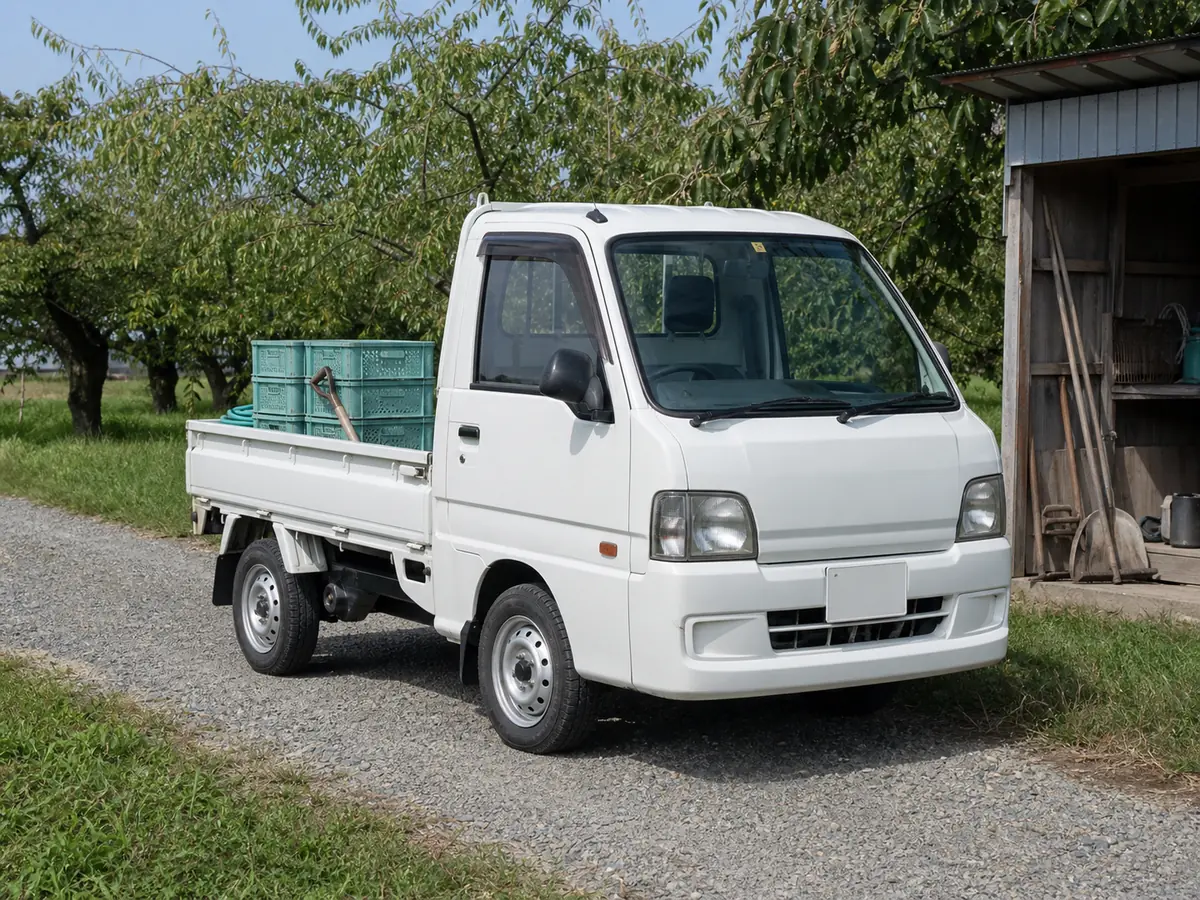
Keep a standard truck simple
A plain drop-side bed is the most versatile starting point for property maintenance, produce crates, tools and short local jobs.
- Respect the 350 kg Japanese payload ceiling
- Secure every load below and within the bed
- Buy 4WD for terrain—not for appearance
- Do not assume A/C, power steering, low range or diff lock
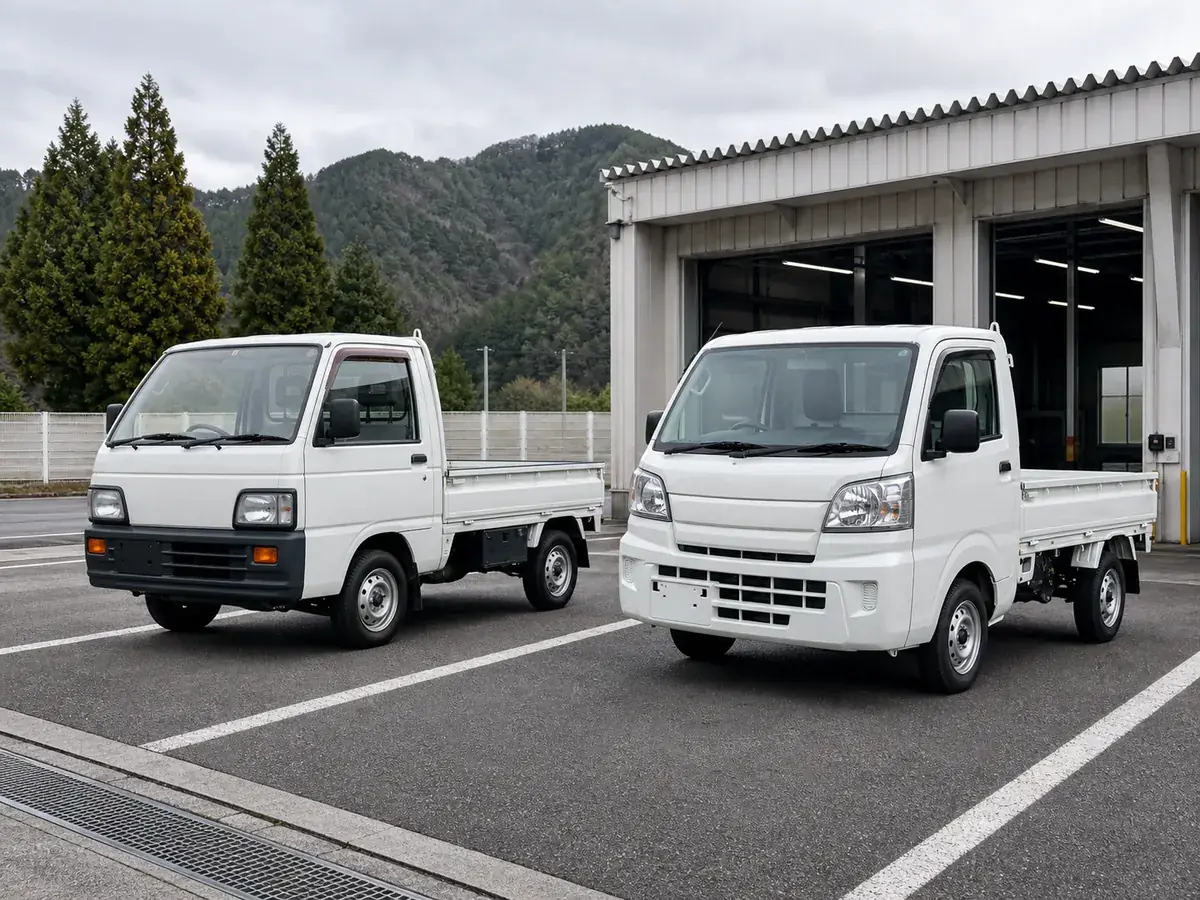
OEM Twins: Different Badge, Shared Kei Truck Platform
Badge-engineered trucks can widen the sourcing pool, but the underlying platform and exact chassis code should guide parts and specification research.
Parts-search rule
Search by the complete model code and production date first. A shared base platform does not guarantee that every lamp, bumper, ECU, cab trim, transmission or compliance component is interchangeable.
Special-Purpose Kei Truck Guides Coming Next
This page stays focused on standard popular kei trucks. Dedicated pages will handle body conversions and modification categories in depth.
Older trucks dominate U.S. supply
U.S. demand centers on 1990s and 2000–01 chassis that have cleared the 25-year rule. Your intended work should shape the model family and chassis band you target, then verify the individual truck.
- Choose your intended use
- Narrow to a model family and chassis band
- Verify the individual truck’s manufacture date and equipment
- Then read the detailed U.S. import guide
Popular Kei Truck FAQs
Direct answers about model choice, chassis codes and country-specific shopping patterns.
What are the five most useful kei truck families to compare?
Start with the Suzuki Carry, Honda Acty, Subaru Sambar, Daihatsu Hijet and Mitsubishi Minicab. Together they cover the largest U.S. marketplace, auction and specialist-stock footprint in the reviewed evidence.
Which kei truck has the deepest U.S. supply?
The Suzuki Carry has the deepest U.S. supply: it spans classic 1990s trucks through eligible chassis with broad Bring a Trailer auction visibility, and the Honda Acty and Daihatsu Hijet follow closely. Supply changes, so treat this as a July 2026 snapshot.
Which kei truck is most popular in the United States?
There is no complete public U.S. registration ranking for imported kei trucks. Current Bring a Trailer activity supports the Honda Acty, Suzuki Carry, Subaru Sambar and Daihatsu Hijet as high-visibility choices; the Mitsubishi Minicab is a secondary but valid alternative.
Why are older kei trucks more visible in the USA?
The 25-year federal import age route strongly shapes U.S. supply. In July 2026, the newest normal age-route trucks are 2001 builds that have reached 25 years from their exact manufacture month.
Why are 2000–01 the newest kei trucks most U.S. buyers can import?
The U.S. 25-year federal import rule is measured from the exact manufacture month, so in July 2026 the newest normal-route trucks are 2001 builds. Newer chassis such as the DA63T Carry are not yet old enough for the age route.
Can I import a current or newer kei truck to the USA?
Not on the standard age route. A kei truck must reach 25 years from its exact manufacture month before it qualifies for the normal U.S. import route, so most newer trucks are not yet eligible; a specialist listing abroad does not change U.S. eligibility.
Does every 4WD kei truck have low range or differential lock?
No. Four-wheel drive, high/low transfer gearing and differential lock are separate equipment decisions. Verify the model code, grade, physical controls and function on the individual truck.
Is a later Subaru Sambar still a rear-engine Subaru?
No. Subaru-built KS3/KS4 and TT1/TT2 trucks use the rear-engine EN07 layout. From 2012, the Sambar truck became a Daihatsu Hijet OEM model, so later chassis belong to a different mechanical family.
Is the Mitsubishi Minicab always a unique Mitsubishi design?
No. U41T/U42T and U61T/U62T are Mitsubishi-built Minicab families. From 2014, the DS16T Minicab Truck is based on the Suzuki Carry.
Should I choose a kei truck by model name or chassis code?
Choose the model family first, then buy by chassis code, manufacture date, drivetrain, grade, body and condition. The model name alone is too broad to prove engine, 4WD system or installed equipment.
Does this page confirm import or road legality?
No. This is a popularity and model-selection page. Import, compliance, registration, insurance and public-road rules belong in the linked country and state/province guides.
Can Mirai source a specific year and chassis?
Yes. Send Mirai your intended work, year range, chassis target, drivetrain, transmission, A/C requirement and any low-range or differential-lock requirement. Mirai can search Japanese auction and dealer supply against that specification.
Sources & Popularity Method
Manufacturer and government sources verify the trucks and chassis context; current market sources show which models and years buyers are actually seeing.
- Suzuki Digital Library: Carry history and current Carry grades.
- Honda Acty Truck archive and Honda’s official model-code documentation for HA6/HA7 and HA8/HA9.
- Subaru’s 1999 Sambar release and current OEM disclosure.
- Daihatsu S200P/S210P documentation, S500P/S510P documentation and the current Hijet catalog.
- Mitsubishi Motors vehicle history and Minicab chassis documentation.
- Bring a Trailer Acty, Carry, Sambar and Hijet market pages for U.S. auction visibility.
- National age context: the U.S. NHTSA 25-year import rule.
Method and limitation
Market evidence was captured on July 21, 2026. Marketplace counts, inventory and register entries change. Mirai uses them to identify high-visibility model families and shopping-year patterns; they are not represented as audited national sales totals. Chassis facts were cross-checked against manufacturer archives, official recall/model documents and current catalogs.
How Mirai Built This Shortlist
No complete public database ranks private kei-truck imports into the USA. This page therefore uses an evidence-backed shortlist, not a made-up global sales league table.
Mirai compared current marketplace activity, specialist importer stock, public auction visibility and model-specific enthusiast coverage. Manufacturer archives, recall records and current catalogs were then used to verify chassis families, production periods and mechanical layouts.
The result answers a practical buying question: which trucks and chassis codes U.S. buyers are most likely to encounter, and what kind of work are they best suited to? It does not answer whether a specific truck can be imported, registered or driven on public roads.
Popularity is not legal eligibility
A model can be widely advertised yet still require vehicle-specific import, compliance, registration and insurance checks. The U.S. 25-year age rule is shown only because it strongly shapes which years appear in the market. Use Mirai’s kei truck laws by state table and the detailed state guides for legal decisions. For the insurance step, see Mirai’s guide to kei truck insurance in the USA.
Tell Mirai Which Kei Truck Fits Your Needs
Send your intended work, preferred year band, chassis family, 2WD/4WD, transmission and comfort requirements. Mirai can source the correct Japanese-market truck and document its identity before shipment.