
Why are kei trucks illegal in some states?
Why are kei trucks illegal in some states? The usual obstacle is state titling or road-registration policy, even when a truck qualifies for the federal 25-year import exemption; new nonconforming trucks face federal safety rules too.
NHTSA measures from manufacture date.
Original engine configuration matters.
A federal entry does not issue a state plate.
A speech did not rewrite the statutes.
Why are kei trucks illegal on a U.S. road?
There are two distinct gates. First, NHTSA normally requires imported road vehicles to meet Federal Motor Vehicle Safety Standards. Its import FAQ says a vehicle at least 25 years old may enter without FMVSS conformity. EPA has a separate over-21 provision that depends on the engine retaining its original configuration. Neither federal pathway commands a state DMV to issue a road title.
States classify, title and register vehicles differently. For example, Oregon DMV says kei vehicles generally cannot be road titled; Minnesota’s 2025 §169.045 allows mini-trucks only by local permit on designated roads; and Alabama’s October 2024 rule provides a restricted non-interstate tag. Those are three different legal paths, not a national ban. Read the state-law hub for the current 51-jurisdiction table, then the linked official DMV or statute for your destination.
Will kei trucks become legal after the 2025 announcement?
No. On December 3, 2025, federal leaders spoke favorably about Japanese small cars while announcing a separate fuel-economy proposal. The DOT release does not establish a new general FMVSS class, waive import requirements or alter any state title law. On the October 14, 2026 research date, this guide found no enacted general exemption or final NHTSA rule making new nonconforming kei trucks ordinary U.S. road vehicles. A future proposal would need an actual legal effective date before it changes a purchase plan.
Road title, limited use and off-road work
A truck can be lawful to import yet be limited to farm land, private property or a state-specific mini-truck permit. Limited-road laws may set speed and road-class restrictions; they are not equivalent to unrestricted registration. California illustrates why the distinction matters: its state guide deals with California-specific title and emissions issues rather than serving as the national answer.
Start with the intended state and use, then collect build-month proof, Japanese ownership papers, engine identity, export certificate and auction record. The U.S. import guide covers the federal entry sequence. Mirai can source kei trucks for sale with suitable evidence, but state agencies make the road-use determination.
Why might my state refuse this truck?
Choose a state to read the current hub classification and the state-specific guide. This is a route finder, not registration approval.
What makes an import file strong
Documented build month, engine identity and export papers make the federal entry review clearer. Destination-state road eligibility is separate; a high auction grade cannot turn an ineligible truck into a road-registrable one.
Shortlist trucks with clean import papers in the Mirai Auction Portal
Mirai’s customer-only Auction Portal can filter lots from major Japanese auction houses by build month, chassis identity, engine configuration, grade and document availability. Those filters help eliminate candidates that clearly fail a U.S. brief, but they do not substitute for a destination DMV decision. Tell us where the truck will be registered and whether road or private-property use matters; we can prioritize candidates with the evidence your state guide calls for.
Request Auction Portal access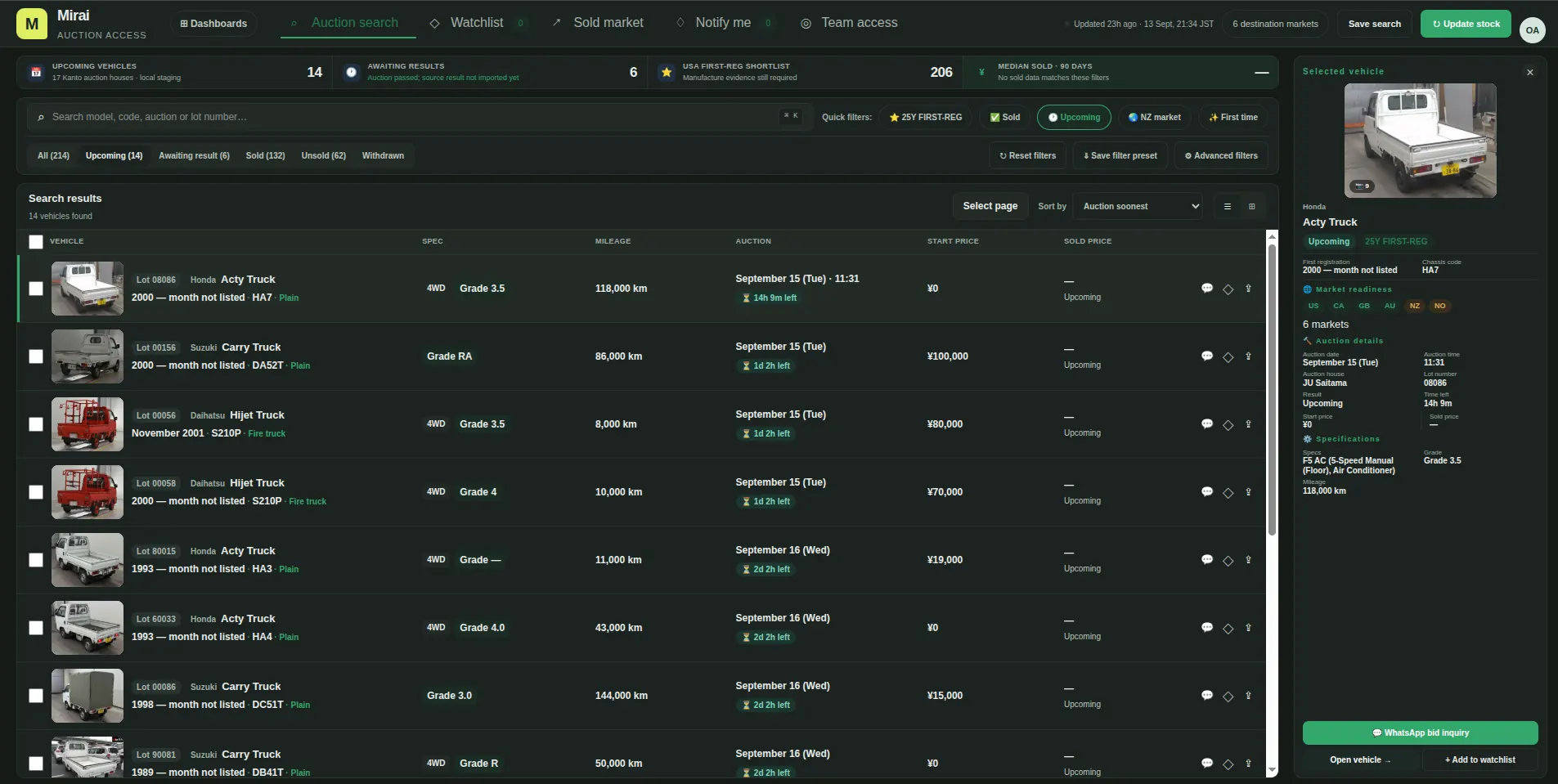
Frequently asked questions
Why are states banning kei trucks?
States may reject a road title because of vehicle classification, original off-highway designation or safety-equipment rules. The exact reason depends on the state’s statute and DMV policy.
Does federal import approval make a kei truck street legal?
No. Federal entry and state road registration are separate decisions. A 25-year-old vehicle may enter without FMVSS conformity while its destination state still refuses a plate.
Will kei trucks become legal nationwide?
No. Nationwide legalization was not in force on October 14, 2026. A policy remark is not a final federal rule or a change to every state statute.
Why do kei trucks have to be 25 years old?
NHTSA’s age-based exception allows a vehicle at least 25 years old to be imported without showing FMVSS conformity. Younger nonconforming vehicles need another lawful entry route.
Can I buy a brand-new kei truck for U.S. roads?
Generally no. A new Japanese-market truck is not automatically certified to U.S. FMVSS and EPA rules; ordinary retail road import is not the same as a 25-year-old exempt vehicle.
Are kei trucks still being made in Japan?
Yes. Suzuki and Daihatsu publish current Carry and Hijet truck catalogs. Their Japanese availability does not establish U.S. road eligibility.
Can an imported kei truck be used on a farm?
Generally yes. Private-property farm use with the owner’s permission is usually possible, subject to local rules and insurance. Public road travel between fields is a separate question.
Do mini-truck statutes allow interstate driving?
Generally no. Where states create limited mini-truck routes, interstate or high-speed roads are commonly excluded. Read the specific statute rather than assuming a plate covers all roads.
Does the EPA 21-year rule replace the NHTSA 25-year rule?
No. EPA emissions and NHTSA safety requirements are distinct federal regimes. The older-engine provision also depends on original engine configuration.
Where should I check my state’s rule?
Start with Mirai’s state-law hub and open the individual state guide. The cited DMV page or statute is the final source for your application.
Sources and verification
- NHTSA importation and certification FAQ — live page, checked 2026-10-14.
- EPA importing vehicles and engines — live page, checked 2026-10-14.
- U.S. Department of Transportation December 3, 2025 announcement — December 3, 2025.
- Oregon DMV vehicle types and kei policy — live page, checked 2026-10-14.
- Minnesota Statutes §169.045 — 2025 statutes, checked 2026-10-14.
- Alabama DOR mini-truck registration rule — October 2024 rule.
Start with the state, then the truck
Tell Mirai where you will use it. We can build a candidate shortlist around the documents that decision requires.