
Are Kei Trucks Legal in Arkansas? Registration & Road Rules
A kei truck in Arkansas can qualify for a narrow public-road route when it meets the state’s mini-truck definition, is registered as a Class Eight farm vehicle and is used for the authorized farm purposes. That is not blanket approval for commuting, errands or general business deliveries. Back to all state laws. Neighboring state guides: Louisiana, Tennessee, and Texas.
Yes—but only through a tightly defined route. Arkansas Code §27-14-726 expressly lets the owner of a qualifying mini-truck register it as a Class Eight farm vehicle. The truck must satisfy unusual size, minimum-weight and equipment tests, carry liability insurance, be used for the certified farm purposes and stay off Interstates, controlled-access highways, roads posted above 55 mph and any road where mini-trucks are prohibited.
1Are Kei Trucks Legal in Arkansas?
Yes, in limited circumstances. Four separate gates decide whether the exact truck, use and route are legal.
Federal import
The truck must have entered the United States lawfully under the correct NHTSA, EPA and Customs declarations.
NHTSA • EPA • CBPArkansas mini-truck fit
Width, bumper-to-bumper length, wet unladen weight, cab construction and every listed safety item must qualify.
ARK. CODE §27-14-726Farm registration
The owner supplies proof of ownership, insurance and the farm affidavit and pays the Class Eight fee.
DFA OFFICE OF MOTOR VEHICLELegal trip
The driver, purpose, load and every road segment must stay within the statute and the affidavit.
DRIVER • ROUTE • USE“Street legal” is trip-specific in Arkansas
A valid farm plate does not authorize every trip. A journey can become unlawful because its purpose is personal, it enters a controlled-access road, the posted limit rises above 55 mph, a sign prohibits mini-trucks or the truck cannot maintain the posted speed.
The statute provides an express route—not a blanket approval
Arkansas created its mini-truck registration provision in 2009 and updated the safety-glass and mirror references in 2019. Section 27-14-726 says the owner of a qualifying mini-truck may register and license it as a Class Eight farm vehicle. The statute then incorporates the farm affidavit, insurance and operating restrictions.
That wording supports a documented farm route. It does not say that every Japanese kei truck is an ordinary pickup, nor does it grant a general personal-transportation plate. Because “may” is permissive and the statute does not answer every unusual title history, obtain a written decision from the Arkansas Office of Motor Vehicle before treating another plate class as available.
Ownership and road operation are different
You may own and use a truck on private land with the landowner’s permission even when it is not registered for public roads. Import release does not guarantee Arkansas registration; an Arkansas title does not repair an unlawful import; and a plate does not authorize a prohibited route or non-farm use.
2Does Your Kei Truck Meet Arkansas’s Definition?
Arkansas’s mini-truck definition is narrower than the everyday use of “kei truck.” Check the actual vehicle—not a model-wide assumption.
| Test | Arkansas requirement | What to verify |
|---|---|---|
| Width | At least 48 inches | Measure the completed truck at its qualifying width; keep a dated measurement record. |
| Overall length | No more than 135 inches, including bumpers | Measure bumper to bumper. A rear step, guard or replacement bumper can change the result. |
| Unladen weight | At least 1,500 lb, including fuel and fluids | Use a reliable scale ticket for the exact chassis in the state-described condition. |
| Basic layout | Four or more tires, steering wheel, side-by-side seating for at least two | Confirm the original seating and steering configuration remains intact. |
| Cab | Fully enclosed, metal or metal-reinforced cab | Open utility vehicles and soft-sided cabs do not fit this element. |
| Doors | Metal doors with functioning handle locks | Both door structure and working latches/locks matter. |
| Glazing and mirrors | Safety glass and mirrors meeting the federal standards cited as of 1 January 2019 | Ask DFA what evidence it will accept. Japanese markings alone may not prove FMVSS compliance. |
| Required equipment | Headlamps, tail lamps, signal lamps, horn, seat belts, front and rear bumpers | Inspect operation and documentation before applying. |
| Vehicle type | Mini-truck is not an ATV; cargo bed is optional | Do not apply Arkansas ATV rules to a statutory mini-truck. |
The 1,500 lb minimum is an easy-to-miss failure point
Many kei trucks are lightweight by design. Do not convert a brochure curb weight and assume it qualifies. Arkansas uses unladen weight including fuel and fluids; weigh the exact truck and retain the scale ticket before spending money on a registration plan.
3Arkansas Mini-Truck Dimension Checker
This calculator screens only the three numeric definition tests. It cannot decide equipment, import, farm-use, title or agency acceptance.
Enter the exact truck’s measurements
Use bumper-to-bumper length and an actual unladen-with-fluids scale weight. Results are rounded for display but tested using full precision.
Numeric pass does not equal legal status
The truck must separately satisfy the cab, door, glass, mirror, lighting, horn, belt and bumper requirements; clear the federal import rules; qualify for Arkansas title and farm registration; be insured; and stay within the use and route limits.
4Federal Import Rules Come First
Arkansas registration cannot cure a vehicle that entered the United States under the wrong federal basis.
NHTSA safety rule
A vehicle at least 25 years old is generally outside the FMVSS compliance requirement. NHTSA measures 25 years from the date of manufacture, not just the model year.
EPA emissions route
A vehicle at least 21 original production years old with its original, unmodified engine/configuration can generally use EPA Form 3520-1 Code E.
Customs entry
CBP reviews the entry, value, origin and tariff treatment. Keep the stamped entry summary and declarations; a truck can face duty up to the truck rate.
For a normal road-use candidate, target a genuinely 25-year-old truck
See how to import a kei truck from Japan for the full documentation walkthrough. The simplest federal route for a conventional imported kei truck is usually NHTSA’s 25-year exemption. The truck reaches that age on its actual manufacture anniversary. Use the Japanese export certificate and reliable production evidence rather than assuming every vehicle in a model-year range was built in January.
At entry, the importer normally declares the NHTSA basis on Form HS-7 and the emissions basis on EPA Form 3520-1. EPA’s 21-year provision depends on the original engine and an unmodified emissions configuration. Engine swaps, newer replacement engines or missing production evidence need specialist review before shipment.
Off-road import classifications are not a shortcut to Arkansas plates
A newer mini-truck imported under a restricted non-road classification may require permanent speed limitation and use restrictions. Arkansas’s mini-truck statute does not erase those federal conditions. Do not buy a newer truck on the theory that a state farm affidavit converts it into a federally lawful road vehicle.
Keep the entire entry file
Retain the Japanese export certificate and translation, purchase invoice, bill of sale, bill of lading, HS-7, EPA 3520-1, CBP Form 7501 and duty/payment records. Arkansas expressly expects English-language proof of ownership, including a bill of sale plus an export certificate or title. Missing federal paperwork can also make later resale or insurer review difficult.
5Pre-Purchase Feasibility Check
Confirm the hard legal gates before bidding, modifying or shipping.
Identity and federal file
- Exact frame/chassis code and legible stamping
- Manufacture month and year documented
- Original Japanese export certificate available
- Accurate English translation prepared
- Original engine and emissions configuration checked
- HS-7 and EPA declaration route identified
- Customs broker has reviewed tariff treatment
Arkansas definition
- Width measured at least 48 inches
- Length including bumpers measured at 135 inches or less
- Scale weight reaches 1,500 lb with fuel and fluids
- Fully enclosed metal or reinforced cab
- Metal doors, handles and locks work
- Glazing/mirror evidence discussed with DFA
- Every required lamp, horn, belt and bumper present
Farm-use fit
- Owner has a genuine Arkansas farm use
- Planned hauling fits Class Eight wording
- No commuter or personal-errand assumption
- No for-hire freight assumption
- Insurance quote covers the disclosed activity
- Legal low-speed route exists to each destination
- Trailer plan exists for distant travel
Condition and support
- Frame, cab mounts and bed supports inspected
- Brakes, tyres, steering and bearings checked
- Cooling, charging and 4WD systems tested
- Stock ride height and sensible tyre size preferred
- Parts lead time and service provider planned
- Road-speed suitability tested safely
- Refusal/return contingency retained
Best Arkansas candidate
A substantially original, documented 25-plus-year-old truck that passes the Arkansas measurements, carries verifiable safety equipment and is bought for a genuine farm job with a legal local-road network is a much stronger candidate than a modified truck bought for commuting.
6How to Register a Kei Truck in Arkansas
The exact office may request additional evidence. Pre-clear the chassis and document set before purchase whenever possible.
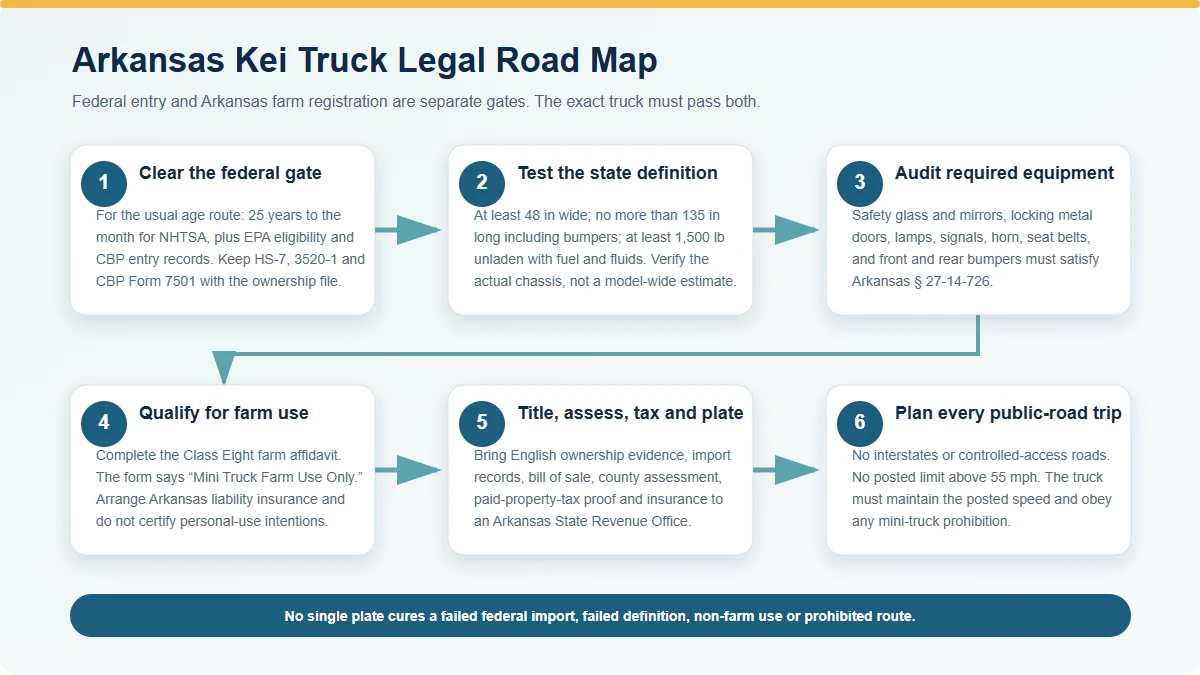
Clear the federal import
Complete NHTSA, EPA and CBP entry under the correct basis and preserve the stamped documents.
Prove the definition
Measure, weigh and document the cab, doors, glass, mirrors, lamps, horn, belts and bumpers.
Assess property
List the truck with the county assessor and resolve prior-year personal property tax requirements.
Insure the truck
Obtain Arkansas liability coverage for the disclosed JDM truck and its actual farm use.
Sign the farm affidavit
Certify exclusive authorized farm use and the mini-truck requirements on DFA’s form.
Title and register
Submit ownership/import records, application, affidavit, assessment, tax and fees to DFA.
Apply within Arkansas’s timing rules
DFA’s current registration guidance says motor vehicles must generally be titled and registered within 60 calendar days of transfer or lien release. Late registration can add $3 for every 10-day period or fraction, up to the annual registration fee. Late sales tax can add a 10-percent penalty. Confirm the clock for an imported vehicle with DFA because the relevant transfer, entry and ownership dates can differ.
Use the correct Class Eight farm declaration
Section 27-14-726 requires the same farm affidavit used for Class Eight registration. For a mini-truck, the affidavit must state that the vehicle will be used exclusively for farm purposes and that it meets the statutory requirements. Signing an inaccurate affidavit can create registration, insurance and enforcement problems.
Expect vehicle-specific review
The statute requires English-language proof of ownership that includes a bill of sale plus an export certificate or title. A Japanese chassis number may not resemble a 17-character North American VIN. Give DFA clear photographs, the original export record and translation rather than inventing or altering an identifier.
7Arkansas Title and Registration Documents
Build one indexed file with originals, translations and proof of each gate.
Japan and federal import
- Original Japanese export/deregistration certificate
- Accurate English translation
- Invoice and signed bill of sale
- Bill of lading and arrival records
- Completed NHTSA Form HS-7
- Completed EPA Form 3520-1
- Stamped CBP Form 7501 and duty receipt
- Manufacture-date and original-engine evidence
Arkansas application file
- Vehicle Registration Application
- Farm Vehicle Affidavit marked for mini-truck use
- Current proof of liability insurance
- County personal-property assessment proof
- Proof prior personal property tax is paid
- Lien contract or release when applicable
- Odometer disclosure if DFA requires it
- Sales/use tax and fee payment
Definition evidence
- Dimension sheet with bumper-to-bumper length
- Scale ticket for wet unladen weight
- Photos of cab, doors, locks and bumpers
- Photos/video of lamps, signals and horn
- Seat-belt condition and mounting photos
- Glazing markings and documentation
- Mirror specification and field-of-view evidence
- Chassis stamping and identification photos
Keep after registration
- Arkansas title and registration
- Copy of signed farm affidavit
- Insurance card and policy declarations
- Assessment and property-tax records
- Import packet and translations
- Maintenance and modification records
- Written DFA correspondence
- Legal-route notes for recurring farm trips
DFA’s posted affidavit appears older than the current statute
The available form is marked 7/21/10 and repeats older safety-glass and mirror wording. Act 394 of 2019 updated those references to the federal standards as of 1 January 2019. Do not alter the agency form yourself; ask DFA which supporting proof it currently wants and keep the written response.
8What Uses Are Allowed?
The Class Eight route is tied to Arkansas farm work. The safest interpretation stays close to the affidavit and statutory classification.
Own-farm product hauling
Noncommercial hauling of farm products produced in Arkansas for the registered owner’s farm operation, within weight and route limits.
Farm inputs and supplies
Trips for feed, seed, fertilizer, poultry litter and other inputs named in the Class Eight provisions, when genuinely part of the farm use.
Timber or farm support work
Some timber and farm purposes appear in the broader Class Eight wording. Match the exact ownership, product and trip to the statute and affidavit.
Commuting and personal errands
Driving to an unrelated job, school, groceries, recreation or social visits is not the certified exclusive farm use.
For-hire freight or delivery
Class Eight is not general commercial carrier authority. Do not treat a farm plate as permission to haul customers’ goods for compensation.
Farm, ranch or industrial property
Private-land operation generally does not depend on public-road registration, but permission, insurance, workplace safety and crossing rules still matter.
A farm can be a business, but the hauling classification is still narrow
Commercial activity in the ordinary sense does not automatically make a trip prohibited: a farm may sell what it produces. The Class Eight wording, however, describes noncommercial hauling connected to Arkansas-produced farm products and specified farm/timber uses. It should not be stretched into for-hire delivery, courier work or unrelated contracting.
Mixed-purpose trips are risky
A trip that combines a legitimate feed pickup with unrelated personal errands can be harder to defend under an affidavit promising exclusive farm use. Separate personal travel from the farm trip, keep receipts or work records, and ask DFA or Arkansas counsel about a recurring use that does not fit the obvious examples.
9Where Can an Arkansas Kei Truck Be Driven?
Test every road segment against five restrictions; route number alone does not answer the question.
| Road or condition | Result | Reason |
|---|---|---|
| Interstate highway | Prohibited | The statute separately bans Interstate operation, even if a work zone temporarily posts 55 mph or less. |
| Controlled-access highway | Prohibited | This is an independent ban. Do not use the posted speed as the only test. |
| Road posted above 55 mph | Prohibited | A 60, 65 or 70 mph posted segment is outside the Arkansas mini-truck rule. |
| Road with mini-truck prohibition sign/rule | Prohibited | Specific local or road-authority prohibition controls. |
| Road at 55 mph or less | Conditional | It must also be non-Interstate, non-controlled-access, not prohibited, and the truck must maintain the posted speed. |
| City or county street | Conditional | State restrictions still apply, plus any lawful local signs, closures, weight limits or operating rules. |
| Private property | Generally possible | Use with permission and appropriate insurance; public-road crossings and workplace rules remain separate. |
“Posted 55” is not permission to drive slowly
Arkansas also prohibits operation when the mini-truck cannot maintain the posted speed. Check realistic kei truck highway speed for the exact chassis before relying on a brochure figure. A truck capable of 55 mph on flat pavement may lose speed on hills, with cargo, into wind or in poor mechanical condition. Plan for actual conditions and traffic—not a brochure maximum.
Can a kei truck use a U.S. or state highway?
Possibly, segment by segment. A U.S.-numbered or state-numbered road is not automatically an Interstate or controlled-access highway. If a segment is not controlled-access, is posted at 55 mph or less, has no mini-truck prohibition and the truck can maintain the posted speed, the state mini-truck bans do not automatically exclude it. The farm-purpose requirement still applies.
Build a legal route before buying
Map the farm, suppliers, fields and service shop. Record posted limits and controlled-access entrances in both directions. A legal route can end abruptly where the limit changes or access control begins. If no continuous permitted route exists, use a properly rated trailer and tow vehicle.
Crossing state lines
An Arkansas registration does not guarantee that another state will recognize the same operating privilege, and the Arkansas Interstate ban makes long-distance travel impractical. Check every destination state’s law and insurer position before crossing the border. Transporting the truck is usually the lower-risk plan.
10Little Rock, Fayetteville, Fort Smith and Other Areas
The statewide statute is the starting point. No separate blanket city permission was identified in the official city materials reviewed.
Little Rock and central Arkansas
Interstates and controlled-access corridors are off-limits. Dense traffic and route changes make a preplanned local farm route essential.
Fayetteville and northwest Arkansas
Hills, faster corridors and congestion can make the maintain-posted-speed rule the practical constraint even on otherwise eligible roads.
Fort Smith and the River Valley
Distinguish local access streets from controlled-access approaches. Check bridge, load and construction restrictions before each recurring route.
Jonesboro and Delta farm areas
Farm use may fit the vehicle’s purpose, but higher-speed rural roads can break an otherwise short legal route. Verify every segment.
Local signs and road controls still count
Section 27-14-726 itself bars roads where mini-trucks are prohibited. Cities, counties and road authorities also manage closures, parking, truck routes, bridges and construction. The absence of a search result is not proof that no local rule or sign exists. Ask the authority responsible for the exact road when the route is uncertain.
No special city plate replaces the state farm registration
Do not assume an ATV, low-speed vehicle, golf-cart or neighborhood-vehicle ordinance applies to a kei truck. Arkansas defines a mini-truck separately and expressly says it is not an all-terrain vehicle.
11Insurance, Sales Tax, Property Tax and Fees
Budget the complete import and Arkansas ownership cost—not only the auction price and farm plate.
Liability insurance
Arkansas’s current minimum limits are 25/50/25: $25,000 for one person, $50,000 for two or more people and $25,000 for property damage.
State sales/use tax
DFA currently lists 6.5 percent for a taxable vehicle price of $4,000 or more, or 7 percent in Texarkana, with applicable local tax.
Class Eight fee
For a two-axle farm vehicle including a mini-truck, the statutory formula is $3.90 per 1,000 lb of gross loaded weight, minimum $32.50 and maximum $65.
Insurance must match the disclosed vehicle and use
Section 27-14-726 treats a mini-truck as a motor vehicle for minimum-liability purposes. Tell the insurer it is a Japanese domestic-market, right-hand-drive mini-truck registered for Arkansas farm use. Disclose business/farm activity, drivers, annual mileage, property locations and modifications. A generic quote that assumes an ordinary U.S.-market pickup may not be dependable.
Minimum liability protects others only up to the policy limits. Consider comprehensive, collision, theft, weather, towing/recovery, property and agreed-value protection separately. Confirm whether off-road farm operation, employees and loaded work use are covered.
Sales/use tax and local tax
DFA says the taxable delivery price includes freight and added equipment. Local sales/use tax may also apply; Arkansas currently caps the local tax at $25 for each one percent due on a single vehicle transaction. Import duty, port charges, broker fees and ocean freight are separate from state tax.
Assessment and personal property tax
Privately owned vehicles are Arkansas individual personal property. The assessment division says property is reported from 1 January through 31 May; late assessment carries a 10-percent penalty. Title/registration and renewal depend on current assessment and prior personal-property-tax status, so contact the county assessor early.
Title and plate costs
DFA’s fee schedule lists a $10 title fee. The mini-truck’s annual registration fee follows the Class Eight farm formula rather than the standard passenger-car schedule. Other title, lien, plate, late, inspection/measurement, translation and county costs may apply to the actual transaction.
12Safety Equipment, Right-Hand Drive and Inspection
Arkansas no longer has a routine statewide passenger-vehicle safety-inspection program, but the mini-truck equipment rules still apply every day.
Required by definition
Safety glass, compliant mirrors, metal locking doors, lamps, signals, horn, belts and front/rear bumpers are elements of the state mini-truck definition.
No blanket RHD ban
The mini-truck statute requires a steering wheel but does not require left-hand drive. Visibility, mirrors and safe operation remain essential.
No inspection waiver
The old recurring state safety inspection was repealed, but that does not excuse missing equipment, unsafe condition or false application evidence.
Glazing and mirror evidence may be the hardest file
Act 394 of 2019 amended the mini-truck definition to reference FMVSS 205/205a safety glazing and FMVSS 111 mirrors as in effect on 1 January 2019. A Japanese windshield may have JIS markings rather than the U.S. DOT markings an Arkansas reviewer expects. Do not claim equivalence without accepted evidence. Ask DFA in writing whether it needs replacement components, manufacturer certification, test documentation or another proof for the exact truck.
Right-hand drive is not automatic disqualification
Nothing in §27-14-726 says the steering wheel must be on the left. Still, the driver must have adequate view, compliant mirrors and safe control. Drive-through facilities, left turns, overtaking and roadside stops require additional care. A right-hand-drive layout does not relax any equipment, insurance or route rule.
Modifications can destroy eligibility
Long bumpers can push the truck over 135 inches. Removed doors, altered glazing, poor mirrors or missing bumpers can fail the definition. Lifts and oversized tyres can reduce braking, steering stability and the ability to maintain the posted speed. Keep the truck close to its proven configuration and document any replacement safety component.
13Can a Kei Truck Get an Arkansas Antique Plate?
Arkansas lowered the age threshold to 30 years in 2025, but the antique route does not clearly override the mini-truck statute.
Do not treat antique registration as a farm-use bypass
Act 325 of 2025 changed the historic/special-interest threshold from 45 to 30 years, and DFA’s current antique-plate page reflects 30 years. Neither source expressly says that a vehicle meeting the separate mini-truck definition may ignore §27-14-726 or its road restrictions.
Age alone is not enough
The antique category is for a vehicle at least 30 years old that is essentially unaltered and preserved because of historical or special interest. It is not a generic way to plate an old work vehicle for unrestricted daily transportation. Other historic-vehicle conditions, insurance and ownership requirements can apply.
Ask two separate questions in writing
- Will the Arkansas Office of Motor Vehicle accept this exact 30-plus-year-old Japanese mini-truck for antique registration based on its documents, identity and condition?
- If accepted, do the mini-truck operating restrictions in §27-14-726—including Interstate, controlled-access, posted-speed and maintain-speed rules—still apply because of the vehicle’s physical definition?
Until DFA answers, plan around the express Class Eight farm route. Even a different plate label should not be assumed to change what the vehicle physically is under Arkansas law.
14Driver, Payload, Towing, Private Property and Resale
Registration is only one part of responsible ownership.
Driver licence
The statute requires a valid driver licence. It does not create a special kei-truck endorsement. Confirm the licence class for the final registration and use.
Payload and towing
Use the exact truck’s ratings, tyres, axles, hitch and Arkansas load rules. Do not turn the common 350 kg Japanese cargo figure into a trailer rating.
Private property
Farm or industrial land can avoid public-road registration questions, but permission, liability, workers, crossings and transport remain important.
Payload is not towing capacity
Review kei truck towing and payload limits before assuming a rating. A kei truck’s familiar 350 kg cargo allowance is a bed payload concept, not a manufacturer trailer rating. Older Acty, Carry, Hijet, Sambar and Minicab trucks often lack a clear North American towing rating. An aftermarket receiver does not create one. If the exact chassis has no defensible rating, use another tow vehicle.
Cargo, driver, passenger, fuel, tools, canopy, spare tyre and accessories all consume capacity. Secure the load and keep the truck within axle, tyre and registered limits. A high or shifting farm load can make a narrow, short-wheelbase truck unstable.
Private land and public-road crossings
A nonregistered truck can be useful inside a farm, nursery, warehouse, hunting property or facility when the owner permits it and insurance/workplace rules are satisfied. Crossing or briefly traveling on a public road can still trigger motor-vehicle law; do not assume a short distance is exempt.
Resale and title continuity
Give the next owner the Arkansas title, import packet, export certificate/translation, bill of sale, measurement evidence and maintenance history. Do not promise that another state will issue the same plate or recognize Arkansas farm operation. Each state decides its own registration and road-use rules.
What Mirai Trading can and cannot do
Mirai Trading can source kei trucks in Japan, inspect identity and condition, and prepare Japan-side export records. Arkansas title, classification, insurance and road-use decisions belong to the responsible agencies and providers. Send the intended use and target chassis when you request a vehicle search.
15Kei Truck Arkansas FAQs
Direct answers to common registration, use and road questions.
Are kei trucks legal in Arkansas?
Yes, in limited circumstances. A qualifying mini-truck can use Arkansas’s express Class Eight farm-registration route when it meets the definition, is insured, is used for the certified farm purposes and obeys every road restriction.
Can I register a kei truck for ordinary personal use in Arkansas?
No general personal-use route is expressly created by the mini-truck statute. The documented route is Class Eight farm registration with an affidavit promising exclusive authorized farm use; ask DFA in writing before relying on another classification.
Does every Japanese kei truck meet the Arkansas mini-truck definition?
No. The exact truck must be at least 48 inches wide, no more than 135 inches long including bumpers, at least 1,500 lb unladen with fuel/fluids, and satisfy the cab, door, glass, mirror and equipment tests.
Can an Arkansas kei truck use the Interstate?
No. Section 27-14-726 prohibits mini-truck operation on an Interstate highway, independently of the posted speed.
Can a kei truck use an Arkansas highway?
Yes, potentially, on a particular non-Interstate, non-controlled-access segment posted at 55 mph or less when mini-trucks are not prohibited and the truck can maintain the posted speed. The trip must still be an authorized farm use.
Can I drive a kei truck on a road posted at 55 mph?
Yes, potentially. The road must also be non-Interstate, non-controlled-access and not subject to a mini-truck prohibition, and the truck must be capable of maintaining the posted 55 mph in the actual conditions.
Can I drive a kei truck on a 60 mph road?
No. Arkansas prohibits mini-trucks on roads with a posted speed limit greater than 55 mph.
Can I use an Arkansas farm-plated kei truck for commuting?
No, not under the express farm route. Commuting to an unrelated job is not the exclusive authorized farm purpose certified in the affidavit.
Can I use a kei truck for my Arkansas farm business?
Yes, when the exact use fits the Class Eight farm provisions, such as qualifying noncommercial hauling of the farm’s Arkansas products or listed farm inputs. It is not general for-hire freight authority.
What documents are needed to title an imported kei truck in Arkansas?
Start with the original Japanese export certificate and English translation, bill of sale, invoice, federal HS-7 and EPA 3520-1 declarations, CBP 7501, title application, insurance, assessment/tax proof, farm affidavit and vehicle-qualification evidence.
Does Arkansas require a kei truck safety inspection?
No recurring statewide passenger-vehicle safety inspection is currently required, but that does not waive §27-14-726’s glass, mirror, door, lighting, horn, belt, bumper or roadworthiness requirements.
Is right-hand drive legal in Arkansas?
Yes, potentially. The mini-truck statute does not require left-hand drive, but the exact truck still needs compliant mirrors, adequate visibility, safe condition, insurance, registration and lawful operation.
Can a 30-year-old kei truck get an Arkansas antique plate?
Not automatically. Age alone does not guarantee acceptance, and it should not be treated as a farm-use bypass. Ask DFA in writing whether the exact truck qualifies for the 30-year antique plate and whether §27-14-726’s mini-truck operating restrictions still apply.
Must a kei truck be 25 years old to register in Arkansas?
Not because of an Arkansas age rule, but a conventional road vehicle imported from Japan usually relies on NHTSA’s federal 25-year exemption. Newer restricted/off-road imports do not become road legal merely because Arkansas has a mini-truck statute.
What insurance does an Arkansas kei truck need?
It needs at least Arkansas motor-vehicle liability coverage; the current minimum is 25/50/25. Disclose the Japanese-market truck, right-hand drive, farm registration, drivers and actual work use to the insurer.
Can an Arkansas kei truck tow a trailer?
Yes only when the exact truck has a defensible towing rating and the hitch, trailer, tyres, axles, load and driver comply. Do not use the 350 kg cargo allowance as a towing rating.
Can I drive an unregistered kei truck on private property?
Yes, generally, with the landowner’s permission and appropriate insurance and safety controls. A public-road crossing or workplace use can trigger additional rules.
Can Mirai Trading guarantee Arkansas registration?
No. Mirai Trading can source and export a suitable, documented truck from Japan, but Arkansas DFA, federal agencies, the insurer and enforcement authorities decide import, title, registration and operation questions.
16Official Sources and Research Method
Primary Arkansas and federal materials were checked on 23 July 2026.
- Arkansas Act 146 of 2009: original mini-truck definition, Class Eight registration route, documents, insurance and operating restrictions.
- Arkansas Code §27-14-726: current codified mini-truck provision.
- Arkansas Act 394 of 2019: current safety-glass and mirror references.
- Arkansas Code §27-14-601: Class Eight purposes, affidavit and two-axle fee formula.
- DFA Farm Vehicle Affidavit: current posted mini-truck farm declaration; note the older form wording discussed above.
- DFA Vehicle Tag and Registration: timing, general title documents, taxes and late penalties.
- DFA title/registration checklist.
- DFA registration fee schedule: title fee and general fee references.
- Arkansas individual personal property guidance: vehicle assessment period and late penalty.
- Arkansas Insurance Department Auto Insurance Guide: 25/50/25 minimum liability limits.
- NHTSA import FAQ: 25-year exemption measured from manufacture date and Form HS-7.
- EPA import forms and guidance: Form 3520-1 and emissions declarations.
- EPA vehicle import procedures: 21-year Code E conditions and original-configuration requirement.
- CBP importing a vehicle: customs entry, duty and supporting records.
- Arkansas Act 325 of 2025: 30-year historic/special-interest threshold.
- DFA Antique Vehicle License Plate: current public eligibility summary.
How this guide was prepared
The Mirai Trading editorial team compared current agency guidance, Arkansas session laws, the codified mini-truck rule and federal import materials. The older DFA farm-affidavit language and the newer 2019 statute were not silently merged; the discrepancy is disclosed. AI assisted with research organization, drafting, calculator development and original imagery. Mirai Trading’s expertise is Japan-side sourcing, vehicle inspection and export documentation. This is general information—not Arkansas legal, tax, insurance, customs or registration advice. Obtain written guidance for the exact chassis and use from DFA, the county assessor, the insurer, federal agencies or a qualified Arkansas professional before purchase or shipment.
Source an Arkansas-eligible kei truck candidate
Mirai Trading can search Japan for an original, documented truck, verify dimensions and identity, inspect condition and prepare Japan-side export records. Arkansas registration and permitted use remain vehicle-specific agency decisions.